It has been a summer of good news for Ukraine.
Its drone strikes deep inside Russia have created gasoline shortages, strained Russia’s economy, stoked anxiety among ordinary Russians, and created headaches for Vladimir Putin. Ukrainian forces have effectively isolated occupied Crimea from the Russian mainland, and they continue to strike Russian vessels in the Black Sea and the Sea of Azov.
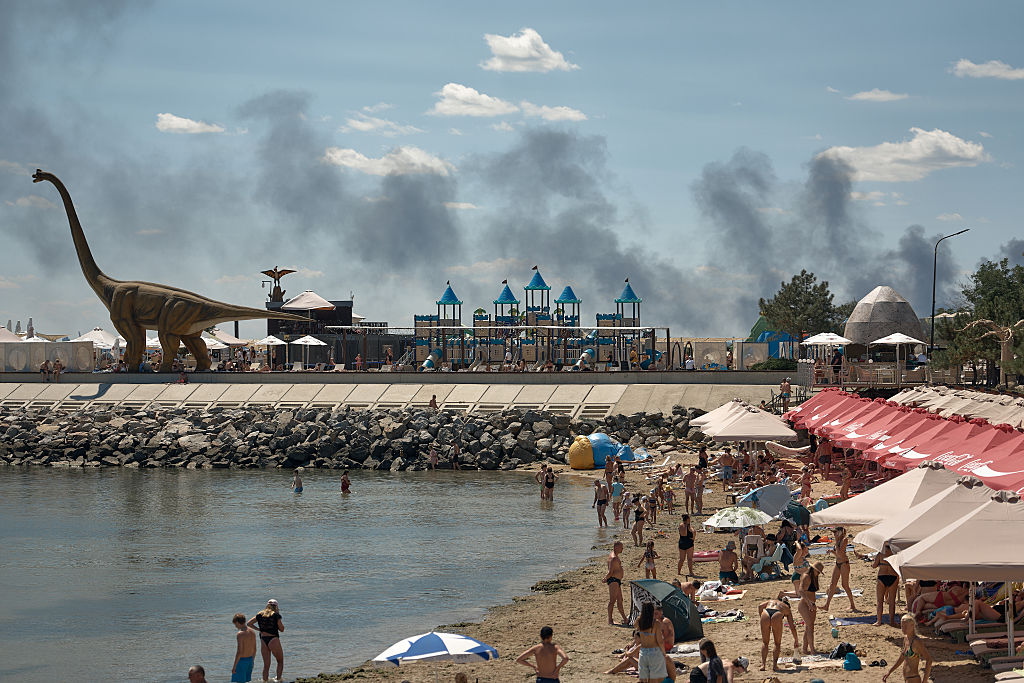
But Russia has scored some points of its own recently, and not just by terrorizing Ukrainian civilians with long-range missiles. A newly intense campaign against Ukraine’s Black Sea ports is exposing a shortage of air-defense interceptors, disrupting grain exports, undermining export revenue, and halting arms deliveries to Ukrainian forces. Agricultural products account for 60% of the country’s goods exports, and Russia’s attacks come just as Ukraine’s farmers prepare for the harvest season.
If the disruption lasts, Russia could choke off a crucial source of foreign currency for Ukraine and boost Russia’s international negotiating leverage by inflicting pain on major grain importers in Africa and Asia.
Kyiv is playing down the damage. After a two-week Russian drone and missile barrage on Odesa and other coastal cities, Ukraine’s agriculture minister claimed in July that ports were open and operational. But roughly 90% of shipowners have suspended port calls because, as in the Strait of Hormuz near Iran, insurance premiums have soared as the risk of further attacks remains.
This is not the first shutdown of Black Sea traffic since the Russian invasion of Ukraine. Waves of Russian attacks on ports in late 2025 and early 2026 did not slow operations for long. But this latest barrage is both broader and more intense, largely because Ukraine’s recent successes, particularly inside Russia, have provoked Putin to try to reclaim battlefield momentum. For now, both Ukraine and Russia remain committed to aggressive military strategies.
Ukraine’s immediate problem is that it relies on its limited supply of American-supplied Patriot interceptors—the only reliable defense against Russian missiles—to protect its cities and military supply lines. Shifting the Patriots to protect ports would be both expensive and dangerous. Knowing this, Russia will continue its port attacks with both missiles and swarms of drones, offering insurers no reason to lower premiums and shipowners no incentive to return.
Beyond cutting into Ukraine’s revenue and its ability to finance the war, Moscow also hopes to weaken international backing for Kyiv by driving up global food prices. Ukraine supplies a quarter of Egypt’s wheat imports and about 18% of Indonesia’s. It is also the European Union’s largest corn supplier, provides 92% of its sunflower oil imports, and remains an important source of feed grains and vegetable oils.
Putin is betting that higher food prices, at a time when the American war with Iran is already driving up the cost of oil and much else, will persuade Ukraine’s trade partners, particularly in Europe, to press Kyiv to de-escalate its attacks inside Russia. That strategy is unlikely to work.
European support for Ukraine remains strong, and governments suffering from higher prices are more likely to blame Moscow than Kyiv. But Putin is now so anxious for battlefield wins that he will stay the course even without a clear-cut victory. Nor should we expect a revival of the agreement brokered by the United Nations in July 2022 that restored safe maritime traffic to and from Ukrainian ports.
Just as the standoff in the Strait of Hormuz has sent neighboring countries scrambling for new ways to move oil out of the Persian Gulf, Ukraine may be able to move grain through the Danube, via Romanian ports, and by rail, as it did in the war’s early days. But as before, diversions are costly and logistically complicated.
For all these reasons, the shape of Russia’s war on Ukraine will continue to shift as each side searches for new ways to break the battlefield stalemate in its favor. And the economic damage, felt well beyond Ukraine and Russia, will continue.