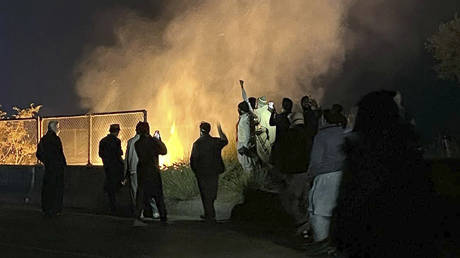
There was nothing much happening in Jerome and Benno Leuer’s yard in Hamel, Minn. on August 11, 1948. It was noontime in the thick of summer and the boys, 10 and 8, were idly playing when, as they later described it, something overhead caught their eyes. They looked up and their jaws dropped.
Roughly 12 ft. up in the air was a dull gray, circular object, about 1 ft. thick and 2 ft. in diameter, slowly descending between them. They stood transfixed as the object settled onto the ground, making a clattering sound like metal hitting metal. The object rested there a moment, and then began emitting a high-pitched whistle that, to the boys, sounded like a teakettle. It spun in place once, then shot 20 ft. into the air, hovered for a moment, and ascended to 30 ft., maneuvering around tree branches and telephone wires in its path. Finally, it jetted out of sight.
Jerome and Benno ran inside and told their parents what they had seen. Their father notified the only authority he could think of: R.R. Sheridan, the local postmaster. Sheridan, in turn, called the FBI field office in St. Paul. To the family’s surprise, the bureau sent an agent. He interviewed the boys and inspected the yard.
“The spot where the alleged ‘flying saucer’ had landed was approximately 2 ft. in diameter and appeared as though a heavy object had landed there or had touched down,” read the statement in the official report. “The ground was dented and protruding rocks had been leveled.”
The boys grew up and moved on. Nothing came of their mysterious sighting, but the government preserved the report all the same, filing it away in a cache of documents it had already begun keeping, of both civilian and military accounts of flying, hovering, blinking objects that appeared in the skies, skittering about, sometimes touching down, and then vanishing back the way they came, just as Jerome’s and Benno’s object had. For 78 years, the boys’ story—and hundreds of others like it—had languished in storage. Until May 8, 2026, when President Donald Trump began a serial release of four tranches of more than 450 official reports going back to the middle of the last century, ordering that they be posted on a Department of Defense website and made available for public perusal.
After decades of secrecy, stigma, and sometimes silliness—like the conspiratorial tales about recovered spacecraft and alien remains at a place known as Area 51 in Roswell, N.M.—the government has at long last begun taking things seriously. What used to be called UFOs and now go by the more decorous handle of UAPs—or unidentified anomalous phenomena—are being given the full investigatory treatment.
Congressional hearings into the origins of the sightings were held in 2022 and 2023. In 2022, the All-domain Anomaly Resolution Office (AARO) was established “to detect, identify and attribute objects of interest.” In December 2023, then President Joe Biden signed into law the Unidentified Anomalous Phenomena Disclosure Act, requiring the collection, review, and public disclosure of all sightings and encounters.
On June 12, capturing the global hunger for answers to the UAP mystery, director Steven Spielberg—who has long had a sort of seismographic sense of the popular mood—released his latest film, Disclosure Day, in which a government cover-up of extraterrestrial visitations is exposed. The movie grossed $94 million worldwide on its opening weekend alone. At about the same time, the White House established the UAP Science Advisory Council, a body led by Harvard astrophysicist and cosmologist Avi Loeb to study the national-security risks posed by UAPs.
“I was tasked to create a panel for the White House, AARO, the Director of National Intelligence, the FBI, and related agencies, so that all of these organizations are in contact [about UAPs],” says Loeb. “It’s clear, based on much better sensors that we have, that there are objects the intelligence agencies and the Pentagon do not, cannot figure out.”
It’s not just for the government, academia, and Hollywood to do that figuring. Last year, the nonprofit Disclosure Foundation, led by former Deputy Assistant Secretary of Defense for Intelligence Christopher Mellon launched, was launched, with the aim of encouraging the release of UAP reports, promoting scientific investigation of sightings, supporting whistle-blowers, and formulating policy related to UAPs. On June 25 of this year the group convened a Capitol Hill forum in the Kennedy Caucus Room of the Russell Senate Office Building.
The daylong event featured political figures including Representatives Eric Burlison (Republican, Missouri), Anna Paulina Luna (Republican, Florida), André Carson (Democrat, Indiana), and Suhas Subramanyam (Democrat, Virginia), and Senator Mike Rounds (Republican, South Dakota). Loeb was present, as were other well-lettered experts discussing the technological, national-security, economic, psychological, and even religious implications of UAPs. The speakers acknowledged that in some respects they were there at their peril, since publicly discussing flying saucers still carries reputational risk.
“You’re black, you’re Muslim, you represent a district in Indiana,” Carson said of himself, “and now you want to talk about UAPs?”
But it’s a measure of the growing public interest in the phenomena and the mounting evidence that something is out there that more and more serious people are willing to take that risk. Even former President Barack Obama weighed in on the topic. In a February interview, Obama was asked if extra-terrestrial life exists, and he responded, “They’re real,” hastening to add, “But I haven’t seen them. They’re not being kept at Area 51. There’s no underground facility—unless there’s this enormous conspiracy and they hid it from the President of the United States.”
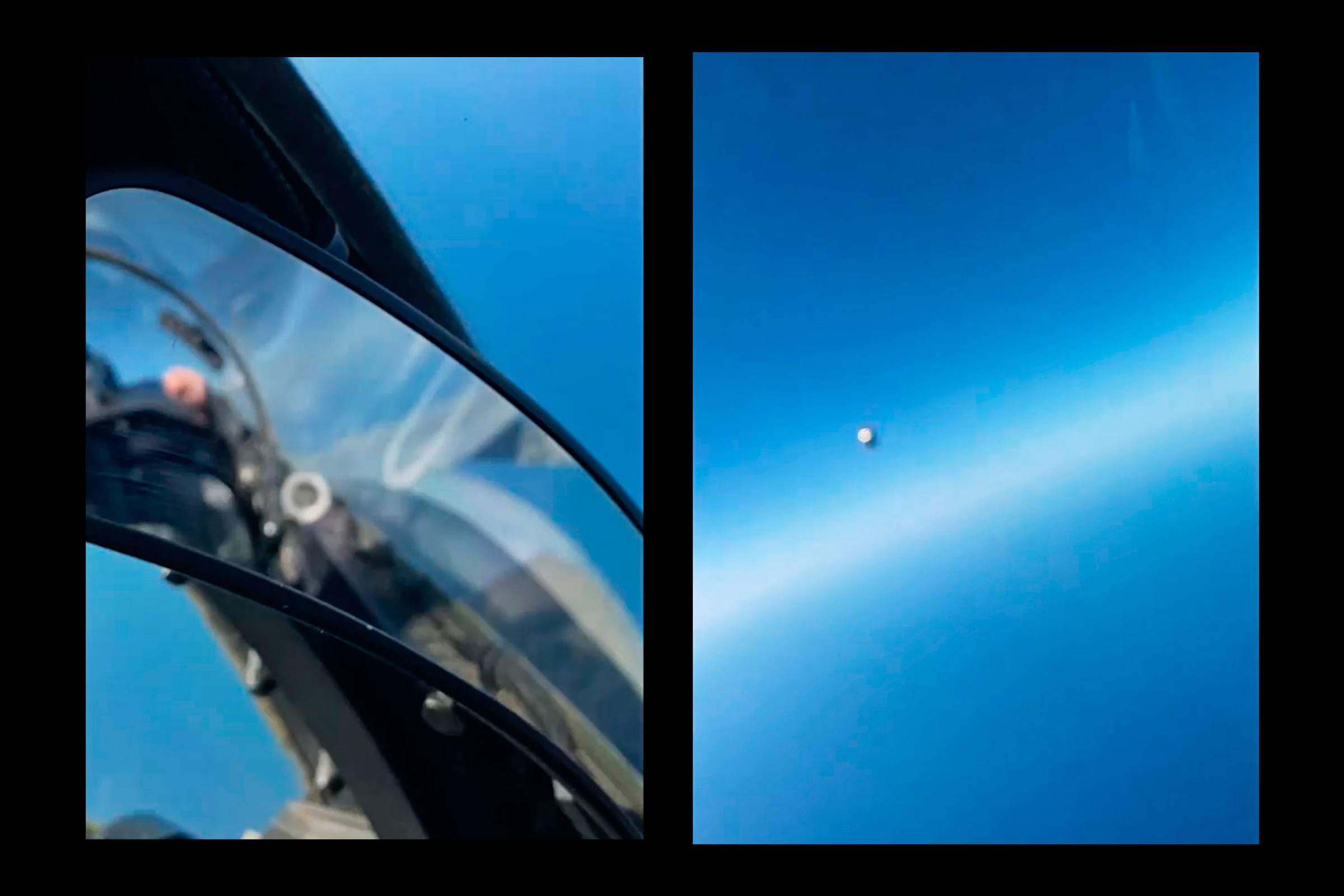
Obama added that he based his belief in the likelihood of extraterrestrial beings in part on the fact that “statistically, the universe is so vast that the odds are good there’s life out there.” That’s a point a lot of believers make, especially since NASA’s Kepler Space Telescope and other space-based and Earth-based observatories have discovered thousands of exoplanets—or planets orbiting other stars—leading astronomers to conclude that virtually every one of the trillions of stars in the sky has at least one world circling it.
As with all things in a loud, messy, pluralistic democracy, public opinion plays a role here too—and Americans are clearly ready for action. According to a poll conducted by the Disclosure Foundation just weeks before the Capitol Hill forum, 84% of respondents want more information from the government on UAPs, 69% believe UAPs are real, 59% support hearings and transparency laws, and just 21% trust the federal government to be telling the complete truth. The responses are bipartisan. A statistically meaningless 1% separates the whopping 89% of Republicans and 88% of Democrats who say they want more information on UAPs.
“You could be a single-issue candidate running in the U.S.,” says Jordan Flowers, the Disclosure Foundation’s executive director. “That single issue could be [UAP] transparency, and you could get elected just based on that.”
Unlike other single issues like taxation, immigration, or climate, which unfold indefinitely over decades, UAP transparency has a fixed end point. The government will tell all it knows, the sightings will be investigated, and their origins will be determined to be terrestrial—highly advanced military or other assets—or, epochally, extraterrestrial.
“My null hypothesis would be that these are human-made objects being operated by adversarial nations, near strategic assets of the U.S.,” says Loeb. And if they’re not? If they do come from … elsewhere? “That will be the biggest discovery ever made by humanity.”
A Question of Security
The U.S. Senate doesn’t lend out the Kennedy Caucus Room to just anybody. Opened in 1909, the room is a prepossessing place, with carved marble walls measuring 74 ft. long, 54 ft. wide, and 35 ft. high—climbing to an ornate ceiling decorated with gilded rosettes and acanthus leaves. The doors of the room open onto the Russell Building’s vaulted, marble rotunda, which rises three stories high.
The caucus room has seen a lot of history: it was the site of hearings on the sinking of the Titanic, the Teapot Dome scandal, Pearl Harbor, the Vietnam War, Watergate, Iran-Contra, and more. Both John and Robert Kennedy announced their presidential runs there. It was thus no small thing that the Disclosure Foundation was cleared to use the space to hold its June 25 summit. The 300-plus people in attendance took the event exceedingly seriously. Despite the once flaky, fringey, fantastical topic under discussion, the vibe was clearly not Burning Man, Comic Con, or South by Southwest. One attendee was decked out in a T-shirt featuring a bug-eyed alien playing electric guitar, but for everyone else in the room, business attire was the order of the day.
“Today, experts that rarely occupy the same room—physicists, historians, economists, intelligence professionals, educators, journalists, and policymakers—are gathered here in this room,” said Mellon in his opening remarks, “to discuss a subject that was, until very recently, untouchable.”
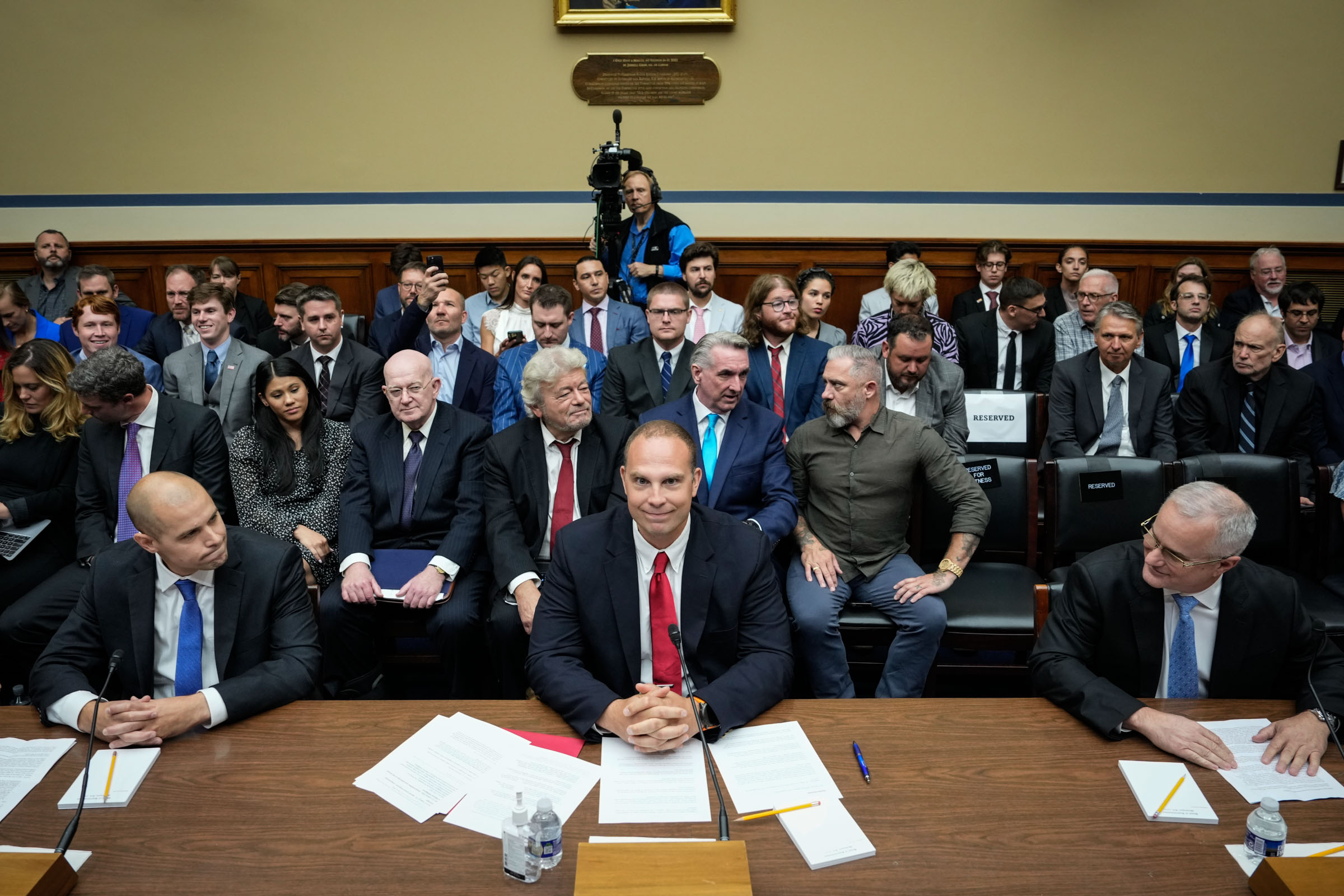
Of all of the panels that appeared throughout the day, it was a morning session on the security and defense implications of UAPs that had the most gravity. The panelists discussed the repeated sightings of UAPs both by naval pilots and personnel at military bases, raising concern about the permeability of armed American airspace. If the objects’ origins were indeed found to be extraterrestrial, the technology of the alien species far eclipses any flying machines human beings have ever developed. If they are terrestrial—built and flown by rival nations—they signal an arms race that we are already losing.
Retired naval Lieutenant Ryan Graves had his first encounter with UAPs off the East Coast of the U.S. 14 years ago and more in the two years that followed. “We came back from a deployment in 2012 and began to upgrade our radar systems,” he told TIME, “and we immediately saw objects in our working area that we were not expecting. There were usually anywhere between three and six objects within the airspace off the coast of Virginia Beach. Sometimes [they were] completely stationary at very high winds, sometimes flying at 250 to 350 knots [288 to 402 m.p.h.].”
The objects, Graves said, were 5 to 15 ft. in diameter, and appeared to be a gray or black cube inside a clear sphere. They gave off no exhaust and flew in such a way—diving and soaring and suddenly changing direction—that any human passenger would be subject to potentially deadly g-forces. Sometimes they flew so close to the Navy jets that the pilots were required to file hazard reports so that other planes operating in the vicinity could be warned.
“They would be outside doing these behaviors all day,” Graves says. “It might appear that these objects are using magical physics we don’t understand.” As part of the pilots’ routine rotation, they later shifted their operations to the waters off Jacksonville, Fla. They got no peace there either. The UAPs, says Graves, “were either already down there or they had followed us down, because we had over a dozen incidents.”
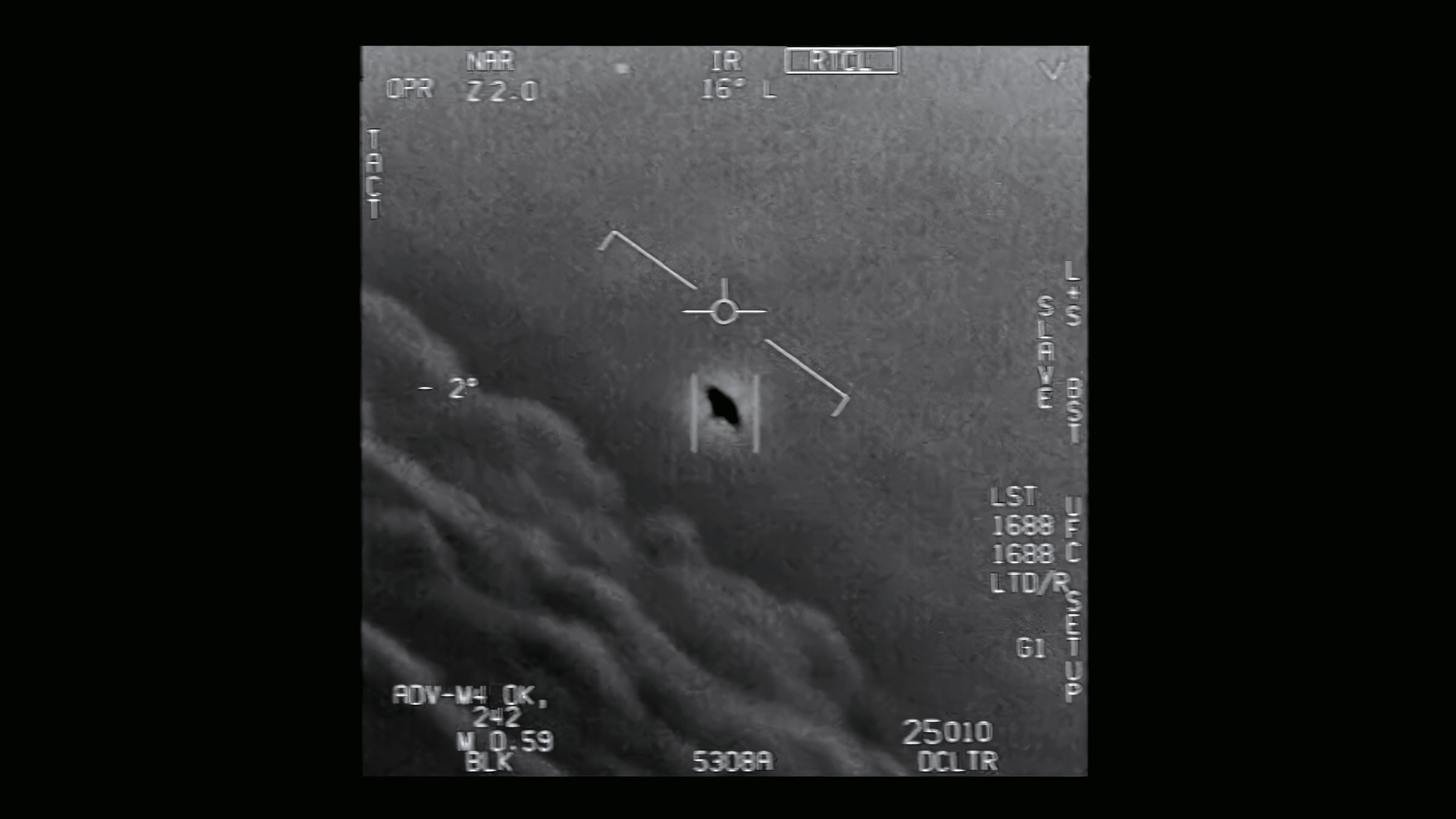
The naval flyers’ Virginia and Florida encounters are by no means the only experience the military has had with UAPs. One of the most compelling is the so-called Tic Tac incident, which occurred off the coast of California in 2004. During an otherwise routine deployment that year, radar personnel repeatedly noticed the reflection of a skittering airborne object they could not explain—looping and diving, climbing and then dropping from an altitude of 80,000 ft. to 20,000 ft. To crack the mystery, a team of flyers was scrambled into the sky. Once aloft, they discovered what they estimated to be a 45-ft.-long flying machine that bore a striking resemblance to a Tic Tac breath mint.
“All four of us looked down and saw a Tic Tac object moving very abruptly over the water,” said pilot David Fravor in a 2023 appearance before a congressional committee. “There were no rotors, no rotor wash, or any sign of visible control surfaces like wings. As we pulled nose onto the object within about a half-mile of it, it rapidly accelerated and disappeared.” Cockpit video preserved the encounter.
Military assets on the ground have been harassed too. For 17 straight nights in December 2024, Langley Air Force Base in Hampton, Va. was swarmed by objects that appeared overhead 45 minutes after sundown and repeatedly flew over the base. According to one eyewitness—former astronaut Scott Kelly, who in 2022 was tapped to serve on a NASA UAP study team—the objects appeared to be 20 ft. long, flying at an altitude of 3,000 to 4,000 ft., at a speed of 100 m.p.h. The incursions became serious enough that Langley canceled nighttime training flights and moved its F-22 jets to another air base.
More dramatic was a reported sighting by six federal law-enforcement officers in October 2023, near what the official memorandum described as “a sensitive national security site in the western United States.” For two consecutive days, just at dusk, the witnesses reported observing “a luminous ‘mother orb’ appear[ing] to produce smaller red orbs, one after another, multiple times over a period of several hours. The ‘red orbs’ reportedly persisted for several seconds before disappearing.”
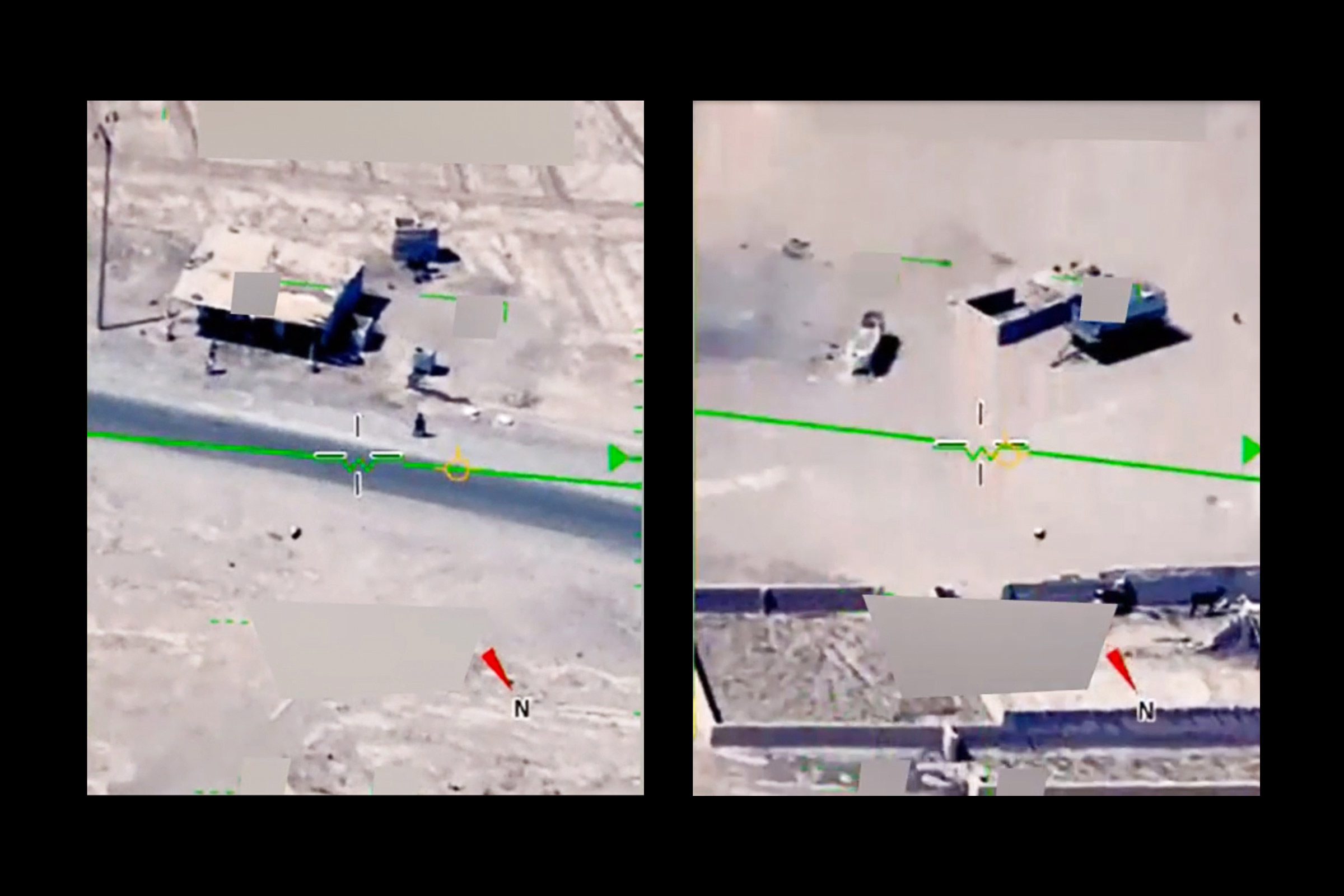
“It is clear that we have lost control of our airspace. Full stop,” says Flowers. “Whether this is some form of human intelligence, or whether it’s something else, I am not creative enough to say.”
“Many of these things are certainly not drones,” says Luis Elizondo, a former intelligence officer with the government’s Advanced Aerospace Threat Identification Program (AATIP). “They are advanced technology from somewhere. If you’re scrambling jets off Langley, you’ve got a problem.”
Not everyone is persuaded by the reports. “Great claims require great evidence,” says Jon Kosloski, director of AARO, “and the evidence just isn’t there yet.” Kelly does not minimize the security risk posed by rogue objects but does not think they have to have an exotic origin. “In science, eyewitness testimony is kind of opinion; it’s not data,” he says. “I have never seen anything that couldn’t be explained.”
Kelly points to a sighting he made during his days as a military pilot when he was flying a Tomcat jet off the coast of Virginia. In the midst of the maneuvers, the pilot in the back seat of the plane suddenly announced, “We just passed something. It looks like a UFO.”
“What?” Kelly asked.
“Yeah, maybe it was like an alien spaceship or something. It looked really weird.”
Kelly banked the jet around in the opposite direction, looking for an object through his wind screen, and indeed saw it in the distance, though it wasn’t showing up on radar. He drew closer and closer until he was on an intercept course, and the bogey at last resolved itself.
“It was Bart Simpson,” Kelly says. “It was a balloon.”
Are We Ready For Extraterrestrial Disclosure?
If UAPs are ever confirmed to have an extraterrestrial origin it will represent what Carlos Eire, professor of history and religious studies at Yale University and a speaker at the Disclosure Forum, calls a “rupture” in human civilization.
“A rupture is something after which nothing is the same,” he says. “It’s similar to the rupture that occurred for the natives of North and South America when Europeans showed up.”
Clinical psychologist Jennice Vilhauer, a member of the advisory boards of both Loeb’s UAP Council and the Disclosure Foundation, spoke at the June 25 event, and her words were sobering. “If this news were to come out tomorrow,” she says, “we’re entirely unprepared.”
An emotional contagion like panic is always possible, but Vilhauer does not think most people would react that way even to such paradigm-shifting news as nonhuman intelligence. “There are certain communities that would look at this through a catastrophic lens, like an end-times event,” she says. “But I don’t see this being something that would spread across the entire population.”
That doesn’t mean that there would not be a psychic impact. A lot, she says, would depend on whether alien life was perceived as either benevolent, indifferent, or hostile. Even a microbe could be hostile if it posed a risk of infection—a peril about which humans have always been mindful. During the first three moon-landing missions, returning astronauts were required to spend three weeks in medical quarantine against the chance that they picked up alien germs—a practical impossibility since no microorganisms could survive on the dry, airless moon.
Also playing a role would be the question of what Vilhauer calls personal relevance—whether the news of nonhuman life affected any one person directly. The greatest emotional reaction would occur in people who perceive a high threat level and high personal relevance; the least effect would be in people who see low threat and low personal relevance. “Disclosure alone would be a huge, unprecedented event,” Vilhauer says. “Those two things together—personal relevance and threat—could create a really negative response.”
Mental health will not be the only thing that’s affected by UAP disclosure; spiritual health will be too. As long ago as the 1970s, divinity scholars established the concept of exotheology—a branch of Christian thought that includes the possibility of life in the cosmos. That can come in handy now. Eire believes that the three leading monotheistic religions—Christianity, Judaism, and Islam—will have the most work to do coming to terms with nonhuman intelligence. That’s because all three of them share the idea that there is one God, and that he created everything including human beings. Our species, we like to think, is his crowning creation—a belief that will be harder to hold onto if a cosmic species comes along that’s better, smarter, fitter than us. “The book of Genesis, which is shared in different ways by Jews, Christians, and Muslims, poses this very troubling story about human origins,” says Eire.
Christianity, Eire believes, will have a special hurdle to overcome in adjusting to the idea of off-Earth life because of its teaching that God became human. On the other hand, all three mono-theistic religions do have some practice with the idea of intelligent, nonhuman life. “Jews, Christians, and Muslims accept as a given that human beings are not alone in God’s creation,” says Eire. “There have always been angels.”
The puzzle of how to marry theology and extraterrestrial life predates the current surge in UAP disclosures. In 2014, Brother Guy Consolmagno, then the director of the Vatican Observatory, coauthored the cheeky book Would You Baptize an Extraterrestrial?…and Other Questions From the Astronomer’s In-Box at the Vatican Observatory. When someone posed the baptism question to him directly, he famously answered “Only if she asked.”
The Likelihood of Extraterrestrial Life
Questions about UAPs and the life-forms that may or may not have sent them our way may turn in part on faith, but they also turn on physics. While exobiologists continue to explore the possibility of microbial life on Mars and on ocean moons like Jupiter’s Europa and Saturn’s Enceladus, it is well accepted that our solar system has just one world with advanced, intelligent life, and that’s ours. That means looking for exceptional beings farther afield.
The closest star system to Earth is Proxima Centauri, a tidy 4.25 light-years—or 25 trillion miles—distant. Getting from there to here would in theory take at least 4.25 years, and only if you’re traveling at the speed of light—which Albert Einstein long ago proved can’t be done. Other star systems lie thousands and billions of light-years away, meaning that traveling the trans-Earth distance could take almost as long as the age of the universe itself.
Still, plenty of academics don’t rule out the possibility of alien visitors from the stars. “I would put the estimate of the chances that we’ve been visited—and I would define that as an exploration through our solar system, leading to them being aware that Earth has life and civilization—at maybe something like 50%,” says Jack Singal, professor of physics at the University of Richmond. He puts the odds that any of the claimed UFO or UAP sightings over the past century have actually been one of those visitations at a much lower 5%. “I think there’s just enough mundane explanations for these things,” he says.
Jonathan Miller, a program engineer for MIT’s department of mechanical engineering and the director of an academic program called Confronting Unknowns, which explores the question of UAPs, does not go as far as Singal, but he is open to the possibility that other civilizations are not as constrained by Einsteinian physics as we think they’d be. “There are the physics of traveling from point A to point B,” he says. “But there may be alternative ways to sort of bridge that gap. There’s probably an iceberg of possibilities [to explain UAPs] below the waterline.”
Some of those explanations may be straightforward—at least compared with extraterrestrials. If it’s possible that some rival power has developed advanced technology that can perform the acrobatics the UAPs do, it’s equally possible that the U.S. has as well and that witnesses are simply observing domestic hardware. The military is nothing if not secretive, and all of this work could be done in the dark—much the way the Manhattan Project, which developed the world’s first nuclear weapons, operated silently, invisibly, from June 1942 to August 1947.
It’s possible too that there is something even more prosaic than earthly or alien space technology at play. Miller speaks admiringly of the “mark one eyeballs of a well-trained pilot” as perhaps the most reliable sensor system on any plane—better than radar, infrared, or motion sensors. But those eyeballs can be fooled—especially given the thermal, chemical, and physical complexity of the atmosphere in which the UAPs are being seen and reported.
“The atmosphere is a crazy place,” says Singal. “You can see double, triple rainbows. You can go to some Arctic regions and see the sun appear several times at several different angles in the sky. You can have tornadoes that pick up and throw a car or impale a cow on a tree. Could it make a black triangle move across the sky for 10 seconds? I would say it could.”
“You get a lot of reports from naval officers, more so than from the Air Force,” says Kelly. “That’s because the Navy flies over water and it’s an environment that is very subject to optical illusions.”
Witnesses, of course, swear by the evidence of their eyes, and sightings like those of Graves and his fellow pilots, which involved large objects moving at close proximity between two naval jets, are hard to dismiss as just the hallucinatory interplay of light and air.
“We came within 50 ft. of the lead aircraft,” says Graves. “I think some of what we were seeing were true UAPs. What I mean by that is that these were true airborne assets that were physical in nature, that were exhibiting capabilities beyond our state of the art.”
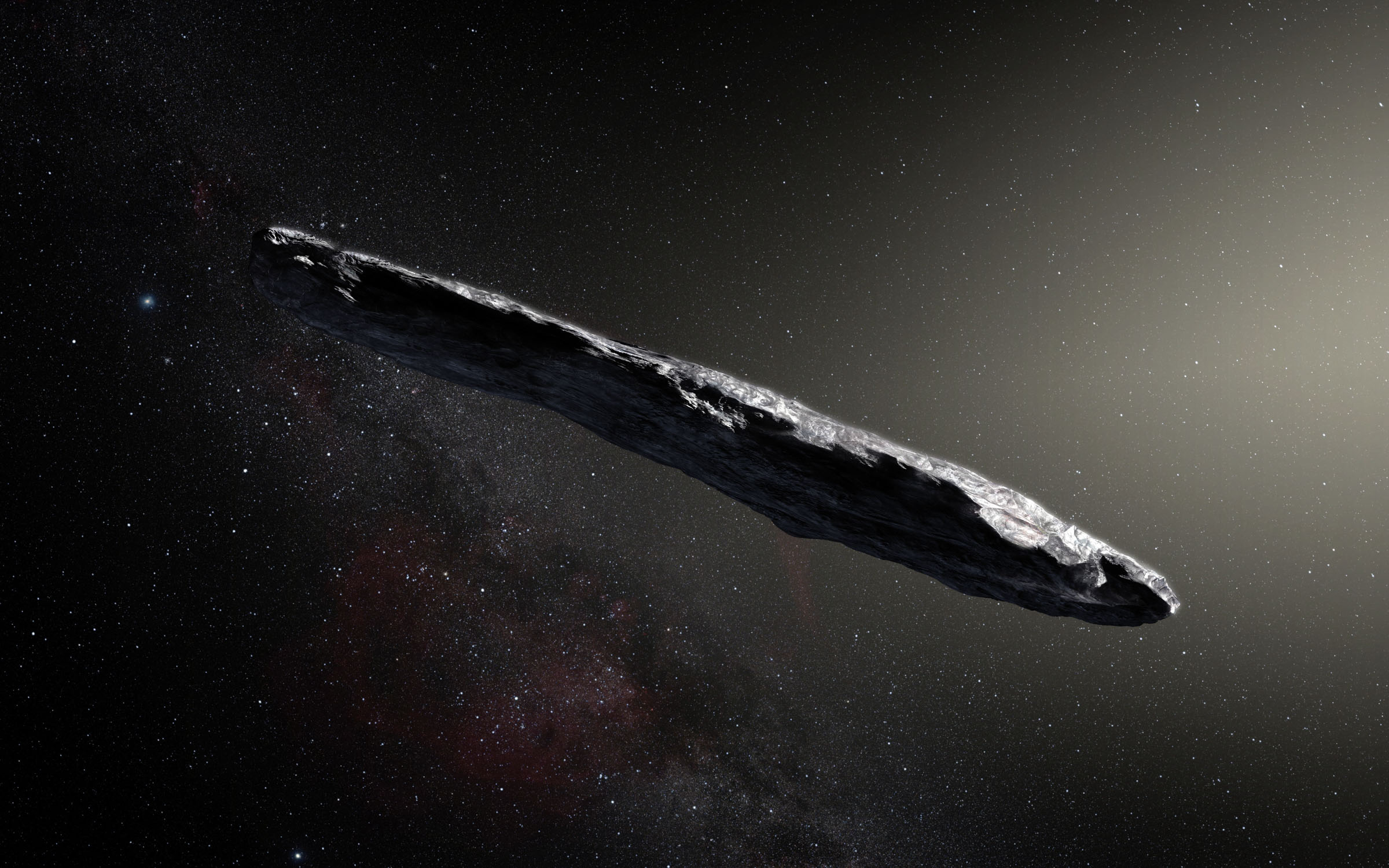
The community of people who believe accounts like these and want to get to the bottom of them is growing. In addition to chairing the UAP Science Advisory Council, Loeb is co-directing the Harvard-based Galileo Project, which scans the skies looking for hints of extraterrestrial technology. Galileo relies on three Earth-based telescopes—in Massachusetts, Pennsylvania, and Nevada—using infrared, visible, and radio sensors to track moving objects that seem to deviate from the performance of earthly technology. In 2018, Loeb and his colleague Shmuel Bialy, then a post-doctorate researcher, made headlines with a paper in the Astrophysical Journal Letters, in which they entertained the idea that the cigar-shaped interstellar comet Oumuamua “may be a fully operational probe sent intentionally to Earth vicinity by an alien civilization.”
In 2017, the object flew into our solar system, whipped around the sun like a comet, and flew back out. On that departing leg of the journey, it accelerated when it should have been slowing down due to the gravitational pull of the sun. That suggested some propulsion system was at work. It is possible, Loeb and Bialy wrote, that the object is “floating in interstellar space as a debris from an advanced technological equipment.”
Other astronomers dismiss that idea, arguing that Oumuamua was pushed either by solar wind, the storm of charged particles forever streaming from the sun, or by solar radiation pressure, the gentle force imparted by electromagnetic energy when it contacts an object. The object has since soared back into deep space, taking the possibility of any answers with it.
Congress is staying on the UAP case—in its own dilatory way. In 2024, lawmakers took up the UAP Transparency Act, which would mandate declassification of all documents related to UAPs. The bill has not yet become law, and its potential impact has been partly mooted by the White House going ahead and releasing the four tranches of documents on its own.
For now, UAPs remain a riddle. They may be real, they may be illusion, they may simply be artifacts of human desire—something we see because we want to see them. A universe with other life-forms, after all, is a lot less lonely than one in which we are the only world with lights in the windows. The eyewitnesses, of course, would differ—knowing what they saw, believing what they saw, and remaining, in some cases, transformed by what they saw. In time—if the proof is found, if biological intelligence is discovered in the void—we may all be transformed the same way.