
It’s undeniable. Socialism is on the rise—or at least growing in popularity in the U.S.
Forty-three percent of Americans have a positive view of socialism, the highest share since Gallup began tracking the measure since 2010. The latest survey, conducted Aug. 3-24, found that socialism has gained ground over time as several market-oriented economic concepts have lost favor. It now ranks ahead of big business, which has fallen to a positive rating of 35% from a peak of 58% in 2012.
Capitalism and free enterprise are still more popular than socialism. Capitalism’s positive rating, however, has fallen to 55% from a peak of 61% in 2010 and 2012. Free enterprise is now favored at 77%, compared to its peak of 89% in 2012. Small business remains the most favored economic system at 95%, relatively unchanged in 2010.
Those figures, however, mask sharp partisan differences. Democrats view socialism much more favorably than Republicans do, and their views have become more positive over time.
This shift has come as progressives and democratic socialists have defeated establishment candidates in several key Democratic primary contests. Zohran Mamdani’s election as New York City Mayor last year marked a breakthrough for the Democratic Socialists of America (DSA). In June, all three of his endorsed candidates won against establishment Democrats in congressional primaries in New York City.
Read More: Congress Is Headed for a Massive Turnover
Progressives also won high-profile primaries elsewhere, including Senate candidates Abdul El-Sayed in Michigan and Peggy Flanagan in Minnesota, both of whom have not adopted the socialist label, as well as DSA members and House candidates Melat Kiros in Colorado and Chris Rabb in Pennsylvania. Democratic socialist Francesca Hong narrowly lost in the gubernatorial primary in Wisconsin, a battleground state.
What Brookings analysts dubbed a “DSA summer” serves to “signal that unhappiness with the Democratic establishment and, in the post-Biden world, opposition to elderly officeholders can be leveraged by young, charismatic DSA candidates—and reflect an impatience with party leadership that transcends ideology.”
Republicans have sought to portray those victories as evidence that the Democratic Party is moving too far left ahead of the November midterm elections, while Democratic leaders have tried to temper concerns about the party’s direction. In November 2025, the House voted 285-98 to approve a resolution denouncing the “horrors of socialism,” which was followed by another resolution condemning socialism that passed 220-192 earlier this month. A July analysis by the Cook Political Report found that center-left candidates dominated primaries in the competitive House seats most likely to determine control of Congress, suggesting that progressive victories may not signal a leftward shift across the country.
“If left-wing nominees manage to win in swing districts, their overall movement will be strengthened,” the August Brookings analysis said. “If they lose districts deemed winnable and cost Democrats control of the House and Senate, their mainstream presence will likely be diminished.”
Still, changing views among the American public could indicate growing openness to what was once a political red line.
Read More: ‘We’re Proving It Works’: Inside the DSA’s Push to Remake the Democratic Party
Here’s what the latest polls say.
Partisan split
Socialism isn’t gaining popularity universally in the U.S.
Most of the increase in socialism’s positive rating through 2025 came from growing favorability among Democrats. In 2010, 50% of Democrats viewed socialism positively, according to Gallup. That rose to 66% last year, and remained relatively unchanged at 65% this year. Socialism now matches free enterprise in favorability among Democrats, following a sharp decline in their positive views of free enterprise since 2021.
Democrats have also viewed socialism more favorably than capitalism since 2016, when 54% of Democrats viewed capitalism positively, while 60% viewed socialism positively. That year marked a breakthrough for the DSA as longtime Senator Bernie Sanders (I, Vt.) brought the organization to national attention during his presidential run.

Capitalism’s positive rating has further fallen among Democrats, declining from 42% last year to 35%.
Other polls have found a similar pattern among Democrats. A CBS/YouGov poll, conducted Aug. 12-14, found that 58% of Democrats viewed socialism positively, compared to 32% for capitalism. College-educated Democrats were especially positive about socialism, with 71% viewing it favorably.
Meanwhile, 50% of Democrats viewed capitalism negatively, compared with 18% for socialism. That contrasts with the broader public, which overall favored capitalism to socialism.
The poll also found that half of Democrats viewed the label “democratic socialist” positively.
A Marquette Law School poll highlighted by CNN in June similarly found that the DSA had a higher net favorability among Democrats and Democrat-leaning independents than Democrats in Congress by 13 points. A national survey conducted by Data for Progress in August 2025 found that Democrats preferred democratic socialism to capitalism by a 58-percentage-point margin.
Socialism has also grown in popularity among political independents, accounting for the overall boost to socialism’s favorability in the latest Gallup poll. The share of independents rating socialism positively rose from 37% last year to 45%, surpassing big business which fell to a record low of 32%. Capitalism, free enterprise, and small business still ranked above socialism in favorability among independents.
Republicans remained overwhelmingly skeptical of socialism, with just 14% viewing it positively. Large majorities of Republicans continued to have positive views of small business, free enterprise, and capitalism, while 62% of Republicans viewed big business positively.
Still, Americans’ economic views are more complicated than the results might initially suggest, according to a Gallup analysis from August. The report, based on open-ended survey responses, found there is broad support for free-market principles like economic competition and market choice, despite concerns about capitalism spurring economic inequality and excessive corporate power.
The CBS/YouGov poll, meanwhile, found that support for government intervention crossed party lines, with 75% of Democrats, 62% of independents, and 54% of Republicans supporting government price controls.
And the Data for Progress survey showed 70% of 1,257 respondents said the U.S. economic system is “rigged in favor of corporations and the wealthy” and favored replacing it with one that “gives working people a fair shot,” including 67% of independents and 58% of Republicans. Additionally, 83% of respondents, including 81% of independents and 80% of Republicans, agreed that social work and mental health are necessary parts of a public safety budget.
Generational differences
Younger Americans are more receptive to socialism, polls show.
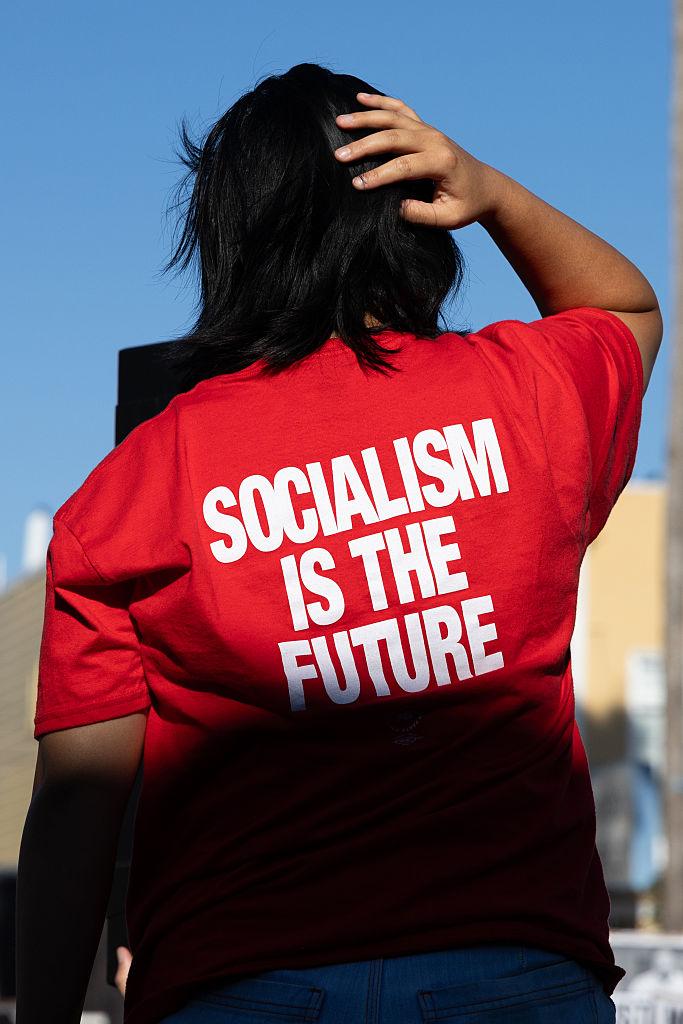
According to Gallup, 57% of Americans aged 18 to 34 viewed socialism positively, compared with 43% for capitalism. The pattern was reversed among older adults: 65% of those aged 55 and older viewed capitalism positively, while 34% viewed socialism positively. Of Americans aged 35 to 54, 50% rated capitalism positively, while 45% rated socialism positively.
The August CBS/YouGov poll also found that younger Americans were more likely to perceive shrinking economic opportunities. Fifty-four percent of American adults under 30 said their opportunities to succeed are worse than their parents’ generation’s, compared with 31% of those aged 65 and older. Of those under 30, 80% also said buying or owning a home is harder for their generation than previous generations, while 71% saw worse prospects for financial security and 64% for having a good job.
Among those under 30, 61% described the U.S. economic system as somewhat or very unfair. Socialism was viewed positively by 43%, compared with 38% for capitalism. By contrast, 30% of those 65 and older viewed socialism positively and 59% viewed capitalism positively.