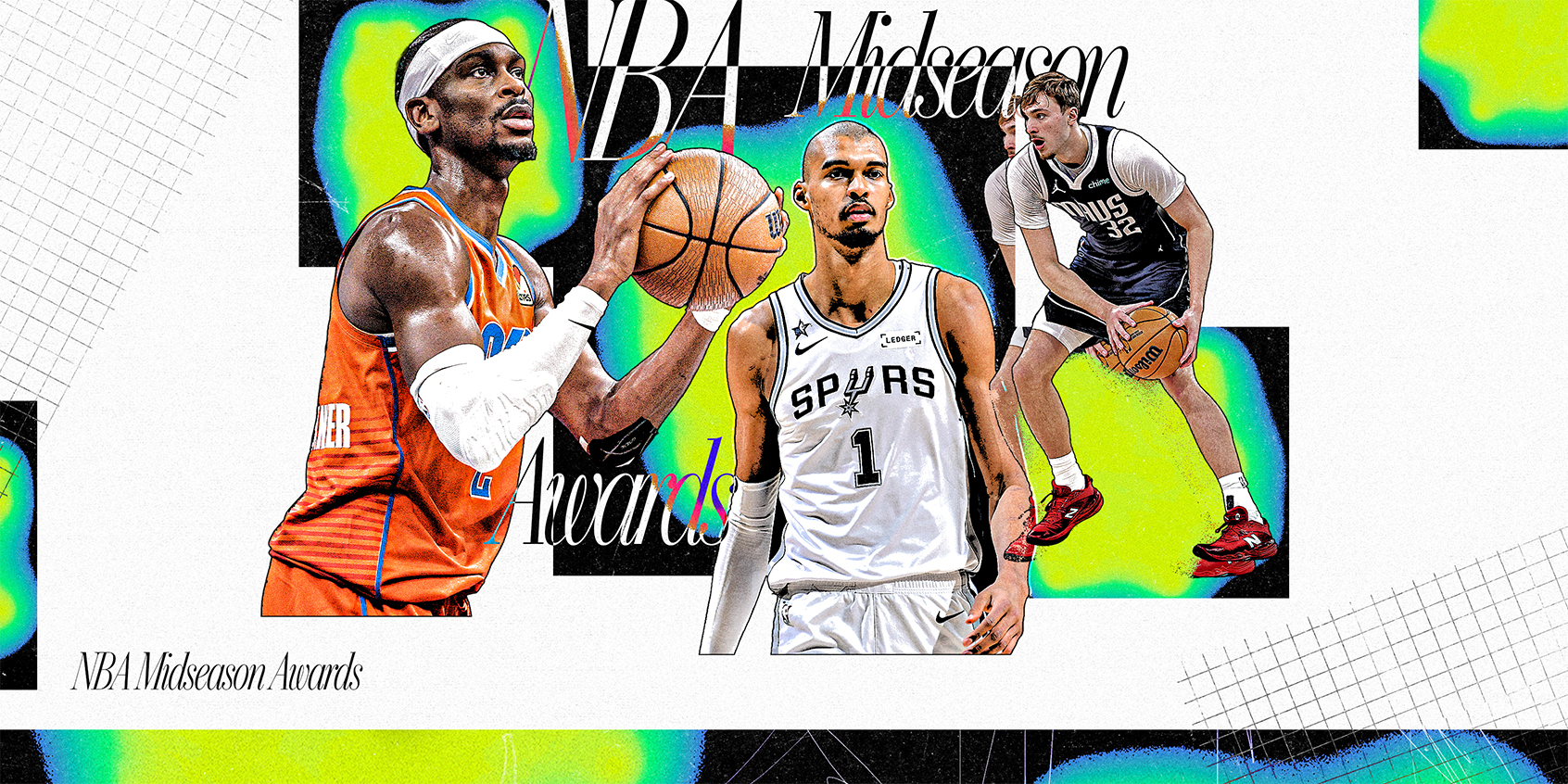
Who has been the MVP of the league at the season’s halfway point? Who’s winning the Rookie of the Year race? With every team hitting the 41-game mark, let’s hand out midseason awards.
The Midseason MVP is …
Dan Devine: Shai Gilgeous-Alexander, Thunder, for many of the same reasons he won last year. Take your pick: the best player on the best team; historically elite individual production that lines up pretty neatly next to Michael Jordan; the driving force behind what profiles as one of the greatest teams of all time; the primary reason OKC has a 5.5-game lead on the rest of the West; the most valuable clutch contributor in the league; first or second in nearly every advanced stat known to NBA nerdkind; and has played 10 more games and about 300 more minutes than Nikola Jokić. It’s a pretty strong damn case.
Tom Haberstroh: Shai Gilgeous-Alexander. Injuries to the other four major candidates — Nikola Jokić, Giannis Antetokounmpo, Luka Dončić and Victor Wembanyama — have paved the way for the reigning MVP to repeat. I think Cade Cunningham could make a late-season push, but it’s Gilgeous-Alexander’s award to lose. He’s the best player on the best team and has established himself as the game’s top clutch assassin, scoring a league-high 122 points with the score within five points in the final five minutes.
Steve Jones: Shai Gilgeous-Alexander. The debate will rage on down the stretch, but with an injury to Jokić, the Bucks fighting to get into the play-in and the Lakers slipping down the Western Conference standings, it feels like it’s clearly Gilgeous-Alexander. The consistency he’s brought on the offensive end has continued to power the Thunder to the top of the standings. It will be intriguing to see how hard Cunningham, Wembanyama and Jaylen Brown start to knock on the door.
Morten Stig Jensen: Nikola Jokić, Nuggets. Gilgeous-Alexander has played in 10 more games so far, but that advantage isn’t quite enough, in my eyes, to overtake Jokić’s season. That will change, however, should Joker miss a significant portion of games throughout the rest of the season. If not by him becoming ineligible, then because Gilgeous-Alexander is playing so well that a games-played gap justifies him.
Kelly Iko: Shai Gilgeous-Alexander. The Joker can miss only six more games before he’s ineligible due to the 65-game rule — and Cunningham would have a decent argument in any other season (26/10/6 on a team that should win 65 games) — but it’s SGA’s to lose. He’s averaging the highest points per shot attempt of any guard over the past decade (only Steph Curry comes close), OKC has a bottom-five offense without him, and his latest trick — dragging a Thunder team down its starting center and second-leading scorer across the finish line with the NBA’s best record — should be the icing on the cake.
The Midseason Rookie of the Year is …
Iko: Cooper Flagg, Mavericks. He still has a ways to go in the efficiency department, but we’re talking about a 19-year-old posting 19/6/4 on a middling Mavericks team. That Dallas is within striking distance of the play-in is remarkable. Flagg has been asked to initiate offense, finish possessions, and defend multiple positions — and he’s taken those challenges with confidence. He’ll need to get to a point where he’s not a sub-30% 3-point shooter, but he’s done enough this season to warrant the award. Kon Knueppel has been awesome, though.
Haberstroh: Kon Knueppel, Hornets. What a revelation. Think Klay Thompson or Khris Middleton — but with a higher ceiling. He’s a year and a half older than his former Duke mate Cooper Flagg, so in a sense it’s not too surprising that Knueppel has been more NBA-ready than the No. 1 overall pick. The Hornets found their franchise cornerstone.
Devine: Kon Knueppel. He leads the rookie class in scoring on pretty shocking shooting efficiency — 56% on 2s, 43.5% on 3s, 89.4% at the charity stripe. As impressive, in my eyes: The 20-year-old has more than kept the Hornets afloat even in the significant amount of floor time he’s played without load-bearing offensive pieces LaMelo Ball and Brandon Miller. Flagg’s been largely fantastic in a tough set of circumstances in Dallas; ditto for Cedric Coward in Memphis; and VJ Edgecombe has fit brilliantly in in Philly. But Knueppel’s walked into the NBA shooting like an all-time-great marksman, and helped elevate the Hornets to within arm’s reach of the play-in tournament.
Jones: Cooper Flagg. It’s hard to ignore the corner Flagg has turned this season and the consistent aggression and confidence he’s brought to the table. Despite the tough start, Flagg leads the Mavericks in total points, rebounds, assists and steals, which speaks to his responsibility on a nightly basis. Flagg has a great feel for when and how to get to his spots. And while Kon Knueppel has been great, Flagg has overcome his circumstances to impact the game every night.
Jensen: Cooper Flagg, by a freaking hair. This one is far from over, folks. We have a legit Rookie of the Year race on our hands between Flagg and Knueppel, who looks as if he’s going to be one of the league’s primary shooters for the next decade-plus. Every ROY race is welcome around these parts, so the fact that we aren’t seeing someone run away with this thing yet is extremely enticing.
[Subscribe to Yahoo Sports NBA on YouTube]
The Midseason Coach of the Year is …
Jones: J.B. Bickerstaff, Pistons. One of the more underrated skills for a coach to have is to understand the talent you have, maximize it and get the entire roster to buy in. Bickerstaff has been able to do that, keeping Detroit at the top of the East. The great play of Cunningham is one thing, the growth of Jalen Duren is another, but when you go through the roster you see an identity where everyone contributes. This team defends and believes every night, and whatever expectation you had has been exceeded to this point.
Jensen: Mitch Johnson, Spurs. Victor Wembanyama has been in and out of the lineup, and Johnson is relying heavily on a three-guard rotation consisting primarily of players who aren’t strong natural shooters. Devin Vassell has also missed time, and when he’s played his influence has been somewhat average. Yet the Spurs are winning despite all of that. This group has fully embraced a team-first mentality, and that doesn’t happen without a high level of quality in the leadership department.
Devine: Jordan Ott, Suns. Everyone’s on their best behavior at media day: swearing that it’s going to develop a culture of relentlessness competitiveness that hinges on accountability and the non-negotiability of playing hard. Everyone says that stuff. The Suns are actually doing it, though — eighth in points allowed per possession, second in steals, third in deflections, tied for fourth in loose balls recovered, fifth in offensive rebound rate, sixth in how frequently they dial up full-court pressure, etc. — and they’re reaping the benefits, sitting at 26-17. The Suns needed a full-tilt spiritual reset in the worst way; Ott has brought it from Day 1.
Iko: Mitch Johnson. The Suns have been a revelation and Ott has been at its epicenter, but what Johnson has done is simply too incredible to downplay. I was present when Johnson was introduced by Gregg Popovich and outlined his plan to improve the Spurs on both sides of the ball. The results are clear: They are eighth in offense, third in defense, fifth in rebounding and turnover rate and, more importantly, have learned to play without Wembanyama. The improvement of Stephon Castle, Keldon Johnson’s shapeshifting ability and Dylan Harper’s development all have Johnson’s fingerprints on them as well.
Haberstroh: Mitch Johnson. San Antonio hasn’t had the full complement of Victor Wembanyama, De’Aaron Fox, Stephon Castle and Dylan Harper for half the season and yet it’s emerged as the second-best team in the loaded West. The first-year head coach has pulled all the right levers and scoffs at your NBA Cup hangover talk.
The Midseason Defensive Player of the Year is …
Jensen: Victor Wembanyama. Dear NBA, the games played requirement for awards is officially nuts if Wemby goes his third straight season without winning DPOY, which in about 15 years should probably be named after him. The 7-foot-5 dynamo takes away everything. Shots at the rim, passing in the midrange area, corner 3-pointers, and everything in-between. His athleticism, length, and defensive IQ are all off the charts, and virtually all of his opponents rave about him after games. Come on now.
Jones: Victor Wembanyama. His impact on the defensive end of the floor is a massive reason why the Spurs have been able to hang near the top of the Western Conference. A consistent presence in the paint, his weakside help consistently forces offenses to make decisions night in and night out. It’s not just his ability to erase space, rotate or protect the paint, it’s the communication and awareness to ensure he’s consistently in the right spot at the right time.
Haberstroh: Victor Wembanyama. I love that he and Chet Holmgren are going toe-to-toe — or fingertip-to-fingertip — for this award. The edge goes to Wemby for me because this is an individual award. The Thunder defense is elite no matter who steps on the floor. Wemby is the sole reason why the Spurs have a top-five defense in the NBA.
Iko: Victor Wembanyama.There is no other player that alters opponents’ offensive game plans more aggressively than him. He’s the reason why the Spurs’ defense is menacing. Teams take the most shots from the perimeter and fewest at the rim when he’s on the floor (I wonder why that is), and don’t even think about getting easy baskets in transition.
Devine: Victor Wembanyama. Just 45.4% of Spurs opponents’ shot attempts come in the paint when Wembanyama is on the floor; they convert those shots at league-worst levels when he’s out there. The Spurs allow a microscopic 105.8 points per 100 possessions in his floor time, and 117.4 points-per-100 without him; he is, in effect, the difference between San Antonio defending like the Thunder and defending like the Pacers. There are other reasonable answers — Rudy Gobert in Minnesota, Holmgren in OKC — but to me, the most obvious answer feels like the right one.
The Midseason Sixth Man of the Year is …
Iko: Keldon Johnson, Spurs. He is the current favorite to win the award, according to BetMGM, but aside from that, let’s talk about the seventh-year guy who’s had to embody a different role nearly every season. He’s shooting a career-best from 3 (42%) and from 2 (63.3%); he’s among the upper echelon in rebounding rate; and he’s simplified his approach to basketball and seen it pay ultimate dividends for the Spurs. This just feels like a San Antonio year.
Haberstroh: Jaime Jaquez Jr., Heat. The NBA leaders in points in the paint are a bunch of All-Stars with the exception of one bench player: Jaquez. The UCLA product has bounced back after a dreadful sophomore slump, nearly averaging 15-5-5 off the bench for a winning team in Miami.
Devine: Isaiah Stewart, Pistons. You can just stuff your instant-offense guards and wings in a sack, Mister. Beef Stew is an all-around physical menace who leads the NBA in defensive field goal percentage allowed at the rim, who has turned himself into a credible frontcourt floor-spacer (36% from 3-point range) while also having the best interior finishing season of his career, and who has played a massive role in Detroit’s rise to second in the league in defensive efficiency and the top spot in the East. Stewart makes his impact differently than the kind of high-scoring ball-handlers who typically get this award, but that doesn’t mean the impact he makes is any less forceful, vital or worthy of recognition.
Jensen: Keldon Johnson. This guy used to average 22 points per game, but has totally rebranded himself as a complete buy-in guy who does whatever is asked of him. He’s rebounding better than ever, taking more shots from around the rim, and moving the ball with intent, all while coming off the bench and embracing his own role. It’s a major success story for both him and the Spurs.
Jones: Jaime Jaquez Jr. There are a variety of bench players who have really impacted their teams, so this could get even more interesting in the second half of the season. As of now, I salute Jaquez for how he’s helped lift Miami’s offensive attack. A shift to more spacing, more drive-and-kick and more cutting has been helped by Jaquez’s consistent ability to get into the paint and not only finish but showcase improved decision-making.
The Midseason Most Improved Player is …
Iko: Deni Avdija, Trail Blazers. It’s hilarious to recall Avdija was the throw-in piece in the Malcolm Brogdon deal; this is a man averaging a stunning 30/7/7 since the calendar flipped to 2026. How do you argue against a fellow who’s been trusted with carrying Portland’s entire offense on his shoulders all while keeping the Blazers in the thick of the play-in? Look no further than the home-and-home against the Rockets for a microcosm of how important Avdija is to winning basketball. Sometimes all you need is a push. Or a trade away from the Wizards.
Jones: Nickeil Alexander-Walker, Hawks. There is always a debate on what exactly this award should mean, and there are a lot of names that could be added to the list. There is a world where people point to Jalen Johnson, Jalen Duren and Dillon Brooks for their contributions. Keyonte George, Collin Gillespie and Anthony Black have consistently turned heads. I point to Alexander-Walker. Opportunity is everything, but to go from averaging single digits to 20 points a night is not easy.
Haberstroh: Deni Avdija. The Blazers have missed more games due to injury than any team in the NBA, and yet they’re .500 in the West. It’s all because of Avdija, who’s now one of three players to average at least 25 points, six rebounds and six assists this season. It’s him, Luka Dončić and Nikola Jokić. His first All-Star is coming any day now. If he keeps this up — every value metric has him as a top-15 player this season — so should his first All-NBA appearance.
Devine: Keyonte George, Jazz. This time last year, George was shooting under 40% from the floor with a too-high-for-a-lead-guard turnover rate while profiling as one of the NBA’s worst defenders. Now, he’s averaging 24 points, 7 assists and 4 rebounds per game, looking like a completely different, more composed and more aggressive offensive player. (He’s even showing — slightly — improved block and steal rates.) Reasonable arguments can be made for making-the-All-Star-leap dudes like Avdija and Duren; here, though, I’ll shout out someone who looked like he might be circling the drain on his way to being out of the league, but has done the work to climb back into consideration as a cornerstone for his franchise.
Jensen: Nickeil Alexander-Walker.It’s between Avdija, George, and Alexander-Walker for me. I lean toward Alexander-Walker because of that surprise factor. We saw Avdija wrap up 2024-25 on a high note, so this doesn’t register as a major surprise. However, George is playing out of his mind, and if Utah had been just a slightly better team, I might have rewarded him for that. There’s still time, though.