You may have heard reports of people using AirTags to track others, but what if it’s you who is being tracked? What if you are the one who sees the warning that an AirTag has been detected near you, and what should you do if that’s the case?
The first thing is not to panic. It probably isn’t anything malicious. You might have found something someone had lost, or a pet with an AirTag in its collar might have taken a shine to you. You may also see an alert for other devices moving with you, such as AirPods and other Bluetooth trackers, so it could be an innocent case of having borrowed an item from someone with an AirTag attached or inside it.
In this article, we will help you identify whether you are being tracked by an AirTag and explain what to do, including how to locate the AirTag and how to stop it from tracking you. We will also explain how to make sure you will receive alerts if an AirTag is tracking you.
What to do if you think an AirTag is tracking you
If you suspect an unknown AirTag is tracking you, the most important first step is to remain calm.
Apple has built multiple safety features into the Find My network to help prevent unwanted tracking. These include on-screen alerts and audible sounds designed to notify you if an AirTag that doesn’t belong to you is nearby.
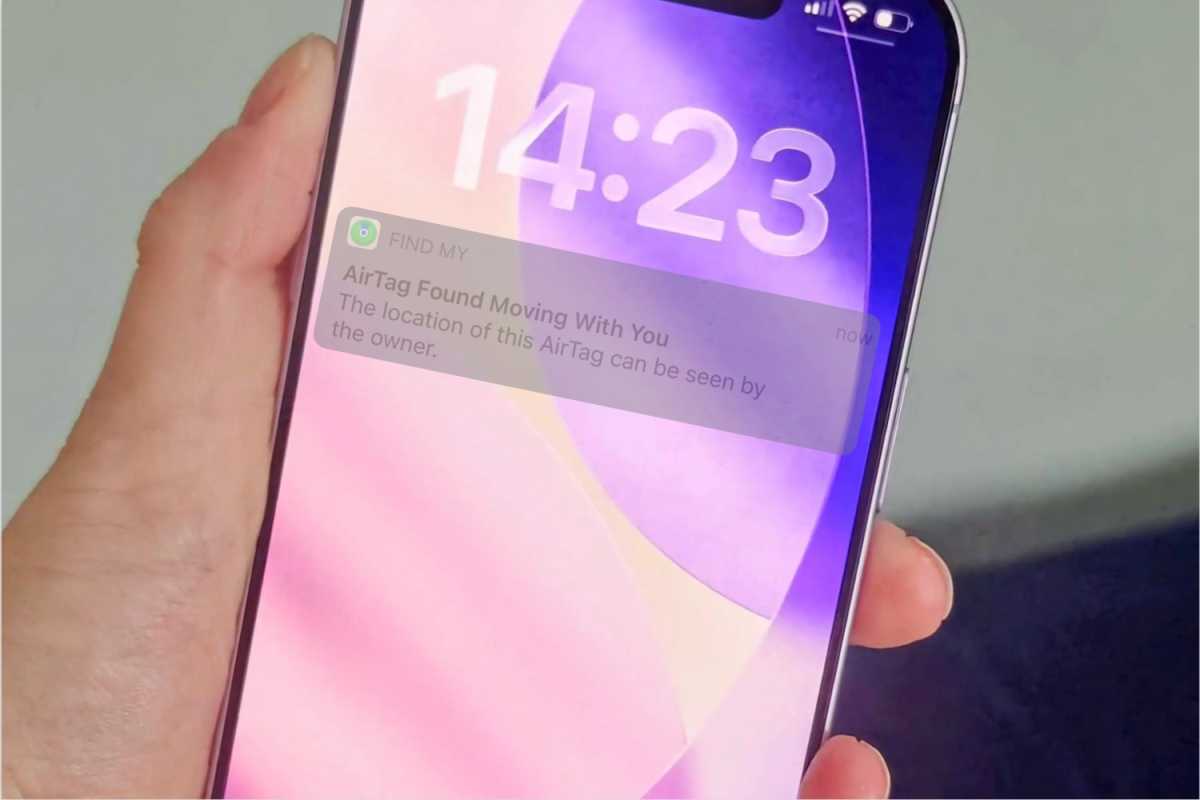
If an AirTag is detected near you that is not associated with your iCloud account, your iPhone – or an Android phone using Apple’s tracker detection tools – will display an alert. These notifications typically appear after a period of time, or when you are moving and the AirTag appears to be moving with you.
When you see an alert that an AirTag is following you, you can play a sound or use Precision Finding to help locate it. We explain how to do this below.
Even if you don’t receive an alert, an AirTag that has been separated from its owner for a while (around three days) will eventually emit a chirping sound to draw attention to itself. This safeguard is effective as long as the AirTag’s owner is not frequently nearby.
If you believe you are being intentionally tracked, do not confront a potential perpetrator. Instead, prioritise your safety and contact law enforcement for assistance.
Locate the AirTag by playing a sound
Foundry
If an unknown AirTag is tracking you, you may see an alert on your iPhone stating: “AirTag Found Moving With You.”
If you have received an alert about an AirTag that is traveling with you can make the AirTag produce a sound so you can locate it. To do so, follow these steps:
- Tap Apple’s Alert.
- Tap Continue.
- Tap Play Sound.
You will have the option to play the sound again.
- Beware that the beep that’s made isn’t ongoing or particularly loud, and it can be muffled.
You may also hear the AirTag beeping, or making a “chirruping” sound without needing to go through the steps above. AirTags are designed to play a sound automatically after being separated from their owner for a period of time (now as short as 30 minutes to a few hours depending on movement).
However, the audio alert will only play if the person engaged in surveillance doesn’t come into contact with it in that time, so if a stalker can come within range of the AirTag at least every three days, the sound won’t play.
What to do if you can’t play a sound on the AirTag
You may find that there is no option to play a sound, in that case, the item may no longer be near you or it may be back in range of its owner. The AirTag needs to be within Bluetooth range to play a sound.
Another possibility is that the AirTag speaker has been disabled. After reports of people disabling AirTag speakers, Apple started adding the notification to alert you to the presence of the AirTag.
If you have been alerted that an AirTag has been found moving with you, the Find My app will display a map showing where the AirTag has ‘followed’ you. This way you can get an idea of where the AirTag has been detected, shown by red dashes and dots. It may put your mind at rest if you realise that the location is one you spent time at with a friend or colleagues who has an AirTag or other device (such as AirPods).
Locate the AirTag with Precision Finding/manual search
Simon Jary
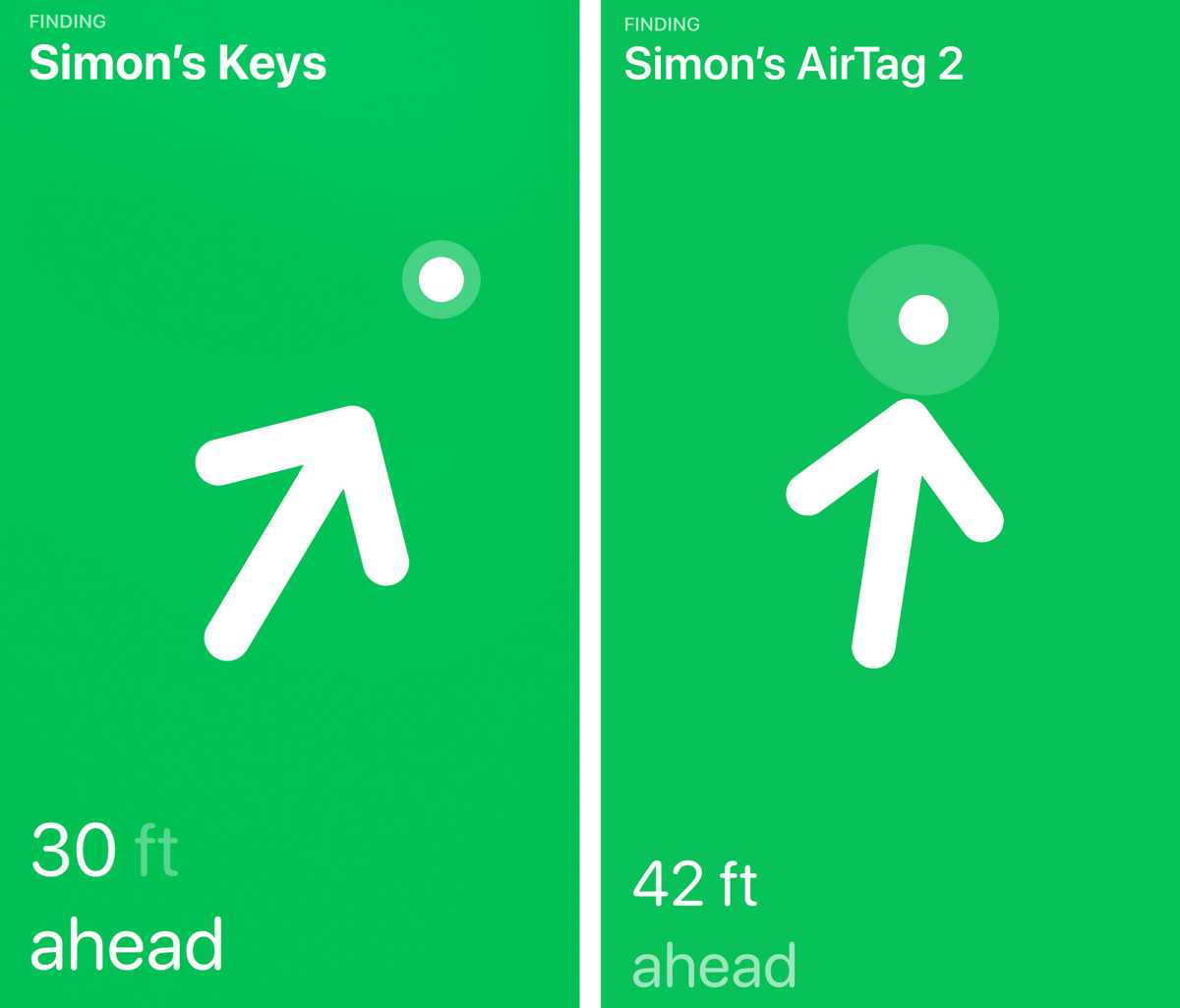
If you were unable to find the AirTag by playing a sound there is another option. If you have an iPhone 11 or later, you can use Precision Finding to see the exact distance and direction to the unknown AirTag.
- Tap Apple’s Alert.
- Tap Continue.
- Tap Find Nearby.
- You will see instructions that should direct you to the location of the AirTag.
Other ways to find an AirTag
If you don’t hear the AirTag chirruping, can’t get the AirTag to play a sound, and can’t find the AirTag using Precision Finding, check common hiding spots such as:
- Check pockets: In clothing, not just pockets but also check inside the lining or anywhere it could have been sewn in.
- Check bags: Look inside purses, luggage, messenger bags, and other items, unzip and also feel for an AirTag that’s been placed or sewn in.
- Examine your car: A car may have a number of locations that are unreachable or hard to check. Because an AirTag has as long as a year’s worth of power, someone might wrap it in cotton (to stifle the beep it may make; see below), slit a fabric seam, slip it in, and sew it back up. Parking your car away from homes and businesses and using a Bluetooth scanner can help you pinpoint if one is in your car. Look under car seats and in vehicle wheel wells.
- Check belongings: Someone could have posted you an item with an AirTag in it.
Identify the AirTag
Foundry
Once you have the physical device, you can gather information about it without alerting the owner.
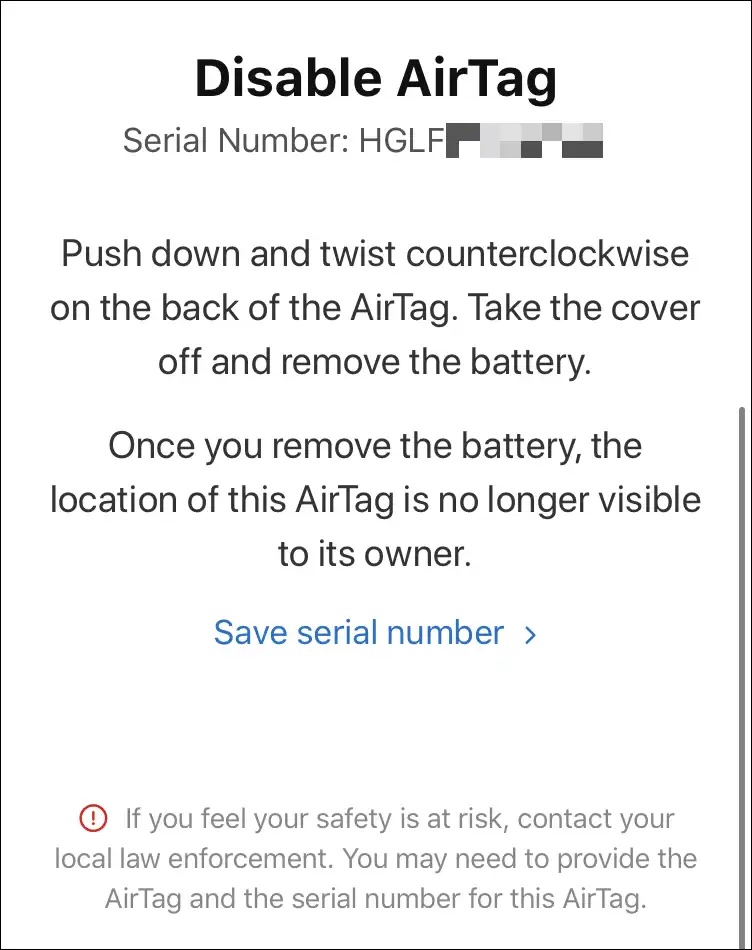
Your iPhone will detect the AirTag and direct you to a URL on Apple’s website where you can identify the AirTag with its serial number.
If you suspect that the AirTag is being used maliciously you should take a screenshot of this information, as the serial number can help law enforcement identify the owner through Apple’s records.
If the owner has marked the device as lost, there may even be a phone number for the owner. And it may be that they had simply lost the AirTag.
Disable the AirTag by removing the battery
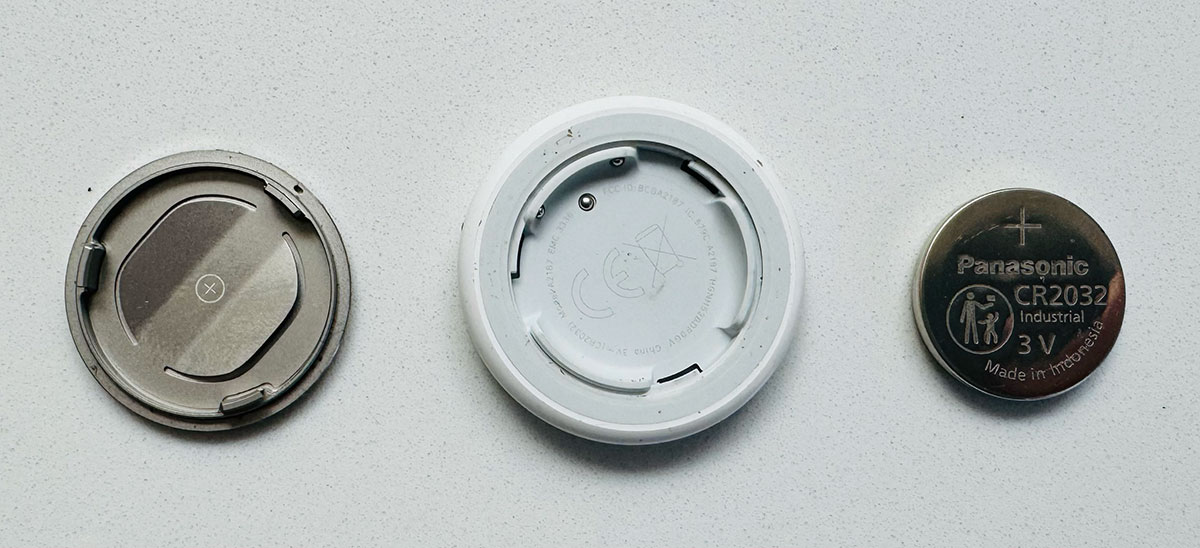
Open up the AirTag to locate the battery.
Foundry
To stop the AirTag from sharing your location immediately, you must disable it physically. Software actions alone won’t stop tracking.
To disable the AirTag you should remove the battery. Follow these steps to do so:
- Push down on the center of the stainless steel battery cover.
- Rotate it counterclockwise to open it.
- Remove the CR2032 battery.
Disabling the AirTag will not notify the owner of who disabled it.
Safety First: If you feel unsafe, do not go home. Instead, go to a public location or a police station.
We recommend keeping the AirTag and battery if law enforcement involvement is possible.
What happens after you have disabled the AirTag

What happens after you have found the AirTag and disabled it
?
Foundry
The AirTag will stop updating its location immediately, but disabling the AirTag won’t erase the location data that it had sent.
The owner will eventually see a “last seen” alert.
What to do if you have an Android phone
While Android does not natively support the Find My network, Google and Apple have collaborated on a joint standard for “Unknown tracker alerts”. Apple also has an Apple’s Tracker Detect app for this purpose.
- Automatic Alerts: Android 6.0 and later will automatically notify you if an unknown AirTag is traveling with you. If you have an Android phone, you can check for unknown AirTags moving with you using the Tracker Detect app. It’s far less robust than Apple’s Find My app and needs to be run manually.
- Manual Scanning: You can also manually scan for nearby trackers by going to Settings > Safety & emergency > Unknown tracker alerts and tapping Scan Now.
How to make sure you are warned if an AirTag is tracking you
You will need to be running iOS 17.5 or later. You also need Bluetooth to be turned on (Settings > Bluetooth).
To make sure you will receive an alert if an AirTag is tracking you need to turn on Location Services.
- On your iPhone (or iPad) go to Settings.
- Swipe down to Privacy & Security.
- Tap on Location Services and make sure it is turned on.
- Swipe down to System Services and tap on it.
- Make sure that Significant Locations is switched on.
- Go back to Settings.
- Swipe to Notifications and tap to open.
- Swipe down to Tracking Notifications.
- Make sure that you have that turned on.
How to report an AirTag tracking you
It goes without saying that you should not confront the perpetrator. If you don’t feel safe you should consult the police. Here are a few things you could do:
In addition to local law enforcement, the FBI, or police, if you’re in need of help, consult one of these U.S.-based services the National Domestic Violence Hotline or more specialized resources for victims of domestic abuse, stalking, and other violence listed by the National Coalition Against Domestic Violence.
In the U.K. victims of stalking and harassment can get support from the police and victim support and the Suzy Lamplugh Trust.
Other ways to find an AirTag
Because AirTag regularly emits Bluetooth signals that Apple devices can pick up, you can use a simple Bluetooth tracker for iOS or iPadOS to scan the area around you and see if an AirTag is nearby. While these tracking apps can’t identify AirTag as such—AirTag changes its Bluetooth ID regularly to avoid being trackable themselves—the apps give you the lay of the landscape. That includes the names of Bluetooth devices that do label themselves in their broadcasts.
BLE Scanner is a limited but free app that provides a list of Bluetooth devices your iPhone or iPad can detect, and offers a mapping feature that roughly sorts them by signal strength into distance away. This is particularly useful if you’re checking out whether a car has a hidden AirTag; less so inside when there may be dozens of your own and neighbors’ devices close enough to register. Regular Bluetooth devices typically identify themselves generically (like my “HP OfficeJet Pro 9010 series” printer) or specifically, as with the sharing name of your Macs, iPhones, iPads, Apple TVs, FitBit trackers, and so on.
Bluetooth BLE Device Finder (free to download, but $4.99 to unlock needed features) has the advantage of letting you drill down into Bluetooth technical details, which may give additional clues about which devices are legitimate and not.
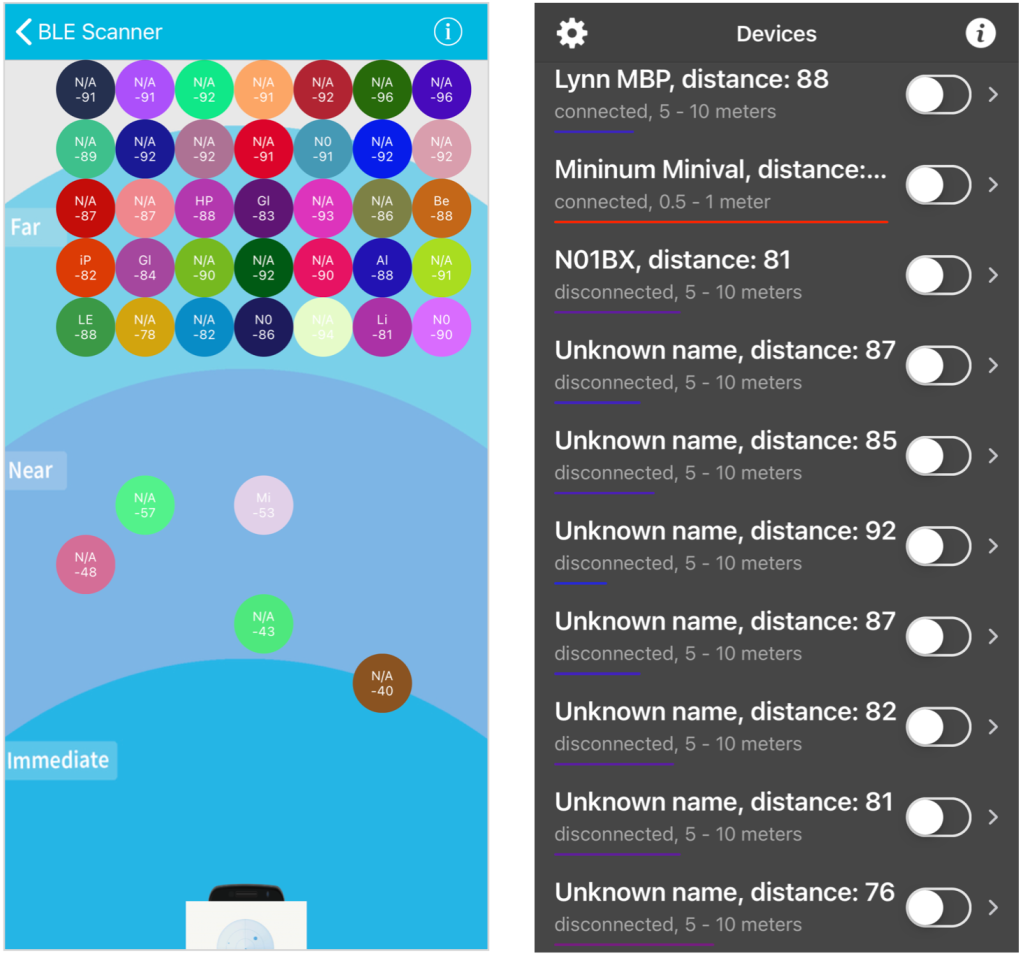
If you can eliminate all known Bluetooth devices, including by powering down equipment that you’re unsure of, and what’s left has no associated name, it can be worth looking further by hand.
How does an AirTag track you
Apple’s AirTag is a compact tracking device that can be attached to personal items to make it easy to find them. Unlike a GPS tracker, which requires cell service and may drain a battery quickly, an AirTag relies on the distributed Find My network of iPhones, iPads, and Macs that hundreds of millions of people around the world carry with them, and uses Bluetooth LE to send a signal to other devices.
While there are a thousand positive and legitimate ways to use an AirTag, unfortunately, AirTags have been used to track people without their knowledge. For example, back in December 2021, the York regional police department in Canada announced that AirTags were being placed in hidden areas of target cars parked in public, and then tracked to the driver’s residence, where the cars are stolen while parked in the driveway. In another incident, a woman claimed that she found an AirTag hidden in her wheel well after her iPhone alerted her to an AirTag moving with her. State governments in New York and Pennsylvania have issued warnings about the misuse of AirTags and similar tracking devices.
Incidents like this are rare (at the time, York police said there had been five AirTag-involved thefts out of 2,000 in the region). Apple has put some safeguards in place so that an iPhone, iPad, and AirTag provide varying alerts and information if the owner who paired the AirTag with their iPhone or iPad isn’t nearby. There are tools built into the iPhone to find and disable AirTags as well as an Android app that will scan for AirTags nearby. This is why you may have seen a warning that an AirTag has been detected near you.
These warnings aren’t restricted to Apple devices: in May 2023, Apple and Google announced a joint initiative to allow Bluetooth location-tracking devices to be compatible with unauthorized tracking detection and alerts across iOS and Android platforms. Read: How to identify unwanted tracking by a compact Bluetooth device.
Because AirTags don’t register proximity except to the owner, the only way it can be used to gather information about you is if it travels with you. An AirTag in your home, office, or classroom won’t reveal anything to someone trying to keep tabs. That reduces the “surface area” of unwanted surveillance because the AirTag has to be in your clothes, wallet, or purse, something else you’re carrying, or in a vehicle you’re in and using exclusively or at least regularly.
If you’re traveling regularly through urban and suburban areas or on public transportation, other people’s devices will still pick up and relay location information about any AirTag that’s with you. That can include something as innocuous as pulling over to a rest area on a highway, and someone 50 feet away has an iPhone, or even driving on a highway near other people who have iPhones or iPads connected to a cellular network.
Bluetooth LE’s range is surprisingly long. I found that an AirTag I temporarily placed in my car, parked two flights of stairs down from our ground floor and about 50 feet from the house still provided regular updates about its location via devices I owned—not to mention those of neighbors walking or driving by.
Everyone’s devices participate in relaying secured, privacy-protecting location information about their devices and AirTags unless they opt out of the Find My network. That makes everyone around you a potential participant in tracking you via an AirTag you don’t know about.
Once the AirTag is in your possession it will relay its location to the owner via the Find My network and other Bluetooth devices.