Apple has launched the MacBook Pro with M5 Pro and M5 Max processors, available in either 14-inch or 16-inch models, with up to 2x faster SSD speeds and starting with 1TB of storage for M5 Pro and 2TB for M5 Max.
Apple claims that the new MacBooks boast “the world’s fastest CPU core”, a next-generation GPU with a Neural Accelerator in each core, and higher unified memory bandwidth – delivering up to 4x AI performance compared to the previous MacBook generation, and up to 8x AI performance compared to M1 models.
The new MacBook Pro includes N1, an Apple-designed wireless networking chip that enables Wi-Fi 7 and Bluetooth 6.
Read on to find out what else is new for the 2026 MacBook Pro, and what hasn’t changed.
Apple MacBook Pro M5 Pro release date & availability
You can pre-order the new 14- and 16-inch MacBook Pro models with M5 Pro and M5 Max from March 4 from the Apple Store and via the Apple Store app in the U.S., U.K. and 31 other countries and regions.
Apple states that all models will begin arriving to customers, and will be in Apple Store locations and Apple Authorized Resellers, starting Wednesday, March 11.
Apple MacBook Pro M5 Pro price
The 14‑inch MacBook Pro with M5 Pro starts at $2,199 (U.S.) and $2,049 (U.S. education); and the 16‑inch MacBook Pro with M5 Pro starts at $2,699 (U.S.) and $2,499 (U.S. education).
As you can see from the table below, the new models have generally higher prices than the equivalent M4 Pro and M4 Max-based MacBook Pros, although you do get twice as much storage compared to the previous generation.
| Model | M5, 16GB RAM, 512GB SSD | M5 Pro, 24GB RAM, 1TB SSD | M5 Max, 36GB RAM, 2TB SSD | M4 Pro, 24GB RAM, 512GB SSD | M4 Max, 36GB RAM, 1TB SSD |
|---|---|---|---|---|---|
| 14-inch MacBook Pro | From $1,699/£1,699 | From $2,199/£2,199 | From $3,599/£3,599 | From $1,999/£1,999 | $3,199/£3,199 |
| 16-inch MacBook Pro | – | From $2,699/£2,699 | From $3,899/£3,899 | From $2,499/£2,499 | $3,499/£3,499 |
The M4 Pro with a 12-core CPU, 16-core GPU, 24GB unified memory, and 512GB SSD cost $1,999, but if you opted for 1TB SSD that would bump the price up to $2,199, so Apple can perhaps go someway to justify the price increase, but it does make what is already a very expensive Mac even more so.
Once the new MacBook Pro models are on sale they will be available to purchase from Apple and third-party stockists.

At a glance: MacBook Pro M5 Pro and M5 Max compared to M4 Pro and M4 Max
| Feature | M5 Pro / M5 Max (new) | M4 Pro / M4 Max (old) | M6 rumours… |
|---|---|---|---|
| Release | March 4, 2026 | October 2024 (current models) | Late 2026/2027 |
| Design | Retains existing design | Same as 2021 model | Redesign |
| Display | Liquid Retina XDR display with Mini-LED backlighting & ProMotion adaptive refresh (up to 120 Hz) | Liquid Retina XDR display with Mini-LED backlighting & ProMotion adaptive refresh (up to 120 Hz) | OLED display, touchscreen |
| CPU Cores | M5 Pro: 15–20 cores; M5 Max: 18 cores | M4 Pro: 12–14 cores M4 Max: 14–16 cores | |
| GPU Cores | M5 Pro: 16–20; M5 Max: 32–40 | M4 Pro: 16–20 M4 Max: 32–40 | |
| Chip Architecture | Built on a new Fusion Architecture combining two 3nm dies into one chip | Built on a single die using TSMC second-generation 3nm process | |
| AI / Neural | Next-gen GPU with a Neural Accelerator in each core | 16-core Neural Engine | |
| Memory & Bandwidth | Higher bandwidth: M5 Pro supports up to 64GB unified memory with up to 307GBps bandwidth; M5 Max supports up to 128GB unified memory with up to 614GBps bandwidth | M4 Max supports up to 128GB unified memory with up to 546GBps bandwidth | |
| Ports & Connectivity | Thunderbolt 5, Wi-Fi 7, Bluetooth 6 | Thunderbolt 5, Wi-Fi 6E, Bluetooth 5.3 | |
| Camera | 12 MP Center Stage camera | 12 MP Center Stage camera | Hole-punch webcam, rather than notch |
New M5 Pro/Max MacBook Pro: Chip architecture changes
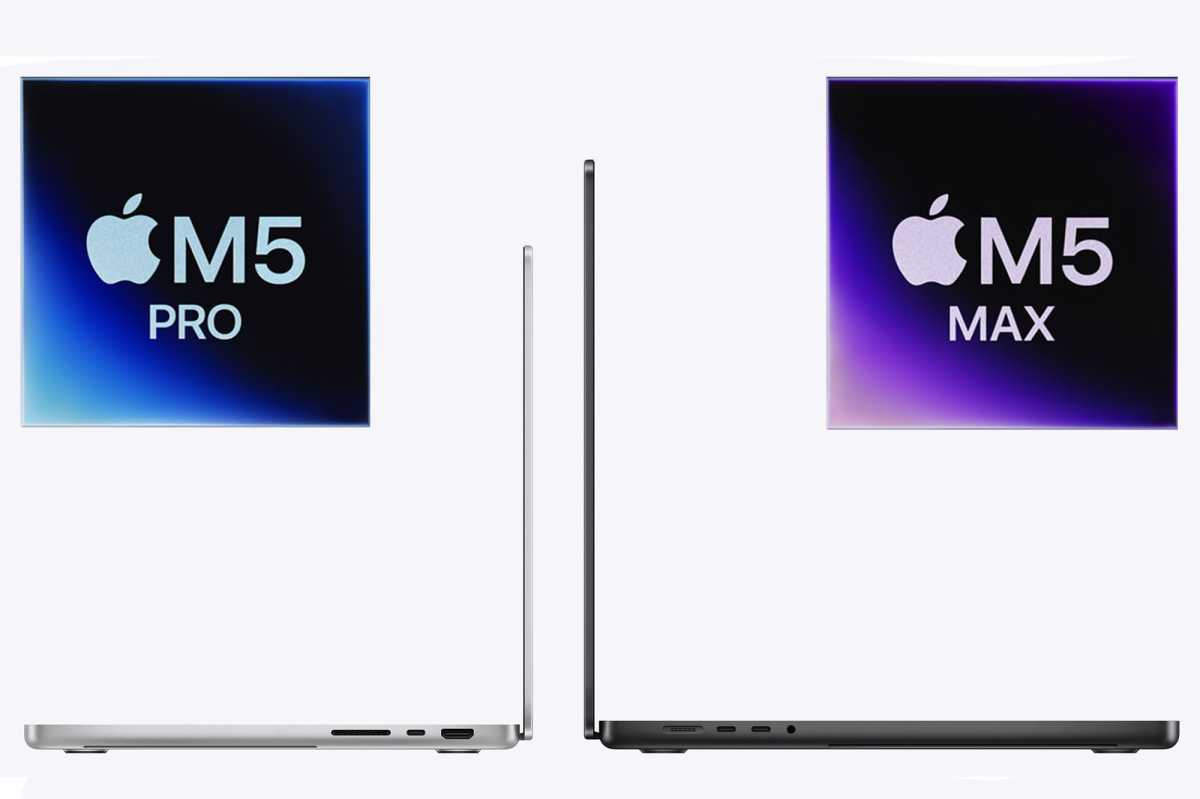
Apple
- New chip design: Built on a new Fusion Architecture combining two 3nm dies into one chip
The M5 Pro and M5 Max chips introduce a major architectural shift aimed at improving AI and parallel processing performance (as the pre-launch rumors had indicated). Apple was thought to be developing a redesigned chip layout that separates the CPU and GPU into distinct blocks. This is exactly what has happened.
Apple’s new Fusion Architecture combines two 3nm CPU and GPU dies into a single unified system on a chip (SoC). This design lets Apple scale performance and efficiency by splitting parts of the chip across multiple physical dies while maintaining unified memory and data flow, according to the company.
As a result the M5 Pro and M5 Max should offer substantial upgrades over the M4 Pro and M4 Max, improving AI compute, multithreaded performance, GPU efficiency, memory bandwidth, and storage speeds.
M5 Pro / M5 Max: CPU performance improvements
- New 18-core CPU architecture
- 6 “super cores” described by Apple as “world’s fastest” single thread
- 12 new performance cores optimized for power-efficient, multithreaded pro workloads
- 30% faster CPU performance compared to M4 Pro: Apple
The M5 Pro has up to 18 cores (6 super cores and 12 performance), while the M4 Pro chip had a maximum of 14 CPU cores (10 performance and four efficiency).
The CPU features what Apple is referring to as “super cores” and “performance cores”, reclassified from the performance cores and efficiency cores of previous generations.
Apple claims the new chips offer around 30% faster CPU performance for pro workloads compared to the previous generation.
The additional cores and architecture improvements result in higher multithread throughput, according to Apple. The company claims the M5 Pro and Max offer 2.5 times the multi-threaded performance of the M1 Pro and Max, while the M5 Max’s multithreaded performance is 15 percent faster than the M4 Max. The M5 Pro’s architecture also supports better compute scaling, which will be an advantage for AI.
M5 Pro / M5 Max: GPU performance improvements
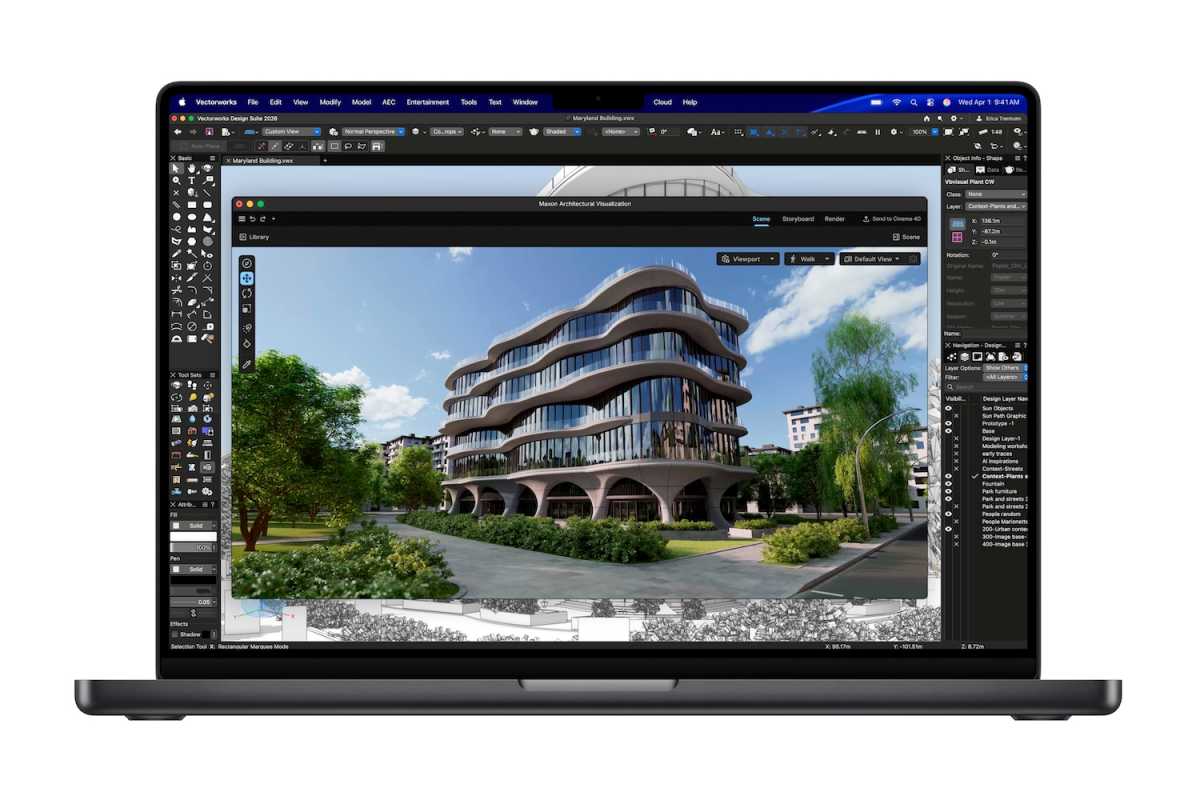
Apple
- M5 Pro GPU: Up to 20 GPU cores
- M5 Max GPU: Up to 40 GPU cores
- Up to 50% higher graphics performance compared with M4 Pro / M4 Max
- 30–35 % better ray-tracing performance (on M5 Max)
With up to 20 GPU cores in the M5 Pro and up to 40 cores in the M5 Max GPU you might assume there is no difference to the M4 Pro and Max, which had the same number of cores, but architectural changes are particularly significant here.
Apple has redesigned the GPU architecture in the M5 generation and the new chips both include Neural Accelerators in every GPU core. These Neural Accelerators should improve AI and machine learning and enable better AI inference and graphics performance for AI boosts, according to Apple.
Other changes to the M5 GPUs include an Enhanced Shader Core with second-generation dynamic caching and hardware-accelerated mesh shading, which Apple states is 20 percent faster than the M4 Pro.
The GPU also benefits from a third-generation ray-tracing engine that is up to 35 percent faster than M4 Pro.
The M5 Max’s memory bandwidth is also significantly higher than the previous generation.
So, despite having the same number of GPU cores, Apple can claim the M5 Max GPU is 20 percent faster at general CPU performance than the M4 Max and promise 50% higher GPU performance for specific workflows, thanks to these architectural changes.
Apple claims:
- M5 Pro vs M4 Pro: Up to 1.4× faster 3D rendering in Maxon Redshift
- M5 Pro vs M4 Pro: Up to 1.6× faster gaming performance with ray tracing
- M5 Max vs M4 Max: Up to 3x faster video effects rendering performance in Blackmagic DaVinci Resolve Studio
- M5 Max vs M4 Max: 3.5x faster AI video-enhancing performance in Topaz Video
M5 Pro / M5 Max: AI improvements
- Faster 16-core Neural Engine
- Neural Accelerators in every GPU core for faster AI tasks
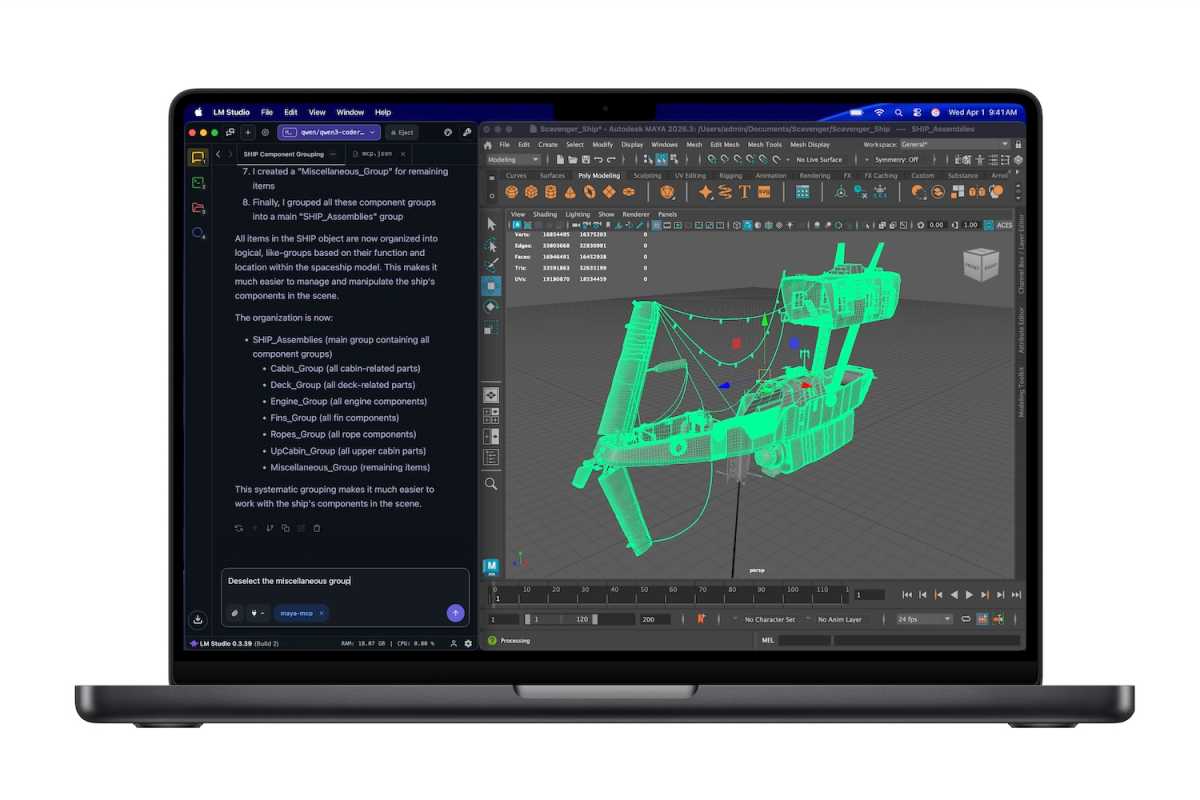
Apple
As discussed above, the GPU gains Neural Accelerators in every core, which should boost on-device machine learning (ML) and large language model (LLM) performance. It means that AI tasks can run much faster because they don’t have to be offloaded to cloud servers.
Both chips also include a faster 16-core Neural Engine, which will benefit AI and machine learning.
Apple makes various claims, such as 4x faster LLM prompt processing, and 8x faster AI image generation (compared to the M1 Pro). These are made possible by the combined improvements of the CPU, GPU, the Neural Engine and higher memory bandwidth.
Apple claims:
- Up to 3.9× faster LLM prompt handling than M4 Pro
- Up to 3.7× faster AI image generation vs M4 Pro
New M5 Pro/Max MacBook Pro: Connectivity – what’s new
- N1 wireless chip for Wi-Fi 7 and Bluetooth 6
One of the many differences between the M5 Pro and the standard M5 MacBook Pro (which arrived in October 2025 and is reviewed here) is the inclusion of Thunderbolt 5 instead of Thunderbolt 4. Thunderbolt 5 enables faster external connectivity, better display support, and more expansion than Thunderbolt 4. But Thunderbolt 5 is nothing new for the MacBook Pro, having arrived with the M4 Pro and Max models in 2024.
What is new for this generation is the inclusion of the N1 chip which is Apple’s networking system-on-chip that handles Wi-Fi and Bluetooth.
The N1 brings Wi-Fi 7 support (up from Wi-Fi 6E), which is the latest Wi-Fi standard and offers multi-gigabit throughput and lower latency. It should be more reliable too.
Bluetooth 6 is also made possible by the N1, an improvement on Bluetooth 5.3. This new standard offers improved range, speed and power efficiency.
Other benefits of the N1 include improvements to Apple’s AirDrop, Continuity and Personal Hotspot features. Plus, putting all this on the chip should make it more power efficient.
New M5 Pro/Max MacBook Pro: SSD – what’s new
The M5 Pro MacBook Pro models now start with a 1TB SSD as standard, double the amount of storage on the previous generation models.
Similarly, the M5 Max models now start with 2TB of storage.
But Apple has done more than double the storage. The company claims that the SSD in the new MacBook Pros is faster than the previous generation’s SSDs, with improved read/write performance and more.
Those with large file workflows will benefit from the additional, faster internal storage.
The maximum storage option is still 8TB and it is still necessary to choose the amount of storage you require at the time of purchase as you cannot update it later.
New M5 Pro/Max MacBook Pro: Battery – what’s new
Battery life remains the same as the predecessors, according to Apple’s calculations:
- 14-inch MacBook Pro, M5 Pro: 22 hours
- 14-inch MacBook Pro, M5 Max: 20 hours
- 16-inch MacBook Pro, M5 Pro: 24 hours
- 16-inch MacBook Pro, M5 Max: 24 hours
Several design elements of the new M5 Pro and M5 Max chips suggest improved power management and energy efficiency though, so we will be interested to see if this translates to better battery life.
We’ll be running our own tests to see how the new models compare with previous generations and the M5 MacBook Pro, which Apple states offers 24 hours battery life.
New M5 Pro/Max MacBook Pro: What hasn’t changed?
There has been no meaningful changes to the design or display hardware on the M5 Pro and Max MacBook Pro models when compared to the previous generation.
Rumors do indicate that changes could be coming to the line up though. Analyst Ming-Chi Kuo believes that Apple is going to launch a MacBook with a touch screen that could arrive on a MacBook Pro as soon as 2026. However, this update is not expected to arrive until the M6 generation and could be delayed until 2027.
Also unchanged are the camera and audio features of these MacBook Pro models.
Read our comparison of every Mac Apple sells: Every Apple Mac and MacBook compared.