- A digital rights group unveils a new version of its free, open-source VPN
- FreeSocks v2 adds Xray-based pluggable proxy to evade VPN blocks
- Post-quantum encryption has also been added for maximum security
With state-sponsored internet blocks growing more sophisticated worldwide, ordinary citizens are finding it increasingly difficult to stay connected. Now, one privacy-focused non-profit is fighting back by completely rebuilding its popular censorship circumvention tool.
Unredacted, a US-based non-profit dedicated to internet freedom, has launched the second generation of its free VPN service, FreeSocks. First released in 2023, the original service successfully issued over 60,000 access keys to users trapped behind digital firewalls.
However, as Unredacted noted in a blog post, censors have refined their blocking skills and become more efficient in blocking VPN and proxy protocols designed to circumvent Internet censorship. “We realized we needed to build FreeSocks from the ground up via a highly flexible system,” the group explains.
Today (July 20), Unredeacted announced the new version of the app, adding that “It’s now time to punch more holes in the closed Internet.”
FreeSocks v2 is now live and promises to provide an incredibly powerful, fully anonymous alternative designed specifically for high-risk environments.
Unredacted’s mission against a closing web
Why the urgent need for a censorship-resistant VPN? 2025 was the worst year on record for internet shutdowns, and state censors are deploying increasingly advanced deep packet inspection (DPI) to identify and block traditional proxy traffic.
Unredacted’s stated mission is to “Operate with absolute transparency, morality, and empathy to directly benefit users and citizens globally.” As governments crack down, everyday users, like Iranians overcoming unprecedented internet censorship, are forced into a daily struggle to access outside information.
Censors got better at blocking VPNs, so we rebuilt ours from the ground up.FreeSocks v2 is out today, with harder-to-block protocols, accounts that collect no personal data, and no IP logging anywhere.It’s free forever. Share it with a friend behind the censored Internet.July 20, 2026
This mirrors global trends where VPN providers have radically adapted how they dodge blocking technology. Rather than relying on easily identifiable connections, modern circumvention demands dynamic VPN obfuscation technology.
Unredacted embraces this approach by shifting away from the easily blocked Outline (Shadowsocks) protocols to a new primary backend running Xray.
By supporting pluggable proxy backends, FreeSocks v2 can instantly pivot if censors catch on. This ongoing cat-and-mouse game continues to pose a broader question to the industry: is the future of censorship-resistant VPNs no VPNs at all?
Upgraded privacy, hardware, and post-quantum encryption
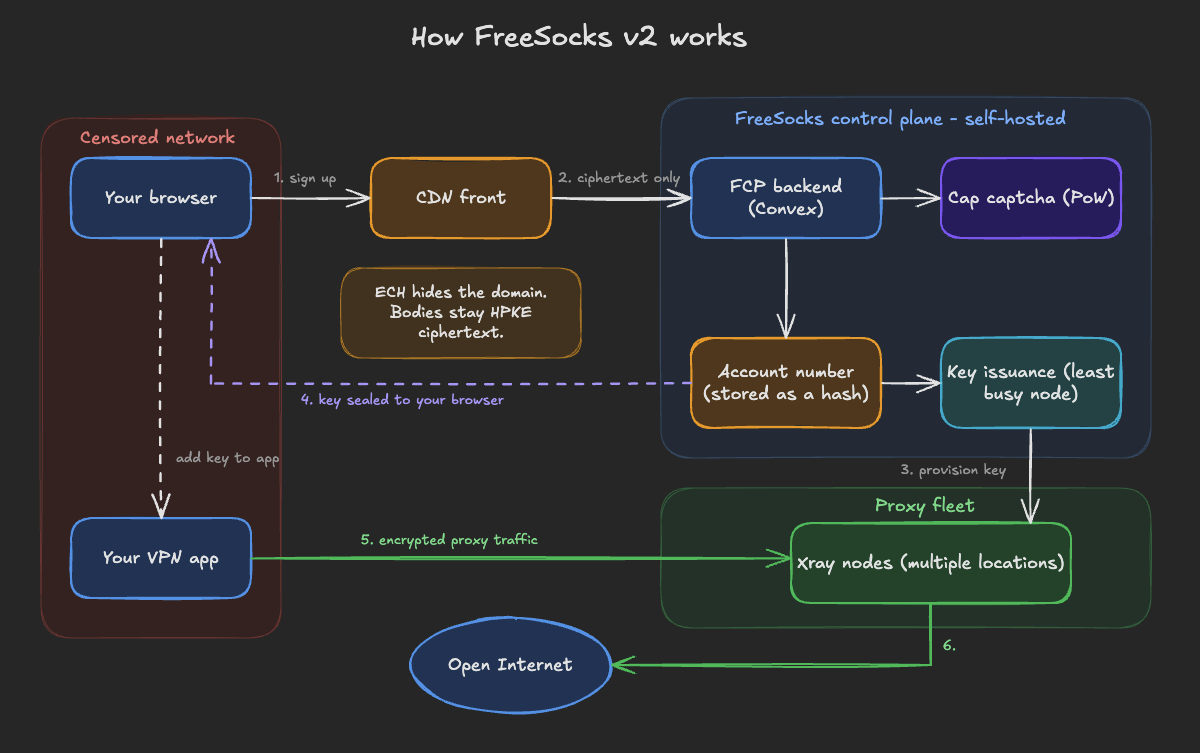
Beyond evading blocks, FreeSocks v2 offers aggressive privacy guarantees. Users don’t need an email or password to sign up. Instead, solving a proof-of-work challenge generates a random 32-digit account number. Furthermore, Unredacted explicitly confirms: “The application never stores a client IP address anywhere – not even hashed.”
Security is also heavily bolstered by hybrid post-quantum encryption. FreeSocks v2 adds X-Wing, a hybrid protocol that combines classical X25519 and post-quantum ML-KEM-768 algorithms. In simple terms, it ensures that your data remains secure even against hypothetical future quantum computers designed to break modern encryption.
Crucially, Unredacted is cutting ties with third-party hosting, too. “FreeSocks v2 is launching fully on hardware that we own, colocated in Kansas City, MO,” the team confirmed. This hardware ownership prevents upstream providers from interfering with user traffic or handing over server logs.
While the core service remains free, users can purchase an optional $5 monthly membership to remove traffic limits. Unredacted also accepts cryptocurrency and fiat donations.
In a unique philanthropic twist, every donation made to the platform directly funds a shared bandwidth bonus that is automatically split across all free users on the network every month.