Beijing says it is “not competing” with Washington, despite racing to land astronauts on the Moon before 2030
Three Chinese astronauts have successfully reached the Tiangong space station, with one of them set to spend more than a year in orbit. This marks another step in Beijing’s preparations for a future lunar landing.
The Shenzhou-23 spacecraft launched aboard a Long March-2F rocket from the Jiuquan Satellite Launch Center in the Gobi Desert late Sunday.
Less than four hours later, following a rapid rendezvous and docking process, the crew, led by Commander Zhu Yangzhu, successfully reached the Tiangong space station, a name that translates as “Heavenly Palace.”
China launched three astronauts to the Tiangong space station aboard Shenzhou-23, with one expected to stay for up to a year, marking one of its longest missions https://t.co/s6HLiJW0Djpic.twitter.com/VBnipDTB8k
Former Air Force pilot Zhang Zhiyuan and payload specialist Lai Ka-ying, a former Hong Kong police officer and the first person from the city to travel to space, were welcomed by the outgoing Shenzhou-22 team.
The astronauts are expected to spend around six months aboard the orbital station, carrying out scientific experiments, maintenance work, and spacewalks. One crew member is set to stay twice as long to complete China’s first year-long mission in orbit.
Shenzhou-21 crew opened the hatch to welcome Shenzhou-23, marking China’s 8th “space reunion” and the first time a Hong Kong astronaut joins the Tiangong family. pic.twitter.com/KlVF0tU1Mg
The China Manned Space Engineering Office (CMSEO) said the Tiangong space station plays a key role in Beijing’s plans to place two astronauts on the Moon before 2030.
The orbital outpost helps provide long-duration spaceflight experience and allows China to test technologies needed for future lunar missions, agency spokesman Zhang Jingbo said. He added that the new Long March-10A rocket and the Mengzhou crew spacecraft will carry out a series of flights to Tiangong over the next two years to verify systems required for crewed Moon landings.
“We carry out the project of crewed lunar exploration under the established plan. We are not competing with other countries in space,” said the agency’s senior engineer Zhou Yaqiang. “When Chinese astronauts land on the Moon in the future, this will be a great feat for all of humanity.”
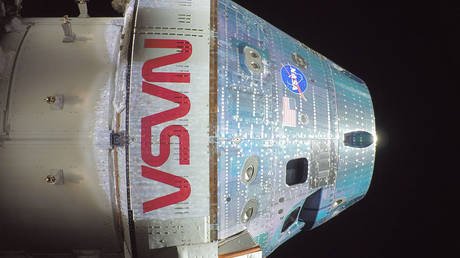
Humans have not landed on the Moon since NASA’s Apollo 17 mission in 1972. The US sent a crew on a flyby earlier this year as part of its Artemis program, but Beijing is seeking to challenge Washington’s efforts to become the first to establish a permanent lunar presence.
Moscow and Beijing have expanded cooperation in space in recent years, agreeing to establish a joint data center for lunar and deep-space exploration focused on the Moon and Mars. In 2021, the two countries announced the International Lunar Research Station (ILRS) project, with Russia seeking to build a power station on the Moon to provide energy for the base within the next decade.