- Apple is expected to launch an M5 and M5 Pro Mac mini in 2026, but ongoing supply shortages and high AI-driven demand could delay the release until later in the year.
- The next Mac mini is expected to focus heavily on AI and graphics performance, with improved M5 chips, faster SSDs and higher baseline storage, while keeping the compact 5-by-5-inch design introduced in 2024.
- Prices may increase compared to the current generation after Apple discontinued the $599 base model, potentially meaning the next Mac mini will start at $699–$799 depending on storage and configuration.
The Mac mini remains one of Apple’s most compelling Macs, combining strong performance, a compact design, and an attractive starting price. Following its major redesign in late 2024, the desktop became smaller, faster, and more versatile than ever, featuring a dramatically reduced 5-by-5-inch footprint alongside Apple’s M4 and M4 Pro chips.
If you’re considering buying a Mac mini, you may be wondering whether a new model is on the horizon, what upgrades a 2026 refresh could bring, and whether Apple will maintain its appealing entry-level pricing. While the M5 chip debuted in October 2025 and the M5 Pro arrived in the MacBook Pro lineup in March 2026, the Mac mini has yet to receive an update based on Apple’s latest silicon.
Some observers hoped Apple would introduce an updated Mac mini with M5 and M5 Pro chips at WWDC on June 8, but the event came and went without an announcement. That outcome wasn’t particularly surprising. Reports have pointed to ongoing supply-chain challenges, including component shortages and fluctuating availability of existing models, which may be contributing to delays in Apple’s refresh plans.
Below, we break down everything we expect from the 2026 Mac mini, including potential performance improvements, new configuration options, pricing expectations, and other key changes.
New 2026 Mac mini release date: Will update the M5 Mac mini soon?
- No WWDC release
Bloomberg’s Mark Gurman previously reported that Apple is developing Mac mini models powered by M5 and M5 Pro chips. While the updated machines remain on Apple’s roadmap, his original expectation of a launch in the first half of 2026 has since shifted to later in the year.
The apparent delay may be linked to ongoing supply constraints affecting the current Mac mini lineup. Demand has remained strong, while shortages of key components have limited availability in several markets.
Apple has acknowledged broader manufacturing challenges affecting its M-series chips and memory supply, with CEO Tim Cook indicating in a financial results call that these constraints are likely to continue for several months.
The current Mac mini lineup has already felt the impact. Apple discontinued the entry-level 256GB model, effectively increasing the starting price, while some higher-memory variants have become difficult to find or have disappeared from sale entirely. Shipping estimates for remaining models have also lengthened significantly in many regions.
At the same time, the Mac mini’s popularity has continued to grow, particularly among developers and enthusiasts running local AI workloads. Its compact design, unified memory architecture, and relatively affordable price have made it an attractive platform for local LLM development, further contributing to inventory shortages.
While supply constraints may simply reflect wider industry challenges, dwindling stock levels have historically preceded hardware refreshes. With Apple having already rolled out M5, M5 Pro, and M5 Max chips across much of its Mac lineup in 2026, the Mac mini remains one of the few models yet to receive the latest generation of Apple silicon.
Despite the uncertainty surrounding its release date, a Mac mini refresh featuring M5 and M5 Pro chips still appears likely before the end of 2026.
2026 Mac mini M5 processor: M5 and M5 Pro chips explained
- The new Mac mini will ship M5 and M5 Pro chips
The new M5 chip may make its way into the Mac mini.
Apple
The M5 and M5 Pro are part of Apple’s latest generation of silicon, powering the current lineup of iPad Pro, MacBook Air and MacBook Pro models. While the standard M5 chip focuses on balancing efficiency with a significant leap in AI and graphics performance for general users, the M5 Pro introduces a new “Fusion Architecture” that combines two dies to scale performance for professional workloads.
Apple’s M5 chip: Debuted in October 2025. It represents a significant shift in Apple silicon by prioritizing graphics performance and on-device artificial intelligence. While it maintains the 3-nanometer architecture of its predecessor, it introduces a new GPU design that incorporates dedicated hardware for AI tasks.
- AI and Graphics: The M5 introduces a “Neural Accelerator” in each GPU core, which Apple claims provides “up to 3.5x the AI performance vs iPad Pro with M4”.
- Memory: It supports up to 153GB/s of unified memory bandwidth, a nearly 30% increase over the M4.
Apple’s M5 Pro chip: Released in March 2026 in the MacBook Pro, the M5 Pro is a high-end chip designed for demanding professional tasks like software development and 4K video editing. It introduced a new “Fusion Architecture” combining two dies with high bandwidth and low latency into one SoC, offering improved multithreaded performance and AI capabilities.
- Core Configuration: The M5 Pro starts with a 15-core CPU (5 “super cores” and 10 performance cores) and a 16-core GPU. It can be configured up to an 18-core CPU and 20-core GPU (with 6 super cores and 12 performance cores).
- Advanced Connectivity: Unlike the standard M5, the M5 Pro supports Thunderbolt 5, enabling much higher data transfer speeds and expanded display support.
- Memory and Bandwidth: It features a significantly higher memory bandwidth of 307Gbps and supports larger amounts of unified memory than the base chip.
At a glance: Performance improvements
As seen in our review of the M5 MacBook Pro and our review of the M5 Max MacBook Pro, the biggest gains for the M5 chip come in graphics and AI-related workloads, rather than raw CPU speed.
- Graphics: GPU performance appears noticeably improved over the M4 generation, although results vary depending on workload and chip tier. Our benchmarks of the M5 Pro and M5 Max suggest graphics gains ranging from roughly 10% to 30%, with larger improvements in AI-assisted compute tasks.
- AI and machine learning: Apple is positioning the M5 family heavily around on-device AI performance. New neural acceleration features could significantly improve local AI workloads such as image generation and large language model inference compared to previous-generation Macs.
- Storage speeds: Apple says some M5 Pro and M5 Max systems can deliver up to twice the SSD performance of earlier models, although real-world results will vary depending on storage configuration.
- CPU performance: CPU improvements appear more iterative than transformational. Early benchmarks suggest around 10–15% faster single-core performance compared to equivalent M4 systems, alongside somewhat larger multi-core gains in higher-end configurations.
Why the next Mac mini could be a huge AI upgrade
The next Mac mini could become one of Apple’s biggest AI upgrades yet thanks to the M5 chip’s expected focus on machine learning and neural processing. In recent releases, Apple has been seen to be prioritizing AI performance improvements far more heavily than raw CPU gains, with faster local image generation, improved large language model performance, and better support for on-device AI tools. That could make the next Mac mini especially appealing to developers, creators, and power users experimenting with AI workloads without relying on cloud services.
M5-powered Mac mini specs: Will the new Mac mini have better specs and configurations?
- Faster 512GB SSD as standard
- Wi-Fi 7 (802.11be) and Bluetooth 6 possible
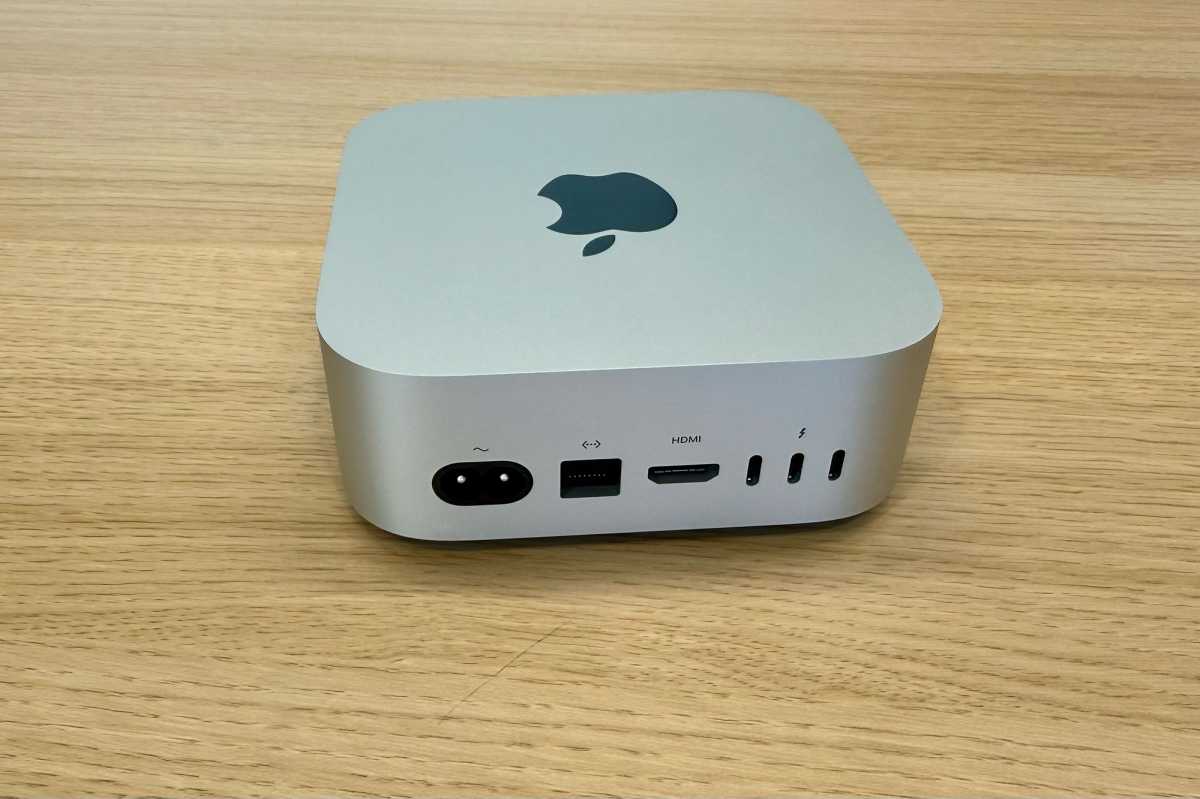
Simon Jary / Foundry
Apple is not expected to redesign the Mac mini again in 2026, so the M5 models will likely keep the compact 5-by-5-inch chassis introduced with the M4 generation. Most of the expected changes focus on connectivity, storage, and memory.
Apple increased the base memory of the Mac mini to 16GB with the M4 generation in late 2024, and that will almost certainly continue with the M5 models as AI features and multitasking demand more RAM. The standard M5 Mac mini is expected to start with 16GB of unified memory, while the M5 Pro model could start at 24GB and offer higher-end configurations beyond that, depending on ongoing global memory shortages.
Storage is also expected to improve. Apple discontinued the 256GB Mac mini in May 2026, making 512GB SSD the new entry-level configuration. That strongly suggests the M5 Mac mini will start with a faster 512GB SSD as standard. Higher-end configurations are likely to continue offering up to 4TB storage on the standard model and up to 8TB on the Pro version.
Connectivity upgrades are also likely. The current M4 Mac mini supports Thunderbolt 4, while the M4 Pro already includes Thunderbolt 5. The M5 Mac mini is expected to keep Thunderbolt 4, while the M5 Pro model will likely continue to offer Thunderbolt 5 for faster external storage and display support.
Wireless connectivity could also receive a major upgrade. Apple added Wi-Fi 7 and Bluetooth 6 to several Macs in early 2026, making those technologies likely additions to the next Mac mini lineup.
At a glance: Expected specs
- 16GB unified memory standard
- 512GB SSD standard
- Up to 4TB SSD (M5) / 8TB SSD (M5 Pro)
- Thunderbolt 4 (M5)
- Thunderbolt 5 (M5 Pro)
- Wi-Fi 7 (802.11be)
- Bluetooth 6
2026 Mac mini M5 design: Are any design changes expected to the Mac mini
- No design changes expected.
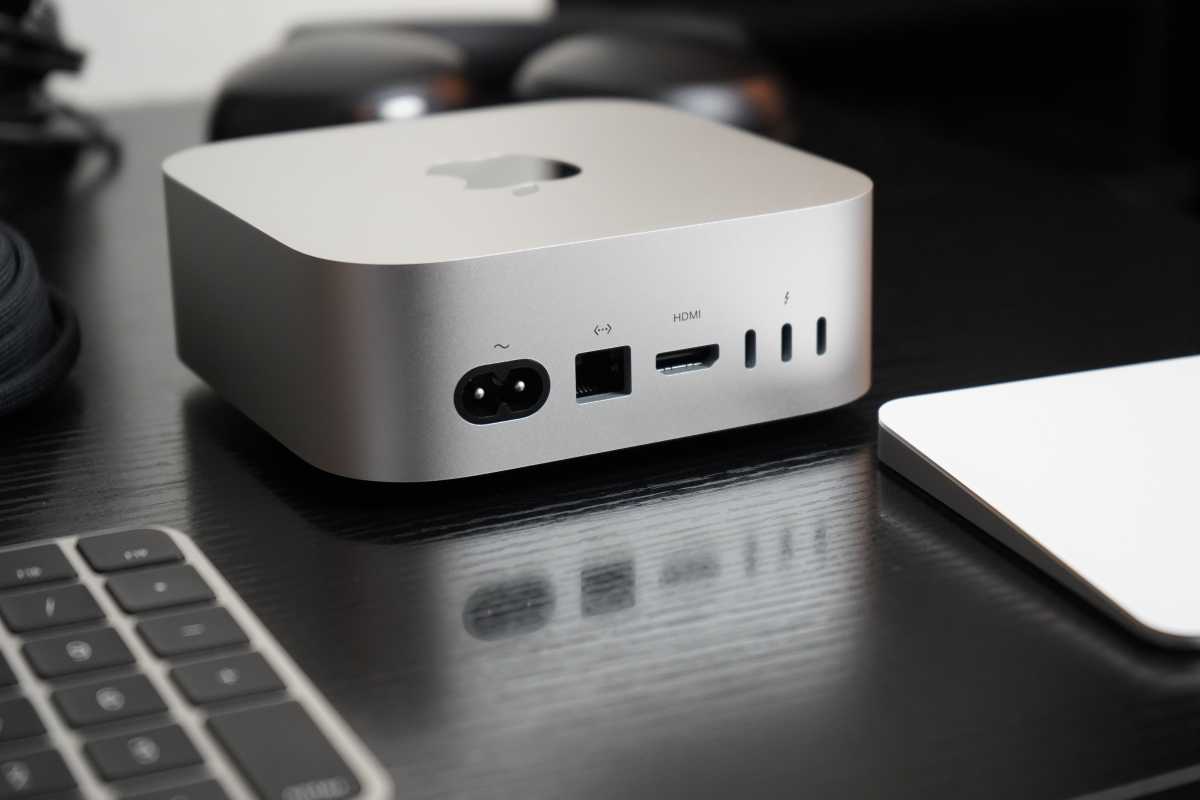
Expect the ports to remain the same on the new Mac mini.
Foundry
The M4 Mac mini underwent a significant physical redesign in October 2024, shrinking to a 5-by-5-inch enclosure. This design will be in place for several years to come. The M5 update is anticipated to focus on internal performance enhancements with no changes to the physical chassis.
No reports indicate that Apple will offer new colors – so a Space Gray Mac mini is unlikely.
New 2026 Mac mini M5: Ports
The port offerings are also expected to remain the same as the M4 Mac mini:
- 2 front USB-C ports (supporting USB 3 at 10Gbps)
- Front 3.5mm audio jack
- 3 rear Thunderbolt ports
- HDMI port
- Gigabit ethernet port (10Gb ethernet option available)
Apple’s Mac mini M5 price: Will the price of the Mac mini increase?
- Price likely to increase compared to M4 generation.
Recent changes to the Mac mini lineup suggest Apple may be shifting its pricing strategy, effectively increasing the cost of entry for buyers. In May 2026, Apple removed the most affordable 256GB version of the M4 Mac mini from its online store, leaving the 512GB configuration as the new base model.
Before that change, the 2024 Mac mini lineup started at:
- $599/£599/CA$799/AU$999 — M4, 16GB unified memory, 256GB SSD – DISCONTINUED
- $799/£799/CA$1,099/AU$1,299 — M4, 16GB unified memory, 512GB SSD
- $999/£999/CA$1,399/AU$1,599 — M4, 24GB unified memory, 512GB SSD
- $1,399/£1,399/CA$1,999/AU$2,199 — M4 Pro, 24GB unified memory, 512GB SSD
With the $599 model now discontinued, the effective starting price of the Mac mini has risen to $799. That marks a notable change for a product long known for its affordability. When the Mac mini launched in 2005, it started at $499, and for nearly two decades Apple kept the entry price relatively close to that figure.
Pricing for the upcoming M5 Mac mini has not been confirmed, but Apple’s recent moves suggest the next generation could launch with a higher starting price. One possibility is that Apple simply carries over the current strategy, making a 512GB SSD the standard entry-level configuration and pricing the M5 Mac mini at $799. Another possibility is a more modest increase, similar to Apple’s recent MacBook pricing strategy, where entry-level prices rose alongside larger base storage capacities. In that scenario, the next Mac mini could start around $699/£699 with 512GB of storage.
There are several reasons prices could increase further, including rising component costs, global memory shortages, and potential tariffs. Apple is also expected to begin assembling some Mac mini models at a Foxconn facility in Texas later in 2026 while continuing production in Asia. U.S. manufacturing could help Apple avoid certain tariffs, although domestic production may also increase costs in other areas.
At the same time, Apple may choose to keep pricing stable to preserve the Mac mini’s reputation as its most affordable desktop Mac. The launch of the $599 MacBook Neo also changes the equation slightly, since the Mac mini is no longer Apple’s only low-cost Mac option. In some respects, the MacBook Neo may offer better overall value because it includes a built-in display, keyboard, and battery.
Should you wait to buy the Mac mini?
If you need a Mac mini immediately, there may be little choice but to buy one now – although availability remains limited. Current delivery estimates range from three to four weeks for standard configurations, while models with higher RAM capacities can take up to 10–12 weeks to ship.
Under normal circumstances, we would also suggest looking for discounts on existing models or considering Apple Certified Refurbished options. Unfortunately, ongoing supply shortages mean that stock is currently limited across both new and refurbished Mac mini configurations.
For more guidance read: Should you buy a Mac mini now or wait for M5?
Considering an alternative? Read our Best Mac buying guide.
Factors affecting availability of the Mac mini
The Mac mini’s current supply constraints and unusually high demand could significantly affect the launch timing and availability of new models. Limited manufacturing capacity for Apple’s advanced M-series chips, combined with global RAM shortages, may restrict Apple’s ability to produce enough next-generation Mac minis at launch, potentially delaying the release until supply stabilizes. At the same time, strong demand from AI developers and businesses using the Mac mini as a compact AI server is rapidly depleting existing inventory, complicating Apple’s transition between generations. While dwindling stock levels can sometimes indicate that a refresh is imminent, the broader component shortages affecting the industry could just as easily reduce launch availability or delay the M5 Mac mini altogether.
Global supply constraints
As of May 2026, the Mac mini is facing significant supply shortages, with low stock at retailers and some configurations disappearing from Apple’s online store. The main issue is limited manufacturing capacity for Apple’s advanced M-series chips, which Tim Cook recently described as the primary bottleneck. A wider global memory shortage has added further pressure, particularly for higher-RAM models, as AI data centers compete for the same components. Rising production costs have also pushed Apple to discontinue the $599 base model, steering buyers toward more expensive configurations.
High demand due to popularity of Mac mini for AI
At the same time, demand for the Mac mini has surged because of its growing popularity as a compact AI server. Developers and companies are increasingly using it to run local AI agents and large language models (LLMs), leading to temporary sell-outs at major retailers. The Mac mini has long been popular as Apple’s most affordable and versatile desktop, but its combination of Apple silicon, unified memory architecture, compact size, and energy efficiency has made it especially attractive for AI workloads and 24/7 local AI setups.
The Mac mini’s unified memory architecture allows the CPU and GPU to share the same memory pool, improving performance for AI tasks compared to traditional PCs with separate RAM and VRAM. Combined with its small footprint and relatively low starting price, it offers an accessible entry point for AI development. However, there are trade-offs: memory and storage cannot be upgraded after purchase, higher RAM configurations are recommended for serious AI work, and users must supply their own monitor and peripherals. Some analysts also believe the limited availability could indicate Apple is preparing updated hardware, although supply issues may have delayed the expected M5 Mac mini launch until later in 2026.