- The World Wide Web was created 35 years ago today
- It was initially designed for sharing documents at CERN
- Its creator says we can return to its spirit of openness and collaboration
These days, it’s hard to go long without connecting to the Internet in one way or another: whether through one of the best web browsers or by connecting to a smart home device, it’s something we often take for granted. The primary means of interacting online — the World Wide Web — has just turned 35 years old today, and its creator has a timely message that couldn’t be more relevant for modern users.
The World Wide Web is the creation of British computer scientist Tim Berners-Lee. Working at the scientific body CERN in the 1980s and 1990s, Berners-Lee wanted a way to store, update, and locate documents within the sprawling organization. At the same time, he sought a solution that would allow for these documents to be shared with outside bodies quickly and straightforwardly.
That desire led to his creation of the World Wide Web. It was announced to the public on August 6, 1991, with Berners-Lee humbly stating that “We are very interested in spreading the web to other areas.” It was a platform whereby anyone could link to any document in a database using hyperlinks, or links embedded in text, images, and other media. Importantly, multiple users were able to access this platform simultaneously and independently of each other.
Adoption quickly spread from CERN to other research organizations before being opened up to the wider public, whereupon it exploded in popularity. And 35 years later, it’s an invention that has turned the world on its head.
An absolutely vital component of this system was that it had to be both free and decentralized. Berners-Lee was adamant that anyone should be able to create a website and implement hyperlinks on their own, without paying a fee and without a central body dictating what could and could not be done. That principle of openness still stands today — but it’s increasingly under threat.
‘It’s not too late’
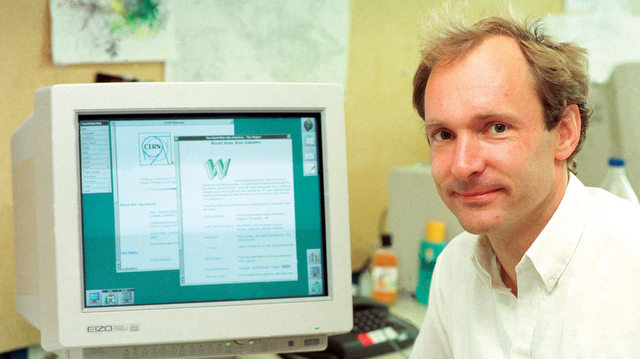
Speaking to The Guardian in September 2025, Berners-Lee lamented that plenty of the web today is no longer free and open. “We see a handful of large platforms harvesting users’ private data to share with commercial brokers or even repressive governments,” he noted, adding: “We see ubiquitous algorithms that are addictive by design and damaging to our teenagers’ mental health. Trading personal data for use certainly does not fit with my vision for a free web.”
At the same time, user data is sold “to actors we never intended it to reach,” with the result being “deliberately harmful content that leads to real-world violence, spreads misinformation, wreaks havoc on our psychological wellbeing and seeks to undermine social cohesion.”
This is especially challenging in the age of AI, Berners-Lee argued. To put things right and get back to the original vision of his creation, the father of the web advocated for strong AI governance and guidance from organizations that are not motivated by data and profit but instead by collaboration and the needs of the individual. On this point, Berners-Lee quipped: “It is hard to imagine a big tech company agreeing to share the world wide web for no commercial reward like CERN allowed me to.”
As the World Wide Web turns 35, the spirit of “collaboration, creativity and compassion” that allowed it to be given away for free is being increasingly challenged by Big Tech — but Berners-Lee still thinks there’s time to put things right: “We can re-empower individuals, and take the web back. It’s not too late.”