On April 28,
Chairman Verlon Jose of the Tohono O’odham Nation received a message from a
representative of the Department of Homeland Security. A contractor working on
behalf of DHS to construct an additional border wall along the U.S.-Mexico
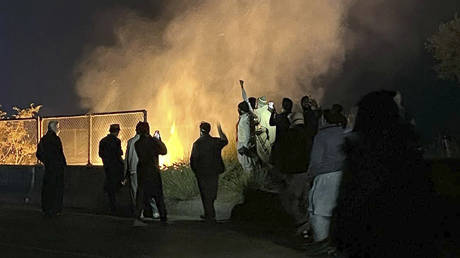
border had destroyed part of a site sacred to the Tohono O’odham—Las Playas
Intaglio, an archeological site featuring art engraved in the
earth in the shape of a fish (comparable to the Nazca Lines in Peru).
Angered, Jose told media that
day: “This was a devastating and entirely
avoidable loss. There is nothing more important than our history, which is what
makes us who we are as O’odham. This site was also an irreplaceable piece of the
United States’ history, one none of us can ever get back.”
Now the Tohono O’odham Nation finds its lands at the center of a dispute with the Trump administration over the building of new segments of the U.S.-Mexico border
wall.
As part of the Trump administration’s attempt to enforce mass deportations, the Department of
Homeland Security has hired contractors to construct new additions to the
U.S.-Mexico border wall. Using funds earmarked by last summer’s spending bill, DHS has hired
several construction
companies to build new segments, adding on to the existing wall originally
built during the first Trump administration. One of those segments would cut
through the Tohono O’odham Reservation.
The Tohono O’odham are facing another battle, in addition.
Since construction began in April, workers for Sullivan Land Services,
a Texas-based construction firm, have desecrated several religious landmarks
sacred to the Tohono O’odham—the aforementioned Las Playas Intaglio among them.
Other sacred sites, such as Horse Peak, would be affected by the wall
construction, as well. In response, the Tohono O’odham Nation is now suing the
Trump administration to block future construction of the wall, arguing that it undermines both tribal sovereignty and a long-standing precedent of
cooperation between the nation and the federal government.
The recent contract to
expand the current wall project is another
unconstitutional vanity project that comes at the expense of the American
people. Like the first border wall, the project is mostly spectacle that won’t
actually achieve its ostensible goal of reducing migration.
In this case, it is also representative of Trump’s and DHS Secretary
Markwayne Mullin’s unprecedented challenge to tribal sovereignty, whether
through this or the unlawful
detention of Native Americans across the country in immigration raids. As
Chairman Verlon Jose told The New Republic, “This attempt to
unilaterally diminish the nation’s reservation is just the latest example of
the federal government violating its own rules regarding sovereign tribes. It
should be of grave concern to all 575 federally recognized tribes in the U.S., as the same thing can happen to them.”
It also underscores the kickbacks given to Trump donors who
receive lucrative contracts for
building the border wall. For an administration that has already declared having “the most secure border in American
History,” it begs the question: Why build the border wall?
Following the contours
of the high Sonoran Desert in southern Arizona are the lands of the Tohono
O’odham Nation. For thousands of years, the Tohono O’odham have lived in a
region that encompasses southern Arizona and northern Sonora, Mexico,
occasionally moving during winter and summer seasons throughout the Colorado
River region.
The Tohono O’odham first
came to the attention of the U.S. government when, in 1854, Mexico sold the
U.S. a strip of land in northern Sonora, in what became known as the Gadsen
Purchase. Suddenly, the new border split the Tohono O’odham Nation into two. President
Ulysses S. Grant identified the nation by the old Spanish term, the Papago, which would remain the tribe’s legal name until 1986, when Tohono O’odham
members called for the tribe to be recognized by its traditional name.
In federal terms, the
land of the Tohono O’odham was delineated during the early twentieth century, amid the restructuring of Native lands. On January 14, 1916, President Woodrow
Wilson penned an executive order that set aside 2.8 million acres of land from
the new state of Arizona for a reservation for the Tohono O’odham. A few years
later, Congress enacted legislation affirming Wilson’s executive order.
By American legal
standards, the Tohono O’odham Nation is transnational, with its lands
straddling the U.S.-Mexico border. Today, the Tohono O’odham lands encompass,
among Native American tribes, the second-longest territory along a border. On May 27, 1907,
President Theodore Roosevelt issued a proclamation
stating that space within 60 feet of the U.S.-Mexico border belonged to the
federal government, to help monitor the border. When Wilson penned his February 1, 1917, executive order outlining the boundaries of the Tohono O’odham Reservation, there was no mention of the U.S.-Mexico
border. It should be noted that, until the late twentieth century, the border
was nothing more than a series of stone markers in the high desert. The first
time a fence was erected, it was to keep encroaching ranchers from claiming
Tohono O’odham land as their own. In 1918, Congress directed the building of a
border fence for cattle.
This did not mean that
the Tohono O’odham Nation neglected the border. Starting in the late 1970s, the
Tohono O’odham began working with Border Patrol on monitoring traffic across
the dividing line. In the decades since, the Tohono O’odham tribal council has hosted Customs and Border Protection officers and permitted the construction of
CBP bases. During the late 1980s, instances of border
crossings ranged from 50 to 60 per month.
Then came Operation
Gatekeeper. Beginning under the Clinton administration in
1994, the Border Patrol and Immigration and Naturalization Service (the
predecessor to ICE) implemented a strategy of “prevention through deterrence”
to reduce the number of immigrants entering via the southern border. Border
walls were constructed around metropolitan areas and ports of entry,
checkpoints were militarized, and detention centers were expanded. Entry into
the U.S. was also more restrictive. One key aspect of this policy was that it forced undocumented migrant movement to dangerous terrain, where migrants could be
easily spotted or deterred by the forces of nature.
The result was a movement of migrants through the Sonoran
Desert, where many perished. In increasing numbers, border crossers entered
through Tohono O’odham land. In the decade that followed, thousands of
immigrants ventured toward the Tohono O’odham lands to bypass more securitized
border entries. On April 27, 2003, The Arizona Republic, in a multipart
series on the border, reported that from 2001 to 2002, 85 of 145
immigrant deaths at the border occurred on Tohono O’odham land.
Tribal Chairman Edward Manuel approached Congress, requesting
additional funding for border protection and social services to address the
rise of migration through the reservation. Since 2003, 1,500 migrants have died
on Tohono O’odham lands while attempting to cross the border, and the tribal
government has spent $6 million of its own funds to process those deaths.
The nation also faced additional concerns over the border:
the harassment of tribal members by Border Patrol agents. Already, in November
2001, members of the Tohono O’odham Nation raised complaints against Border
Patrol agents who targeted nation members for undocumented crossing despite
being U.S. citizens. In response, Tohono O’odham members pushed for the recognition
of Tohono O’odham membership cards as valid proof of citizenship, which could
serve as U.S. passports for crossing the border to visit ancestral lands in
Mexico. Congress has not yet recognized Tohono O’odham IDs as such.
The federal government did, however, help
bolster border security—with the consent of the Tohono O’odham. In
2007, tribal leadership agreed to work with CBP to erect large vehicle barriers
along the border. During the first Trump administration, in 2019, tribal
members approved of the construction of an Integrated Fixed Tower system, which
installed sensors that alerted CBP agents about border activity.
Yet the Tohono O’odham protested the Trump administration for attempting to construct a new border wall that cut through
Tohono O’odham land. In 2019, the Tohono
O’odham Nation submitted an
amicus brief in
support of the Sierra Club in its lawsuit against the border wall, Trump
v. Sierra Club.
In February 2020, CBP contractors destroyed a burial ground at
Monument Hill and damaged Quitobaquito Springs
during the construction of a border wall. Construction of the wall, however,
stopped following the election of Joe Biden in November 2020.
During the Biden years—even during periods when thousands of
asylum petitioners camped by the U.S.-Mexico border for entry—members of the
Tohono O’odham lobbied against future border wall construction, arguing that
the current tower system worked effectively and that wall construction would
produce more harm than good.
In 2024, Tohono
O’odham Nation Chairman Verlon Jose testified before
the House Subcommittee on Oversight and Investigations on
the status of the border. Jose implored the subcommittee that a wall would do
nothing to help with border issues. “As the Nation and others have warned for
years, the border wall is particularly ineffective in remote geographic areas
like our homelands, where it can easily be circumvented by climbing over, tunneling
under, or sawing through it.… CBP data shows that most illegal drugs are
smuggled through ports of entry rather than through the borderlands. The data
clearly shows that federal funds would be put to much better use supporting
tribal and federal law enforcement and border security services and public
health services.”
Since the return of Donald Trump to the White House, Native
Americans have found themselves directly affected by new policies. During the
first year of the Trump administration, Native Americans were severely affected
by funding cuts ordered by the Department of Government Efficiency.
DOGE terminated leases for at least 12 Indian Health Service facilities that
provide medical care on Indian reservations. Among those impacted were the
nearby Tucson IHS facility.
In the first year of Trump’s second term, the border remained
in the background as the Trump administration centered its immigration policy
on mass deportation. Many victims of immigration sweeps were Native Americans.
In several ICE operations, as reported by El
País, members of the Oglala Sioux and the Navajo Nations reported
being detained by ICE agents. In April 2025, the Trump administration issued a
memorandum excluding federal Indian reservations from any border construction
plans. To expedite construction, former DHS Secretary Kristi Noem waived dozens of regulations under
the National Environmental Policy Act.
That changed in February 2026, when the Trump administration
announced new plans to construct a border wall through Tohono O’odham land,
reversing its previous memorandum. On April 19, Jose announced that legal
protection was needed to stop the construction of the two new border walls. In
an interview with the Arizona Daily Star, Jose told reporters, “The wall
does not work. There are so many other things we can work on together to
address this issue. What happened to the government that’s supposed to be for
the people, by the people, when the people have no voice?”
On June 16, legal representatives of the Tohono O’odham Nation filed an
injunction through the U.S. District Court of the
District of Columbia to halt anticipated construction of a new border wall.
Ten days later, the
Trump administration awarded a contract to Sullivan Land
Services, or SLSCO, a
construction company based in Galveston, Texas, to build the segment of the
wall on Tohono O’odham land. The project, which is estimated to cost north of
$1 billion, is dubbed the Tucson 5 Project. The design includes two
30-foot, 62-mile walls that run directly through Tohono O’odham land. For the
current border wall construction, SLSCO was also awarded contracts to work on
the Del Rio 3 Project and the Laredo 2 Project; it previously built several
segments for the border wall during the first Trump administration.
In 2021, the company was sued when a whistleblower alleged that it overcharged for
construction costs and even illegally hired armed Mexican nationals to guard
border wall construction sites. Most importantly, the Houston Chronicle’s report detailed how the Sullivan brothers
have carved a monopoly out of federal construction projects ranging from
disaster relief in Haiti to construction work
on the Port of Galveston.
Weeks later, on July 7, representatives of the DOJ’s Environmental and Natural Resources division challenged the Tohono
O’odham’s injunction in a brief, claiming that allowing the nation to block
construction would be a threat to national security.
“According to Plaintiff Tohono O’odham Nation, however,
Congress silently left a sixty-two mile stretch of the Arizona border
unprotected,” wrote DOJ attorney Stacy Stoller. “That stretch, Plaintiff says,
shares a border with its reservation (the Tribal Reservation). As Plaintiff
tells it, the Secretary may secure that portion of the border only if it [the
Nation] agrees. Under this theory Plaintiff wields veto power over any border-barrier
project in this area. Plaintiff’s theory would, to say the least, break new
legal ground.”
Except the challenge does not break new legal ground. If
anything, it preserves a status quo between the nation and DHS that has existed
for decades. What would be unprecedented, however, is DHS’s move to challenge
tribal sovereignty and create the illusion that the nation dictates all border
policy.
On July 22, attorneys representing the Tohono O’odham and the
Department of Justice convened at the U.S. District Court of the District of
Columbia for a preliminary hearing. Presiding over the case was Judge Richard
Leon, who had already made headlines when he blocked the Trump administration’s
construction of the new White House ballroom after it demolished the
historic East Wing.
In the courtroom, attorney Riyaz Kanji, on behalf of the nation,
argued that the Trump administration engaged in ultra vires actions—that
is, going beyond its legal power—to construct the wall on Tohono O’odham land.
Kanji noted that on several occasions, the Tohono O’odham Nation had warned the
federal government that building a border wall through the nation’s lands would
do nothing to deter migration, that migration levels were at an all-time low,
and that such a project would desecrate sacred sites and have environmental
impacts. Rather, Kanji noted, the existing border system worked well and border crossings were down dramatically from past years.
Judge Leon questioned Kanji about the nation’s case, citing the
government’s argument that President Theodore Roosevelt had initially
designated the lands of the border as a public reservation, regardless of
tribal jurisdiction. Noting that the 1907 Roosevelt executive order designated all
land 60 feet within the border as government property, Leon asked Kanji to
explain why the 1907 order did not grant the federal government the power to
build the wall. Justice Department attorneys asserted that the border
remains U.S. government property, that the project would pose no environmental
threat, and that the national security threat of immigration was real. By the
end of the hearing, Judge Leon asked both parties to bring in written
statements, delaying a final judgment by a few weeks.
For now, the case remains in limbo. Following the hearing, Representative
Adelita Grijalva of Arizona’s 7th district, which encompasses the Tohono
O’odham lands, released a
statement in response. Joining in support of
the nation, Grijalva reminded the press that “it is against the law for DHS to
unilaterally alter the boundaries of a sovereign Tribal Nation, yet that is
exactly what they are trying to do—usurping authority that only Congress
has.”
Chairman Verlon Jose
told me, in response to the trial, “The Nation has worked
closely with CBP and other agencies for decades to protect the U.S. homeland. A
clear purpose for undertaking these extensive security efforts was to avoid an
unnecessary wall that would separate our people, desecrate our sacred sites,
and devastate our environment. History and experience with the terrain in
this part of the country clearly show that an expensive wall won’t work. That
is why we implemented multiple levels of technology and personnel, which has
been effective. The administration has repeatedly stated for months that the
current border is 100 percent secure. As a result, the only impact of building a wall
is to curry political favor, all at great expense to the taxpayers.”
In the meantime, the Trump Administration has decided to take
advantage of the delayed ruling to act. On Thursday, August 6, DHS
stated it would send contractors to the Tohono O’odham Reservation to resume
construction on the wall. The following day, the Tohono O’odham Nation announced
that any contractor who enters the Nation’s lands to work on the wall without
prior authorization would be found illegally trespassing.
Other judgments have been granted to the Trump administration to continue wall construction. On August 3, federal Judge Reggie
B. Walton allowed the Trump administration to move ahead with the construction
of the border wall through the levee
system near the town of Presidio, Texas. Environmental groups
argued doing so would ruin the structure of a nearby levee, which would lead to
flooding. The ruling underscores the legal uncertainty facing border
communities regarding their ability to have a voice in the border wall
construction.
The current attempt to construct two border walls on Tohono
O’odham land reeks of the political graft and backroom deals typical of the Trump administration.
The outcome of the trial is about more than just another one of the president’s
many vanity projects. It could have long-standing consequences for Native
American sovereignty. By ignoring these precedents, as outlined by Congress,
the current border wall project on Tohono O’odham land would mark an erasure of
Native American rights in the U.S. Most of all, it represents another obliteration
of checks and balances between the branches of government. By allowing Trump to
sidestep its authority, Congress sets another precedent to allow an unchecked
executive to dictate federal policy, to the detriment of those who must live in
the aftermath.