- Schenker Element 16 (E26) is on sale now, pairing Intel Panther Lake processors with a 120 Hz 1600p display and a 72 Wh battery in a 1.9 kg chassis, shipping in late August
- The laptop’s screwless quick-release chassis and a firmly planned next-generation mainboard swap make it a potential contender to other semi-modular Framework-built laptops rivals
- Its 72 GB RAM ceiling is an interesting configuration, thanks to 8 GB of soldered memory plus a single SODIMM slot that accepts a module with up to 64GB of memory
Schenker has put its long-teased Element 16 on sale worldwide, and the spec sheet leads with a number you will not find on any other laptop this year: up to 72 GB of DDR5 memory.
The 16-inch machine, sold under the model code E26 through the company’s Bestware store, starts at 1,499 euros, with orders expected to ship in late August 2026.
Buyers can also get a 5% early-bird discount, available until the end of the month, plus a 20-euro discount voucher if they sign up for the store’s newsletter.
A Framework competitor with an interesting RAM configuration
The Schenker Element 16’s potential 72GB of RAM deserves scrutiny for a few reasons: how it is configured to get there and whether it’s available. The Element 16 pairs 8 GB of soldered DDR5 with a single SODIMM slot, and filling that slot with a 64 GB module produces the magic number (72 GB) in an 8G+64G configuration.
This may not have been intentional; ComputerBase, a German news outlet, reported (DE) that Schenker originally planned a replaceable LPCAMM2 module for this design before settling on the soldered-plus-SODIMM arrangement that shipped.
The silicon is Intel’s new Panther Lake generation, marketed as Core Ultra 300. Buyers choose between the eight-core Core Ultra 5 325 in the base configuration and the 16-core Core Ultra 7 356H for a 150 euro premium. Both chips include an NPU for local AI workloads, and both rely on integrated Intel graphics with four Xe3 cores rather than a discrete GPU.
By the standards of a 1.9 kg machine with all-day battery ambitions, the Element 16 is genuinely quick, and 72 GB of memory will happily swallow the virtual machines, containers, and outsized datasets that justify a configuration like this. Getting the memory configuration, however, might be easier said than done, however.
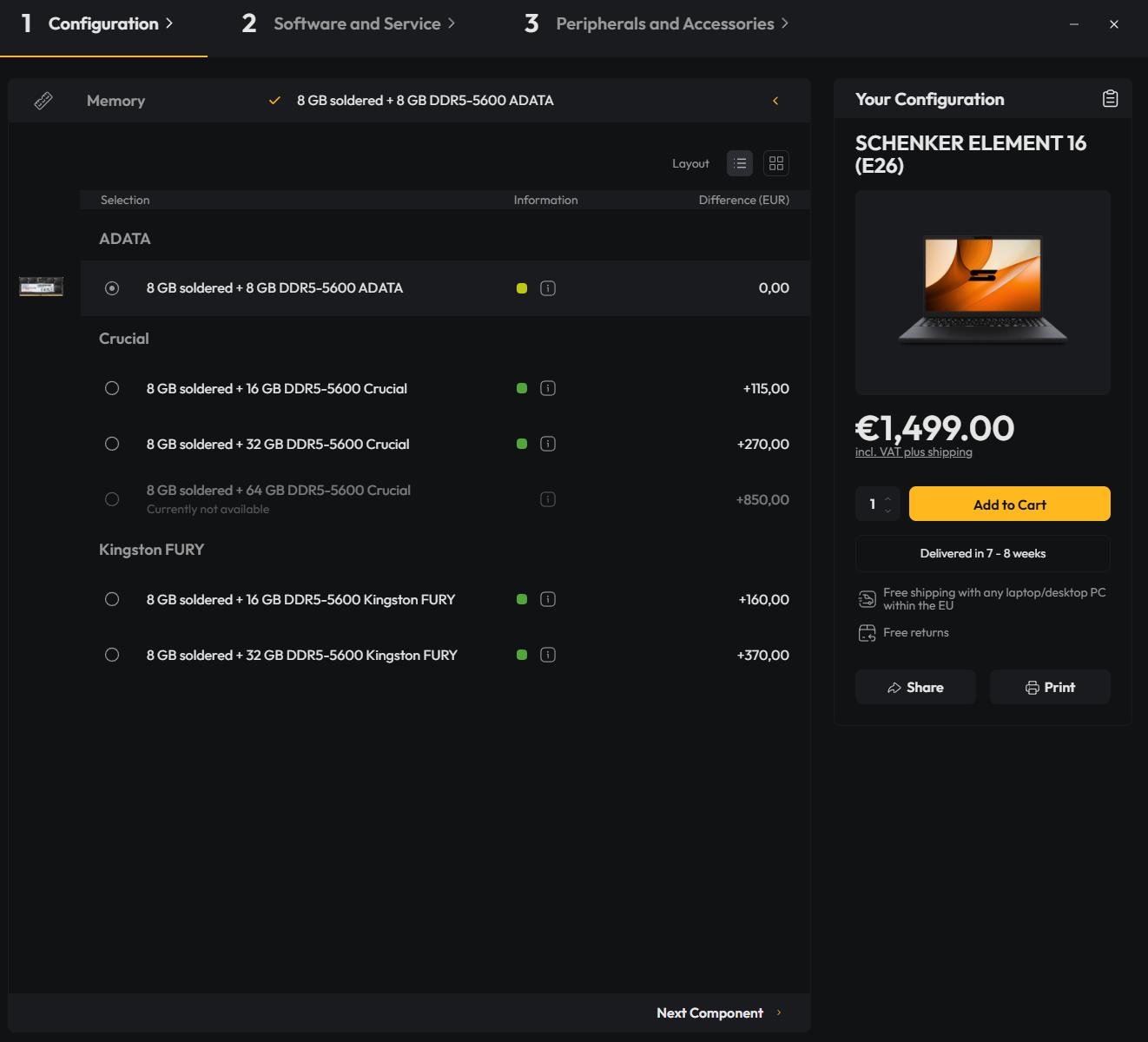
While the laptop can be configured with up to 72 GB, the configurator says the memory configuration is “currently not available.” Users can still opt for a Kingston Fury or Crucial memory module that currently offers a 40 GB SKU.
If you are willing to wait, however, the Schenker Element 16 is a compelling alternative to the popular, modular Framework lineup that’s been all the rage lately for its upgrade-friendly designs.
The 16-inch IPS panel runs at 2560 x 1600 with a 120 Hz refresh rate, 400 nits of brightness, full sRGB coverage, an anti-glare finish, and a 180-degree hinge. Storage sits in an M.2 slot with PCIe 5.0 connectivity, configurable up to 8 TB, which Schenker’s technical FAQ notes is a first for its thin-and-light lineup, since Panther Lake supplies the PCIe 5.0 lanes directly from the processor.
The laptop also meets MIL-STD-810H durability standards and offers solid connectivity, including two Thunderbolt 4 ports with DisplayPort and Power Delivery, Wi-Fi 7, HDMI, two USB-A ports, a microSD reader, and an audio jack.
What distinguishes the Element 16 in a crowded 16-inch market is the promise behind its quick-release bottom panel: a mainstream-looking laptop whose maker has publicly committed to at least one more generation of drop-in mainboards. Whether that commitment holds, is financially viable compared with buying a new laptop, and offers multiple trims based on consumer needs remains unanswered for now, even if you are willing to wait an unstated amount of time to get it in a 72 GB trim.