Europe and Africa are at once impossibly close and worlds apart near the northern tip of Morocco. Ceuta and Melilla are two small cities overlooking the Mediterranean Sea and a short ferry ride across the Strait of Gibraltar from Spain. The cities on the African mainland have been controlled by Spain for centuries, and their residents are Spanish citizens who enjoy the privilege of European Union membership.
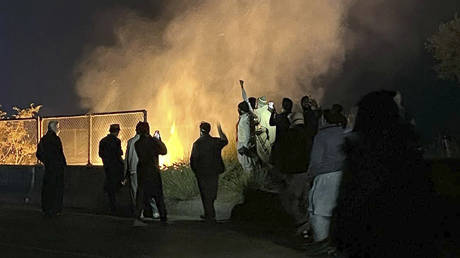
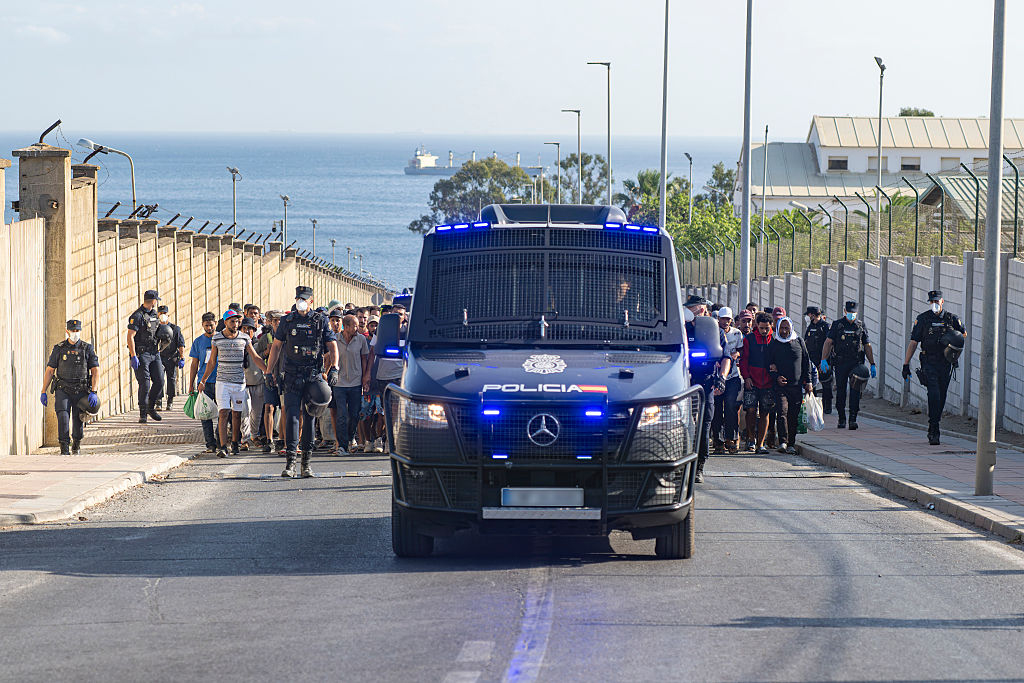
A border fence and a stark disparity in wealth and opportunity separate the two enclaves from Morocco: Ceuta lies a few miles from the adjoining town of Fnideq, and Melilla is 10-minute drive from Beninsar. In late July and early August, an estimated 72,000 people from Morocco—including many minors—walked, swam and ran toward Ceuta. Some made their way to Melilla, hoping the same rare fortune would await them there. Most carried nothing but a phone in a plastic holster and even lost their shoes to the waves, that later deposited them along the shore.
The people who made the hragga—colloquial for irregular migration—were driven by a combination of calculation and desperation. There were roughly three categories of people. Those who had tried before and had come prepared. There were those who had not been planning but had come to believe through a combination of online misinformation and unverified rumors, that a genuine window of opportunity to make it to Spain had opened and could close at any moment if they hesitated. And there were still others who embraced a daredevil approach with a combination of optimism and pessimism: “Why not? I have nothing to lose.” Many weighed the risks, reasoning that even a beating would be worth spending a day in Ceuta, which they are normally forbidden from entering.
Struggling to find food or shelter, most were either expelled by Spanish authorities or returned to Morocco voluntarily. Videos circulated online showing men kicked by the Spanish Guardia Civil while being expelled, then hit with batons by the Moroccan Gendarmerie on the other side of the border, in a choreography of rejection. The human cost was terrible. Some died falling from slippery rocks. Others drowned or were killed in the crush of thousands of bodies converging on the same narrow strip of shore. Among the 141 dead are: Faten, a smiling 20-year-old, talented footballer hoping to play in Europe; Ahmed, only 17; and many more. Parents of many youth who crossed over to Ceuta have been waiting in anguish at the border in Fnideq, carrying photographs of their missing children, checking with strangers if they happened to see their kids.
The timing was especially awkward for the Moroccan government, as the crisis erupted during the annual celebration marking the anniversary of King Mohammed VI’s reign. The government remained disengaged for days and attributed it to organized criminal smugglers. No one bought the argument, as it would be pointless to smuggle a person to the enclaves, since they are not part of the Schengen area. To reach Europe, a migrant would have to reach mainland Spain. Then, Rabat pointed to a Spanish Supreme Court ruling stating that migrants arriving by sea would not be deported automatically, as if legal nuance, rather than desperation in Morocco, was driving the migration.
The Moroccan government resisted acknowledging the reality behind this wave of migration: inequality, and the absence of work and opportunities for the country’s youth. In fact, those inside the country who spoke out against the state’s mishandling of affairs, and who reiterated why Moroccans wished to leave, were arrested. Only after growing pressure within Morocco did the government eventually agree to assist in identifying the unaccompanied minors and the deceased.
A profusion of conspiracy theories about geopolitics, circulating widely online, further obscured the actual forces driving the migration. Certain narratives, offered without any evidence, sought to portray the migrants as pawns in political games, disregarding entirely what drives and motivates people to leave home on such perilous journeys.
Repression and unemployment in Morocco
A constitutional monarchy, Morocco holds regular multiparty elections but the palace and its entourage dominate political and economic power through formal and informal means. Morocco has a repressive state, a deeply unequal society, and a profound crisis of unemployment and underemployment, especially for its young population.
From banning protests to fining editors to arresting rappers and journalists, the crackdowns on political freedoms in Morocco have increased tremendously. While hundreds of the country’s brightest and most promising people perish in prisons, privileged Moroccans are more concerned with reputational damage to Morocco or insist that the country needs evolution and not a revolution. But how is evolution possible when a teenager demanding public hospitals instead of luxury football stadiums or unions pressing legitimate labor demands can get them beaten and arrested?
Morocco’s economic model has produced soaring headline growth alongside deepening inequality, feeding a resentment that runs deep. Over the past two decades, capital has flowed toward megaprojects—the Tangier Med port, the Africa-Atlantic Corridor—financed by a mix of foreign and private investment. The services sector employs the largest number of people, followed by agriculture, forestry, and fishery.
The working age population of the country has grown by more than 10% over the past decade but employment has increased by only 1.5%, according to a 2025 World Bank report. The official unemployment rate stands at around 10% and at around 27% among young people aged 15-24. Yet 60-80% of workers in Morocco work in the informal economy, according to a 2025 report by the UN Economic Commission for Africa. The result is an economy whose glittering infrastructure sits uneasily alongside stagnant wages and rising prices for food, fuel and housing.
Unsurprisingly, many of the Moroccans who had expressed their frustrations and their desire for reform and opportunity in multiple waves of protests—the Arab Spring-era protests in 2011, the Hirak protests in 2016, the Gen Z protests in 2025—trudged by the thousands toward Spain. When loyalty flows only one way, the haves accumulate ever more while the rest are left to watch lavish banquets for Throne Day—and resignedly sigh, “hiwa hadchi li ‘ta Allah (This is the fate God has given us).” Hence, rather than asking, “Why do they leave?” we would do better to ask, “Why would they stay?”
Morocco has no shortage of resources: the country possesses rich agriculture and fisheries, phosphate, minerals, and enormous extractive projects in the occupied Western Sahara. A sense of being cheated is shared by millions as the economic benefits and opportunities do not trickle down to ordinary people. The contradiction between these natural resources and the everyday poverty, unemployment, and hardship experienced by ordinary Moroccans is expressed in the Moroccan chant that goes: “l’fosfat ou jouz bhorra / wa sha’bha mkhorra (Phosphate and two seas / yet its people still suffer).”
Moroccans see their government invest in the bling of glossy festivals and football stadiums built for the 2025 Africa Cup of Nations and the 2030 FIFA World Cup, which Morocco will co-host with Spain and Portugal. In the face of such visible wealth, it is what the state fails to do that carries the greatest weight.
A long transit in Tangier
Tangier is perched on the Strait of Gibraltar and has long served as a bridge between Africa and Europe. The city has drawn a rich tapestry of internal migrants from across Morocco, its diaspora, and the broader African continent.
In the early 1990s, when Spain—following a transformation of migration policies in the European Union and the implementation of the Schengen agreement—imposed more restrictive visa regimes, irregular migration began to accelerate. The International Organization for Migration estimated that irregular crossings to Europe through the Strait of Gibraltar rose from fewer than 5,000 in 1999 to around 20,000 in 2003.
Wars in Afghanistan and Iraq, military interventions and civil wars across Africa and intensifying climate catastrophes in the following two decades swelled global migration flows. Alongside African migrants awaiting passage, thousands from other parts of the world joined them. Europe, Australia and North America have all sought to obstruct migrants from coming in by any means necessary. The European Union outsourced border control offering economic and political incentives to Turkey and Morocco to stem the flow of migrants.
Under one EU-Africa agreement alone, $2.35 billion was allocated for deportations. This includes detaining migrants and dropping them in remote deserts. Several exit points along the so-called Eastern and Central Mediterranean routes were either sealed off by civil war in Libya, by special agreements with Turkey, and a bottleneck formed along the Western route through Morocco and Senegal.
Spain has already constructed a 1,600-foot floating barrier along the sea border following the Ceuta crossings. In the past decade, tens of thousands of migrants have died in Mediterranean crossings alone. But as Hein de Haas, a sociologist of migration, has explained, restrictive immigration policies fail to stop migration as there is a structural demand for cheap migrant labor in Europe. The waters of the Atlantic and the Mediterranean are full of the remains of those who perished while trying to reach Europe, victims of a system that treats human mobility as a threat to be managed rather than a reality to be humanely addressed.
But the combination of rising inequality and violence globally, and the need for a workforce, means people won’t stop migrating. This means that current border policies don’t stem migration but instead increase death and suffering. Precisely because it takes much longer, thousands of migrants are stuck in Morocco. Mehdi Alioua, a Moroccan sociologist, has called this phenomenon “transit migration.” Each must find rent and work, saving for yet another attempt at a better passage. Some have children, who grow up speaking fluent Darija, the Moroccan colloquial tongue, and who eventually become part of the working class fabric of Tangier. Some migrants with means share rented apartments in the affordable, peripheral neighborhoods of Mesnana and Boukhalef in southwestern Tangier.
Migrants without any financial resources, and mostly from other parts of Africa, camp in the woods in the forested outskirts of the city, where conditions are bare. When I visited their makeshift dwellings to meet some of the migrants, a strange odor hung in the air. Sticky puddles drew flies. I moved past the dumping ground and reached their improvised living quarters, which were kept meticulously clean.
During my fieldwork in Morocco between 2013 and 2018, it was obvious that many African migrants in long transit in Tangiers endured dire living conditions and faced racism. Black migrants were often called “Mamadou,” and sometimes even the dreadful “Ebola.”
In December 2013, Cédric, a young Congolese man, fell from his apartment rooftop in Boukhalef while being chased by the police. Many believed he had been pushed. Images that circulated on migrants’ phones showed his head smashed against the granite floor. Two days after his death, I saw the putrid pool of dried blood, nearly black, where he had fallen, when I visited his friends to pay my respects. What stayed with me for months was that I could still make out the pattern of the spatter from the impact.
Cédric’s death was a key turning point. A growing number of Moroccan activists understood the necessity of rejecting the notion that, in a poor and authoritarian country, organizing against racism is a “privileged” or “European preoccupation.” Moroccan activists, drawing on their own experience of repression, understood how short the distance can be between dehumanization, complacency, and abuse. They grew more attentive to the living conditions of migrants and began to challenge the normalization of racism more explicitly.
On one of those days, I met Najiba, a young activist, near Bab Al Qasba, one of the gates leading to Tangier’s medieval city. She and her comrades were showcasing their posters in hopes of garnering support from passersby for a demonstration the next afternoon. A placard read in beautiful Arabic calligraphy: “Kuluna Afariqa (We Are All African.)” Her group got some attention: some people paused for a few minutes to watch before moving on; others muttered some remarks too.
Najiba fell into conversation with a young man, around 16 years old. He had mocked the group’s slogan and pressed her on why they bothered organizing against racism. “Wasn’t it naïve,” he asked, “to defend the Africanos?” She told him that everyone had been a migrant once, and that Tangier itself had known great waves of migration from people of the northern Rif region.
She asked him where his own family was from. They shared Rif ancestry. “Ah, a Riffi, as well,” I heard her respond. “Did you know they used to say the Riyafa were taking people’s jobs and houses when our grandparents first came here?” She took him seriously and made him see historical patterns. He was intrigued and the teasing stopped. By the end of it, she remarked, “So we’ll see you here tomorrow, yes?” He made no promise. But he did wave goodbye, and his laugh, this time, was genuine.
The road from Ceuta
Many people located Ceuta and Melilla on a map for the first time during the recent frenzy. It would be no surprise if eyebrows were raised upon seeing just how far Spanish territory extends. These were sites of Portuguese and Spanish slave-trading routes and military garrisons in the 16th century.
The crossing to Ceuta was neither the first nor will it be the last of its kind. Because of its exceptional scale, Ceuta laid bare, much clearly, the contradictions of humanity in miniature, from kicking down someone to having the capacity to walk in someone else’s shoes. While a Dutch-Moroccan celebrity tweeted tactlessly, “Moroccan swims to Ceuta with an iPhone 16 to get an iPhone 17,” a woman took off her own shoes and handed them to a barefooted migrant.
While Italian, French, Spanish, Dutch, American and British politicians ratcheted up the headlines, numerous border staff stretched their discretion to the maximum to handle the situation with dignity. When fascists across Spain sowed panic and rallied to stop “the invasion,” local communities marched and blocked an anti-migrant demonstration. Ordinary people came out to provide emergency support; groups such as No Name Kitchen documented the treatment of migrants. Hope lies precisely in these different approaches.
I have been thinking repeatedly about Najiba, the activist organizing in defense of African migrants in Tangier. There were migrants from elsewhere in Africa in Ceuta, and they would have had much less protection or support once deported. Najiba’s example gave me hope that, even in the most difficult circumstances, solidarity can arise.
I think of the conversation between Najiba and the young man in Tangier: the boy’s smirk transforming into a thoughtful frown. I would like to think that something clicked in that moment. I wish I could reach back and speak with him. Standing there in Tangier, he was able to see things from another perspective. Perhaps he too instinctively recognized the moment for what it was. Or perhaps he, too, was among the thousands who had left for Ceuta.