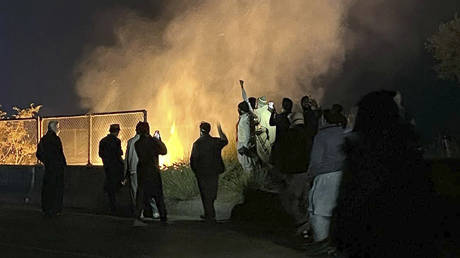
Labor Day is around the corner in the United States, and it’s worth taking stock of what has been, by any objective measure, a chaotic summer. In Nepal, at least 1,010 people have been confirmed dead, so far, after a catastrophic rock landslide on the Langtang Lirung peak brought a glacier down with it; some 4,400 people are still missing. In the Grand Canyon, two people died in recent days as a result of flash flooding. In Indiana, at least five people died amid severe storms and the worst flooding in 30 years; thousands of Gary residents spent two weeks without power. Statewide damages are estimated at roughly $5 billion. Parts of Southeast Asia are now covered in an acrid haze from devastating wildfires in Indonesia—the country’s worst since 2015. Wildfires in the U.S. have already burned through 8.2 million acres—164 percent of the country’s annual average over the last 10 years.
And that’s not even the half of it. The U.K.—which endured its hottest summer since 1884—faced 2,700 heat-related deaths during heat waves in May and June. In Europe, at least 35,000 more people died than would normally be expected due to four record-breaking, back-to-back heat waves earlier this summer. More than 200 people are believed to have died in the unprecedented wildfires that have blanketed eastern Algeria in recent weeks, far outpacing the officially reported death toll.
Indeed, underestimating death has become something of a theme in our warming world. An investigation from NPR and researchers at Boston University revealed that heat deaths in the United States are dramatically and chronically underreported. While the Centers for Disease Control and Prevention has estimated that an average of around 700 people died of heat-related causes per year between 2018 and 2026, NPR’s analysis found—perhaps conservatively—an average of 9,000 heat-related deaths per year during the same period. In some years, heat-related fatalities soared above 10,000, with those in Florida believed to be 40 times greater than officially recorded death tolls.
Other accounts are more reliable. July 2026, for instance, tied with July 2024 for the hottest July since modern record-keeping began in 1850. Thanks to this year’s unusually powerful El Niño and climate change—which is widely believed to be strengthening that El Niño—2026 is very likely to be the hottest year on record, surpassing the previous record, set in 2024. If that turns out be the case, 2026 will have been the latest in a long string of record-setting hot years; as the World Meteorological Organization reported back in January, the last 11 years have been the hottest 11 years on record.
It would be too comforting to imagine that summers marked by steadily worsening heat waves, megafires, and landslides constitute a kind of new normal: a revised baseline that societies can adapt to in some straightforward, linear fashion. Unfortunately, that isn’t the case. As climate scientist Kevin Anderson told Novara Media recently, “This is not a new normal. On average, this is the least extreme weather that I, you, and anyone else listening to this will ever live through.”
Rising global temperatures make some things—like melting glaciers, stronger hurricanes, and hotter summers—more likely. But climate change also makes the planet’s weather systems behave in more “unstable and unprecedented ways,” as climate economist Gernot Wagner has written. The impact of certain carbon “feedbacks,” moreover, like the excess emissions created by wildfires, still aren’t fully understood, and there is good reason to suspect that the earth could be more sensitive to rising concentrations of greenhouse gases than scientists initially thought. Economists have also routinely failed to account for the full and currently ballooning costs of the climate crisis, from dried-up shipping routes to wildfire.
What’s undeniably certain, however, is that the planet is getting warmer. Leading climate modelers now find “unavoidable” a world that is 1.5 degrees Celsius (2.7 degrees Fahrenheit) warmer than preindustrial averages. A report out today from the United Nations Environment Program likewise concludes that a world that’s 1.5 C warmer is now inevitable. Continuing to burn fossil fuels will also keep making the planet warmer. What may well be the hottest summer of our lives, then, may also be the most normal one we’ll ever get.