The iPhone Duo is Apple’s first foldable iPhone, opening like a book from a compact 5.4-inch phone into a much larger 7.6-inch device. Apple describes the internal screen as its largest-ever iPhone display, with 50 percent more screen area than the iPhone 18 Pro Max, while the outer display provides more than 90 percent of the screen area of an iPhone 18 Pro.
The biggest change is obviously the folding design, but Apple has done more than simply add a hinge. iOS 27 adapts to different positions and orientations, supporting Split View multitasking, hands-free FaceTime and video, StandBy without charging, and layouts that move seamlessly between the two screens. Apple Pencil USB-C support is also coming later in 2026.
The other major changes are the 7.6-inch nano-texture inner display, Touch ID replacing Face ID, an A20 Pro processor with vapor-chamber cooling, and a dual-battery system designed around the two halves of the phone. Apple has also introduced camera features that exploit the second screen, including Duo Preview, Smart Take, Kid Cue and Duo FaceTime.
Much of the pre-launch reporting proved accurate: the Duo name, book-style design, roughly 7.7- and 5.4-inch screens, Touch ID, two 48MP rear cameras, two front-facing cameras, A20 Pro, C2 modem, MagSafe and the white/dark-blue colours were all anticipated.
iPhone Duo at a glance
- Apple’s first folding iPhone, with 5.4-inch outer and 7.6-inch inner displays.
- Touch ID replaces Face ID, with the fingerprint sensor incorporated into the side button.
- A20 Pro with vapor-chamber cooling, including a new 2nm manufacturing process.
- Dual-battery architecture, giving up to 44 hours of video playback on the outer display.
- Fold-specific iOS and camera features, including Split View, Duo Preview, Smart Take, Kid Cue and hands-free use.
iPhone Duo: Top 10 features
| Foldable design | Book-style titanium design with precision hinge |
| Inner display | 7.6-inch Super Retina XDR OLED, 120Hz ProMotion |
| Outer display | 5.4-inch Super Retina XDR OLED, 120Hz ProMotion |
| Processor | A20 Pro, 6-core CPU, 7-core GPU |
| Neural Engine | Dual 16-core Neural Engine |
| Authentication | Touch ID in side button |
| Rear cameras | 48MP Main + 48MP Ultra Wide |
| Battery | Dual batteries; up to 44 hours video on outer screen |
| Connectivity | C2 modem, Wi-Fi 7, Bluetooth 6, second-gen UWB |
| Storage | 256GB, 512GB, 1TB or 2TB |
iPhone Duo release date: When will it go on sale?
Apple unveiled the iPhone Duo on September 9, 2026, but unlike the iPhone 18 Pro models it will not arrive in September.
Pre-orders begin on Friday, October 16, at 1pm in the U.K. and 5am Pacific in the U.S. The iPhone Duo officially goes on sale one week later on Friday, October 23 in more than 70 countries and regions, including the U.K., U.S., Canada, Australia, China, France, Germany, India and Japan. A further 28 countries and regions will get it on October 30.
It will be available directly from Apple online and through Apple Stores, with carrier availability varying by market.
The late-October launch confirms earlier reports that the folding iPhone could ship later than the iPhone 18 Pro family, although rumors suggesting a delay as late as December proved overly pessimistic.
iPhone Duo design: What does it look like?
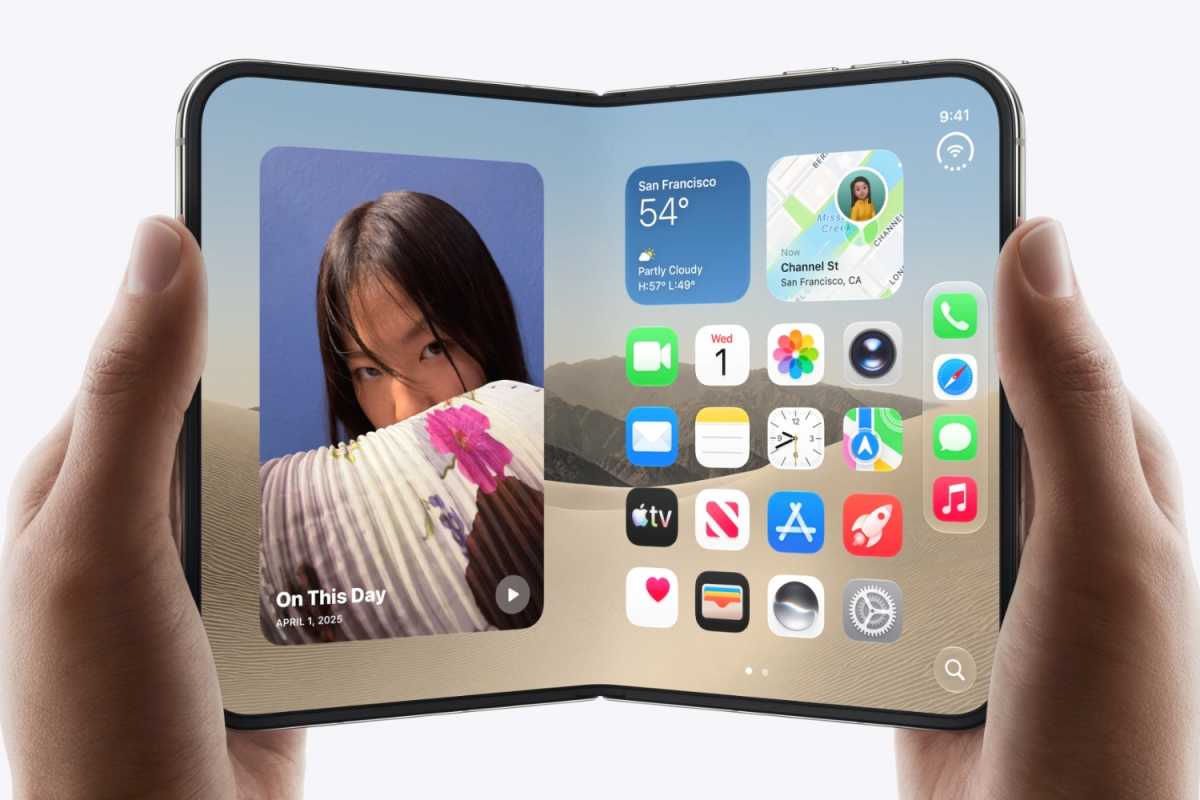
The iPhone Duo opens up like a book.
Apple
The iPhone Duo uses a book-style folding design. Closed, it is unusually short and wide for an iPhone, measuring 84.1mm wide, 117.8mm tall and 11.3mm thick. Open it and the width expands to 164.6mm, while thickness reduces to just 5.2mm, making it Apple’s thinnest iPhone when unfolded (taking that mantel from the iPhone Air). It weighs 254g.
The outer screen measures 5.4 inches, while the folding inner panel measures 7.6 inches. Both are Super Retina XDR OLED displays with ProMotion up to 120Hz, Always-On display support and up to 3,000 nits outdoor peak brightness. The internal display also has a nano-texture surface designed to reduce reflections and make the crease less noticeable.
The frame and hinge cover are made from Grade 5 titanium. Apple uses a mirror-polished finish on the enclosure and a micro-blasted finish on the 3D-printed hinge cover. Ceramic Shield protects the rear, while Ceramic Shield 2 protects the outer display. The phone retains an IP68 rating despite its folding construction.
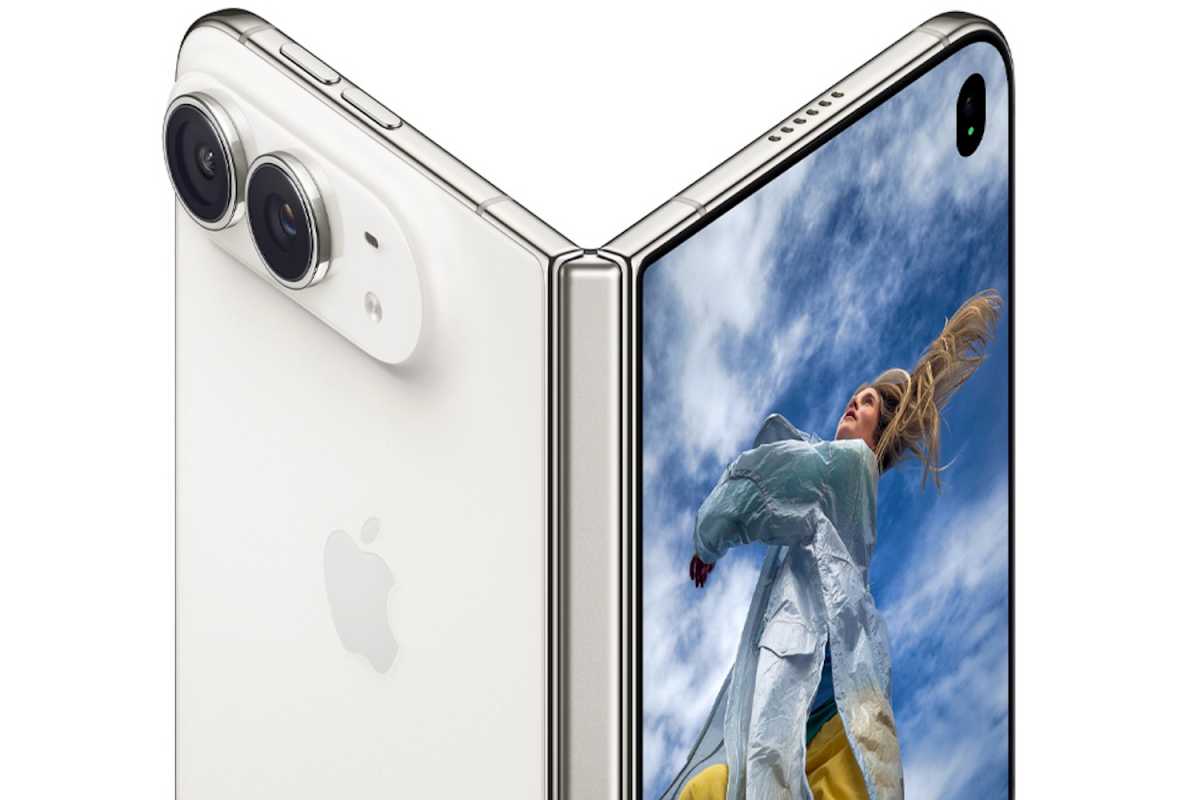
The hinge from the outside.
Apple
There are just two colours: Star White and Night Sky, essentially confirming the pre-event reports of silver/white and a very dark blue.
Action button and Camera Control
There is Camera Control, giving access to exposure, depth, zoom, cameras, styles and tone. It can also launch the new Siri Camera mode.
However, Apple’s Duo doesn’t feature an Action button. The regular iPhone 18 Pro and Pro Max retain both the Action button and Camera Control, so this is one hardware-control compromise of the folding model.
Face ID, Touch ID and the notch
Perhaps the most surprising difference between the iPhone Duo and Apple’s other flagship iPhones is that there is no Face ID.
Instead, Apple has brought back Touch ID, with the fingerprint sensor incorporated into the side button. It works whether the Duo is folded or unfolded, and Apple Watch can also be used to unlock the device. This confirms one of the most persistent pre-launch rumors.
The internal display therefore does not need the TrueDepth sensors used for Face ID. Its FaceTime camera sits beneath the display and disappears when it isn’t being used, giving the inner screen a largely uninterrupted surface.
The inner camera itself is hidden below the display rather than sitting permanently in a visible camera cutout. And yet,despite this and the absence of Face ID, there is still support for Dynamic Island.
iPhone Duo cameras: What cameras does it have?

There are two cameras on the rear.
Apple
The Duo has a 48MP Dual Fusion camera system, comprising:
| Camera | Resolution | Equivalent focal length | Aperture |
|---|---|---|---|
| Fusion Main | 48MP | 26mm | f/1.6 |
| 2x crop from Main | 12MP | 52mm | f/1.6 |
| Fusion Ultra Wide | 48MP | 13mm | f/2.2 |
| Outer front camera | 12MP | — | f/2.2 |
| Inner FaceTime camera | Apple does not specify resolution | — | f/1.8 |
The Duo does not have variable aperture. Variable aperture is exclusive to the 48MP Fusion Main camera in the iPhone 18 Pro and Pro Max.
The biggest camera features for iPhone Duo
Duo Preview
The outer screen can show a live preview while somebody else is being photographed, allowing the subject to adjust their pose and framing.
Smart Take and Kid Cue
Smart Take detects when everybody is ready and automatically captures the shot. Kid Cue uses animations on the outer screen to encourage children to look towards the camera.
Two-screen shooting
The folding design supports unusual shooting configurations, including using the main cameras for selfies or group photos while seeing the composition on the other screen. Duo FaceTime can also put nearby participants onto the outer display.
Other notable camera features include 48MP macro photography, a 2x optical-quality crop from the Main camera, an under-display inner FaceTime camera, Dual Capture for simultaneous front-and-rear video, and 4K Dolby Vision recording at up to 120fps.
Rear cameras
The 48MP Fusion Main has an f/1.6 aperture, sensor-shift stabilization and can shoot 24MP or 48MP images. It also provides a 12MP, 2x optical-quality crop equivalent to a 52mm lens.
The 48MP Fusion Ultra Wide has a 13mm-equivalent lens, f/2.2 aperture and 120-degree field of view. It also supports 48MP macro photography and is the same Ultra Wide camera used by the iPhone 18 Pro family.
That means the Duo does not match the iPhone 18 Pro and Pro Max camera system. Those phones add a dedicated 48MP Fusion Telephoto and variable aperture on the Main camera, making the Pro models much more flexible for photography despite costing substantially less.
Pre-event reports were divided between a Main + Telephoto and Main + Ultra Wide arrangement. Apple ultimately chose Main + Ultra Wide, confirming the earlier reports that a dedicated telephoto could be sacrificed to save space.
Front cameras
On the outside is a 12MP Center Stage camera with an f/2.2 aperture. It supports Center Stage, automatic portrait/landscape framing, Dual Capture, Photonic Engine, Deep Fusion, Smart HDR 5 and 4K Dolby Vision video at up to 60fps.
Inside is an under-display FaceTime camera with an f/1.8 aperture. Apple does not specify its megapixel resolution. It supports Center Stage for video calls and records at up to 1080p/60fps. Its major advantage is visual rather than photographic: the camera effectively disappears beneath the display when it isn’t being used.
iPhone Duo video features
The Main camera records 4K Dolby Vision at 24, 25, 30, 60, 100 or 120fps, with 4K/120fps also available for slo-mo. Cinematic mode reaches 4K/60fps and Action mode up to 2.8K/60fps. Dual Capture can record at up to 4K/30fps.
Apple’s specifications also do not list ProRes or Apple Log recording for the Duo. Those remain more Pro-oriented capabilities rather than part of Apple’s foldable camera proposition.
The Duo does support Spatial Audio recording, Audio Mix, Dolby Vision HDR and Apple’s computational photography features including Photonic Engine, Deep Fusion, Smart HDR 5, Photographic Styles 3, smart focus tracking and Apple Intelligence-powered editing.
Apple does not list conventional Spatial Video capture in the Duo specifications.
iPhone Duo processor: What processor does it use?
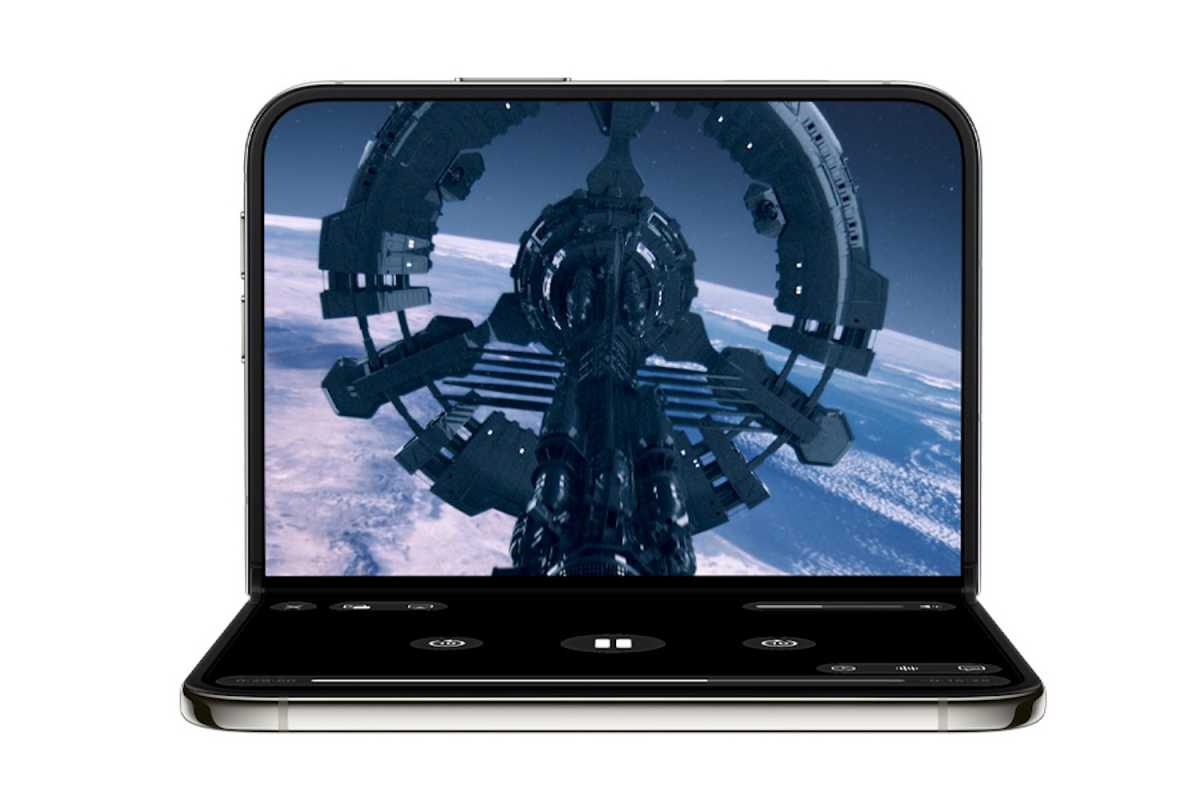
Watch video on the screen.
Apple
The iPhone Duo uses the A20 Pro, the same processor as the iPhone 18 Pro and Pro Max.
It is manufactured using a 2-nanometer process, a major step forward in transistor density and efficiency. Apple combines it with a new chip packaging design inspired by its M-series Mac processors. The package connects the A20 Pro directly to a custom vapor chamber to transfer heat away from the processor more effectively.
The A20 Pro includes:
- 6-core CPU: two super cores and four efficiency cores
- 7-core GPU with Neural Accelerators
- Dual 16-core Neural Engine
- Hardware-accelerated ray tracing
- A dedicated display engine capable of operating both Duo displays
Compared with the A19 Pro, Apple says the CPU is up to 20 percent faster, while the GPU is up to 40 percent faster and more power-efficient. The Dual 16-core Neural Engine delivers twice the compute power, while unified-memory bandwidth rises by 50 percent.
Apple also claims that the complete thermal system gives the Duo up to 35 percent better sustained performance than the iPhone 17 Pro. That sustained-performance figure is particularly important for a folding device because prolonged gaming, multitasking and AI workloads generate considerably more heat than short benchmark bursts.
iPhone Duo RAM: How much memory does it have?
Apple has not disclosed how much RAM is inside the iPhone Duo.
Before launch, supply-chain reports consistently pointed to 12GB of RAM, which would make sense given the demands of running two displays, simultaneous applications, Siri AI and larger on-device AI models. However, until teardowns or diagnostic tools confirm the figure, 12GB should remain labelled as a rumor rather than an official specification.
Apple does reveal that A20 Pro has 50 percent more unified-memory bandwidth than A19 Pro, which should help the Duo move data more quickly between the CPU, GPU and Neural Engine.
Extra memory is particularly useful on the Duo because iOS 27 can display multiple apps simultaneously and because Apple Intelligence and Siri AI increasingly run generative models locally rather than relying entirely on cloud processing.
iPhone Duo connectivity
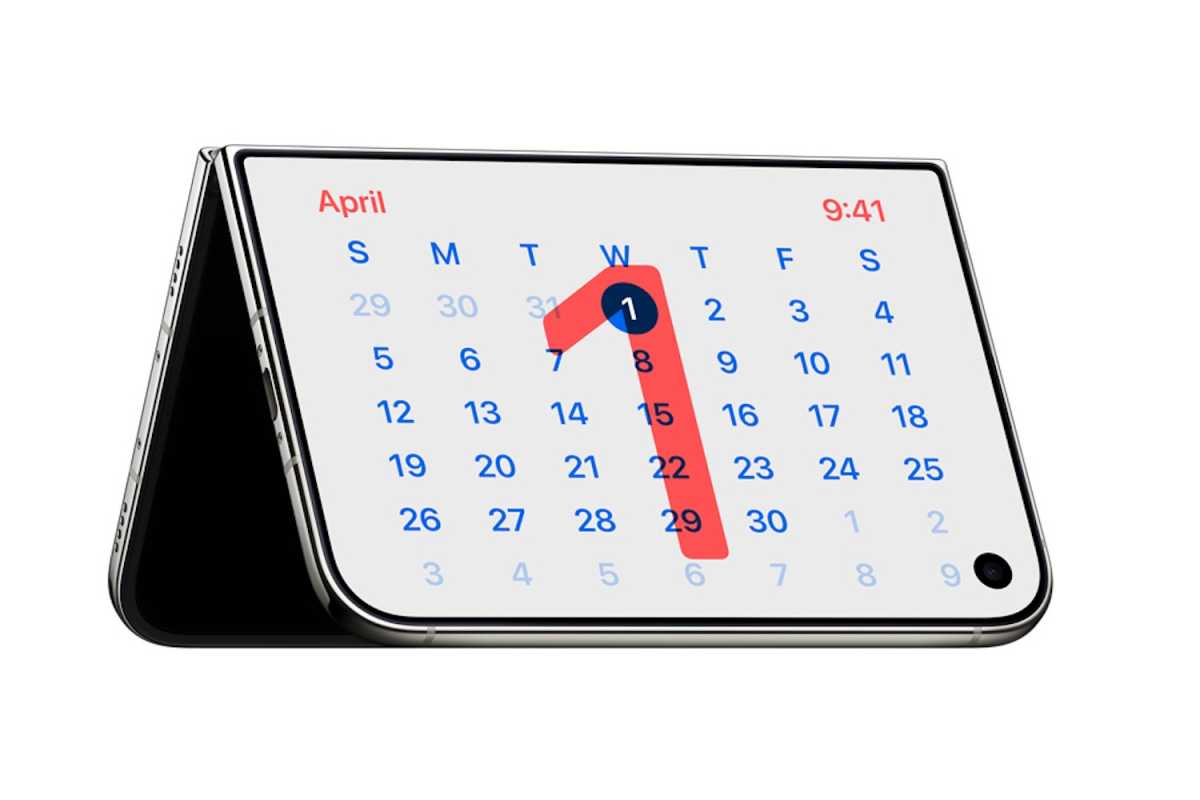
An expensive desk calendar.
Apple
Apple has put a significant amount of its own communications silicon into the iPhone Duo.
It uses Apple’s new C2 cellular modem, replacing Qualcomm silicon. Apple says C2 introduces AI-powered improvements to cellular quality and reliability and supports mmWave 5G in the U.S.
The N1 wireless networking chip provides:
- Wi-Fi 7 with 2×2 MIMO
- Bluetooth 6
- Thread networking
The Duo also has Apple’s second-generation Ultra Wideband chip, NFC and precision dual-frequency GPS.
It is eSIM-only worldwide, something that had been widely rumored before launch. Eliminating the SIM tray gives Apple additional internal space for its batteries.
Satellite capabilities include:
- Emergency SOS via satellite
- Roadside Assistance via satellite
- Find My via satellite
- Messages via satellite
Battery, MagSafe and charging: What’s available?
Instead of one battery spanning the body, the iPhone Duo contains two rechargeable lithium-ion batteries, with one high-energy battery fitted into each half of the device. Apple’s energy-balancing algorithms make them operate as a single battery system.
Apple rates battery life at:
- Up to 24 hours of typical use
- Up to 44 hours video playback using the outer display
- Up to 31 hours using the inner display
- Up to 37 hours streamed video on the outer screen
- Up to 26 hours streamed video on the inner display
Apple has not disclosed the batteries’ combined capacity in mAh. The pre-launch rumor of approximately 5,000-5,500mAh therefore remains unconfirmed.
Wired charging can take the Duo to 50 percent in around 20 minutes with a 60W-or-higher USB-C adapter.
Despite earlier uncertainty, MagSafe is supported, with wireless charging at up to 25W. Qi2 charging also reaches 25W. Apple says a 35W-or-higher adapter and MagSafe charger can bring the battery to around 50 percent in approximately 30 minutes.
iPhone Duo price: How much does it cost?
The iPhone Duo starts at $1,999 in the U.S. and £1,999 in the U.K. for 256GB.
Prices are:
| Storage | Storage |
|---|---|
| 256GB | $1,999/£1,999 |
| 512GB | $2,199/£2,199 |
| 1TB | $2,599/£2,599 |
| 2TB | $3,199/£3,199 |
The 256GB starting capacity means Apple has not created an unusually low-storage entry model simply to make the headline price look lower.
iPhone Duo vs iPhone 18 Pro pricing
The iPhone 18 Pro starts at $1,199/£1,199, while the iPhone 18 Pro Max starts at $1,299/£1,299. That makes the Duo approximately $700/£700 more expensive than the Pro Max at entry level.
That premium buys the folding display, precision hinge, titanium structure, second screen and more complex dual-battery design rather than superior cameras: in several areas the iPhone 18 Pro models are actually better equipped.
Reports before the launch suggested the Duo could cost anywhere from around $1,999 to $2,399 at entry level, largely because of the folding OLED display, hinge mechanism, titanium components and other expensive parts. Apple ultimately landed at the very bottom of those predictions.
iPhone Duo vs iPhone 18 Pro pricing
The iPhone 18 Pro starts at $1,199/£1,199, while the iPhone 18 Pro Max starts at $1,299/£1,299. That makes the Duo approximately $700/£700 more expensive than the Pro Max at entry level.
That premium buys the folding display, precision hinge, titanium structure, second screen and more complex dual-battery design rather than superior cameras: in several areas the iPhone 18 Pro models are actually better equipped.
Reports before the launch suggested the Duo could cost anywhere from around $1,999 to $2,399 at entry level, largely because of the folding OLED display, hinge mechanism, titanium components and other expensive parts. Apple ultimately landed at the very bottom of those predictions.
Should you buy the iPhone Duo?
The iPhone Duo is the iPhone to buy if you genuinely want a phone and small tablet in one device. Its 7.6-inch display, multitasking features, A20 Pro performance and clever fold-specific camera modes offer capabilities no other iPhone has.
But at $1,999/£1,999 it is enormously expensive, and there are significant compromises: no Face ID, no dedicated telephoto camera, no variable aperture and no Action button.
For photography, battery life and conventional everyday use, the iPhone 18 Pro Max is likely to be the better-value flagship. Buy the Duo because you want the folding experience, not because it is simply the “best” iPhone.