At a glance
Expert’s Rating
Pros
- Crazy-fast performance
- Better cooling performance
- A “pro” camera that finally feels like it
Cons
- The price went up
- There are no major new features
- The design is the same
Our Verdict
It’s hard to get excited about a new iPhone that is just “the same thing but faster and with a slightly better camera,” especially when the iPhone Duo was announced at the same time. But the impressive A20 Pro performance and efficiency really help make this the iPhone Pro to beat all others.
Price When Reviewed
This value will show the geolocated pricing text for product undefined
Best Pricing Today
The iPhone 18 Pro is just like last year’s iPhone, but faster and with a slightly better camera. That’s it.
Back in the early iPhone days, we would call this an “S” model, because a year after the iPhone 4, there was the iPhone 4s. A year after the iPhone 5, the 5s. After the 6, the 6s. And each one was physically identical to its predecessor, but faster and with a somewhat better camera.
If you wanted to think of this as the iPhone 17 Pro S, you’d be spot on.
The thing about those “S” models is that, while they were kind of boring, they were still the best iPhones. So is it with this year’s model—there’s no incredible new feature or design change to get excited about, but that “same but better” formula results in one of the best iPhones in a long time.
The iPhone 17 Pro, but better
Last year, Apple introduced a new Cosmic Orange color for iPhone 17 Pro that shocked everyone with its boldness. It was an instant hit.
So it’s a little disappointing that the only thing visually different about the iPhone 18 Pro is that they got rid of Cosmic Orange and replaced it with Burgundy. Which is a fine color, but it’s no Cosmic Orange. There’s a black and a silver this year, along with a new pale blue called Glacier.
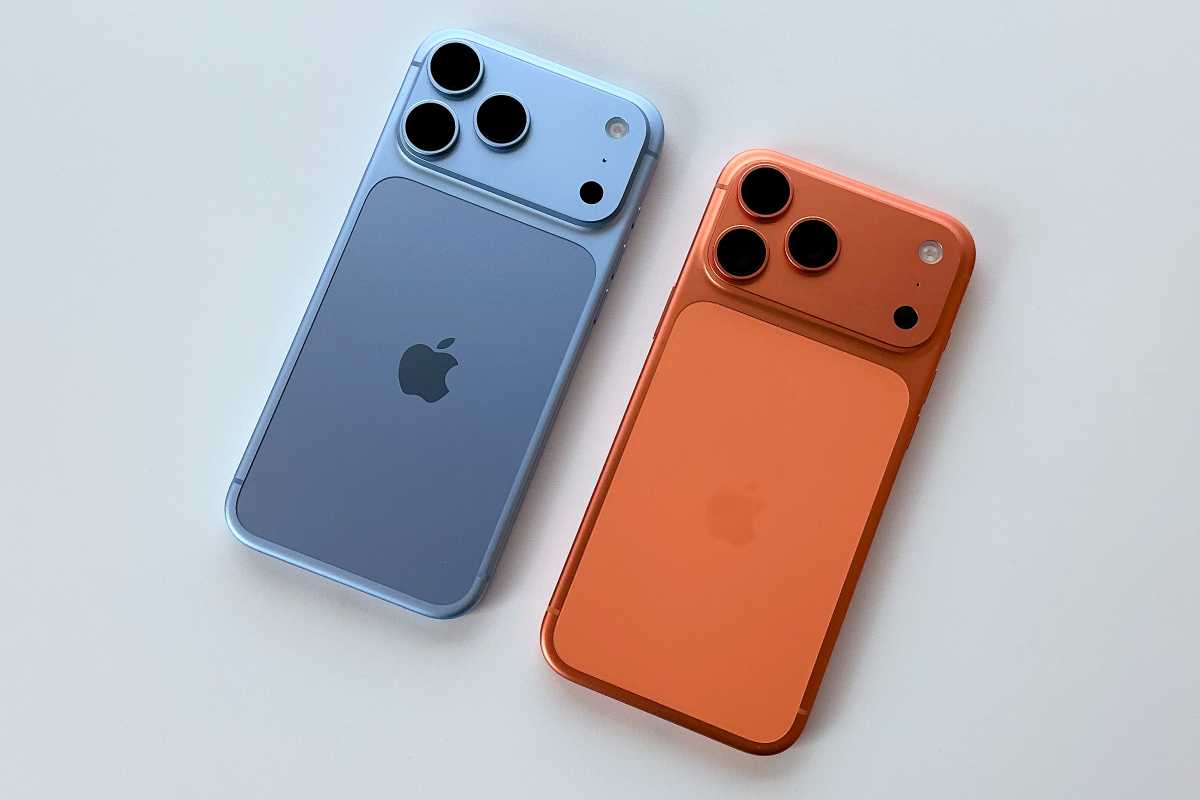
The iPhone 18 Pro, show in Glacier blue, is much more subdued than the ultra-bright 17 Pro
Foundry
Beyond the colors, you’d be hard-pressed to notice a difference between last year’s pro iPhones and this year’s. They have the same dimensions, though this year’s phones are just a touch heavier. They’re so similar that some cases for the iPhone 17 Pro or Pro Max will fit the iPhone 18 Pro or Pro Max just fine. Certain other cases fit poorly because the camera plateau is about a half-millimeter taller on the new phones; it all depends on the design of the case.
You’ll also notice, when the iPhone is on, that the Dynamic Island cutout is just a little smaller, which leaves enough room for two dynamic activities to be tracked at once. Apple moved the IR sensor used with Face ID under the display and off to the side, behind a row of pixels with some sub-pixels removed and others made brighter to compensate. You can’t see it at all, and in my testing it seems to work just fine. But I also haven’t really found the smaller Dynamic Island has changed things much for me, either.
It’s what’s on the inside that makes the 18 Pro special: a new processor system and some camera improvements.
iPhone 18 Pro: A20 Pro performance
The A20 Pro is Apple’s first chip built on a 2nm process, and it’s seriously impressive. It’s not just the chip itself that makes the difference here; it’s what we might call the A20 Pro system. It involves a new packaging technique that puts the RAM off to the side of the chip for better cooling and an all new vapor chamber…also for better cooling.
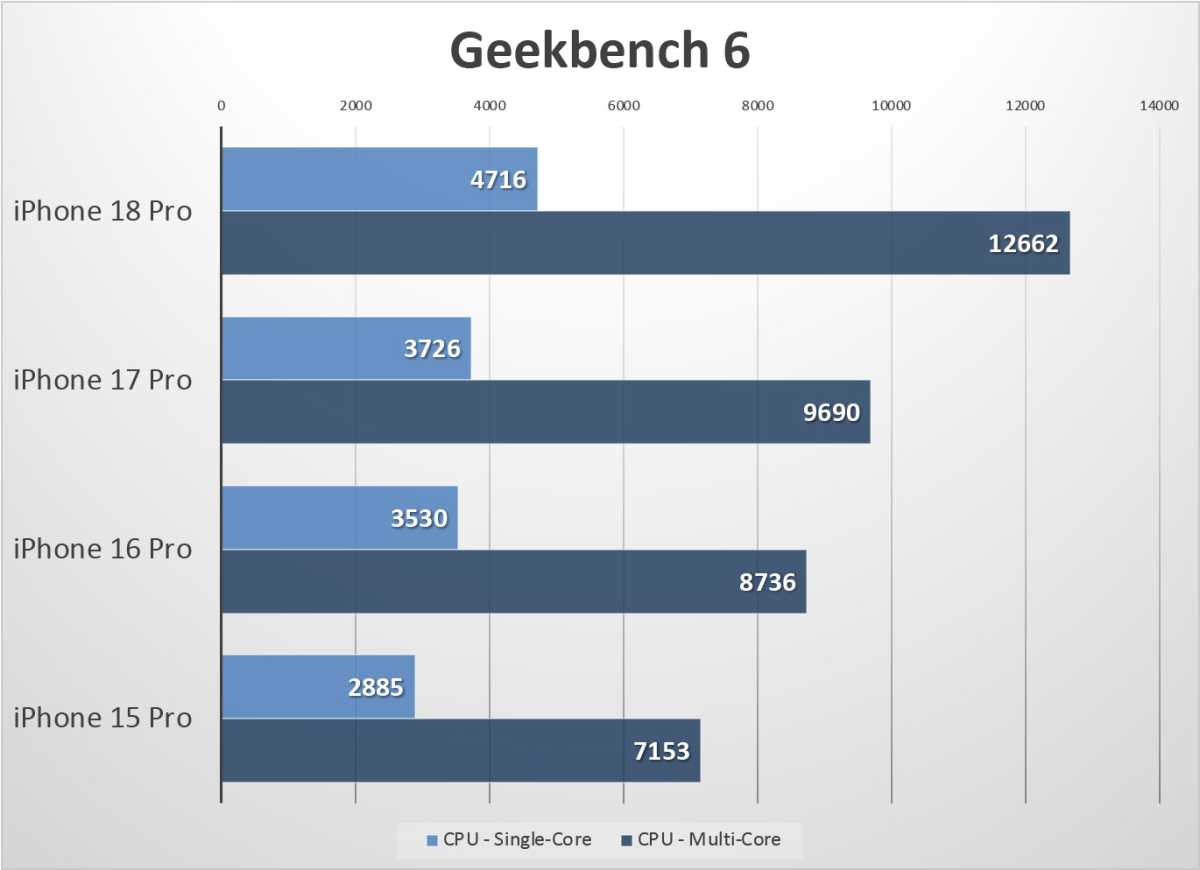
It’s still a six-core CPU, but both the “Super” cores and the efficiency cores are improved, and the memory bus is 50 percent wider, providing 50 percent more bandwidth. The GPU is 7 cores, up for 6 in the A19 Pro, and also features architectural improvements. Take a look at these numbers.
Foundry
In the older Geekbench 6 test, single-core performance jumps an impressive 26 percent. The multi-core score is up even more at 30 percent higher. That’s a crazy jump for one year.
Foundry
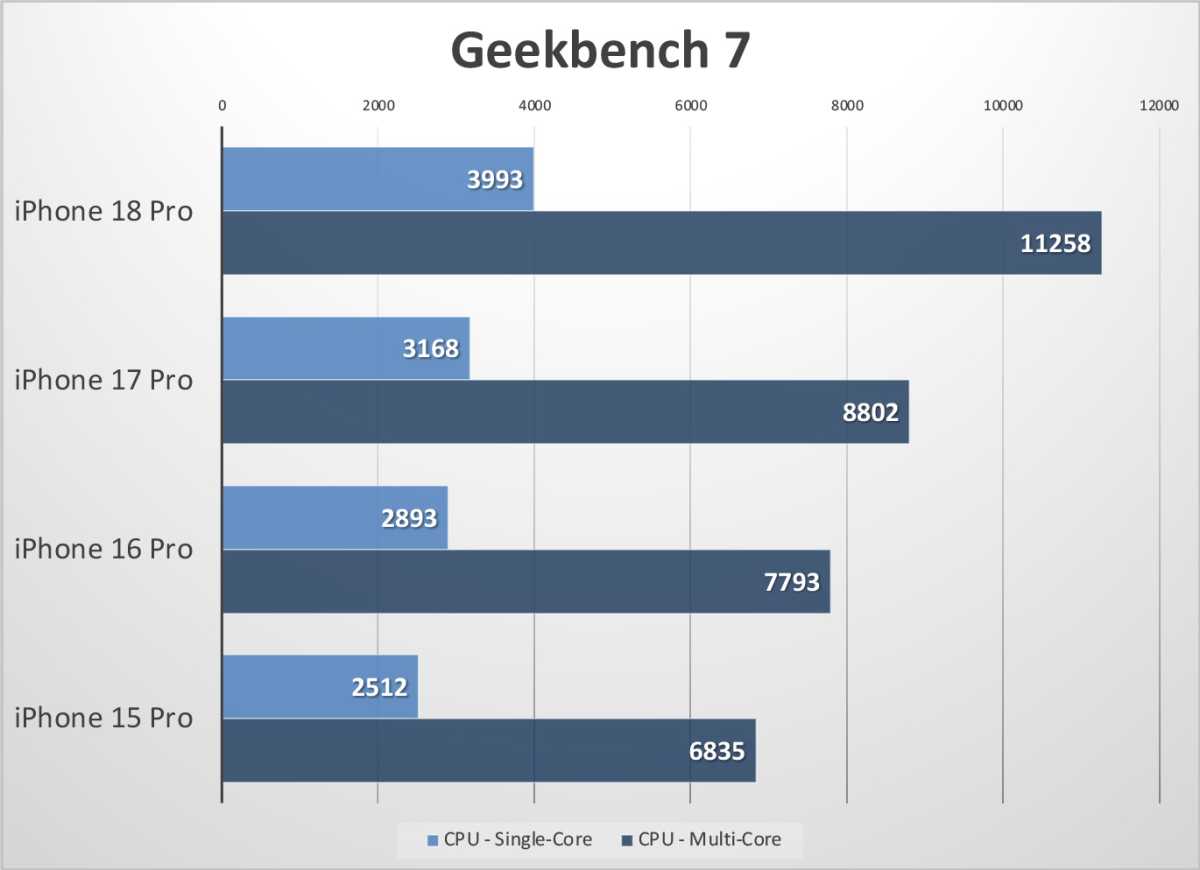
The more modern Geekbench 7 tests are also more strenuous, but the results are the same: a single-core score is 26 percent higher and a multi-core score is 28 percent higher.
Apple calls its big cores “desktop class” and that’s not just hype. This is single-core performance that is higher than an M5 and multi-core performance equal to an M3. In your phone. In your pocket. To put this CPU performance in context, this is a single-core score that beats the best Ryzen or Intel Core i7 desktop CPUs without exotic overclocking, and a multi-core score in the same range as most 8-core desktop CPUs from two or three years ago.
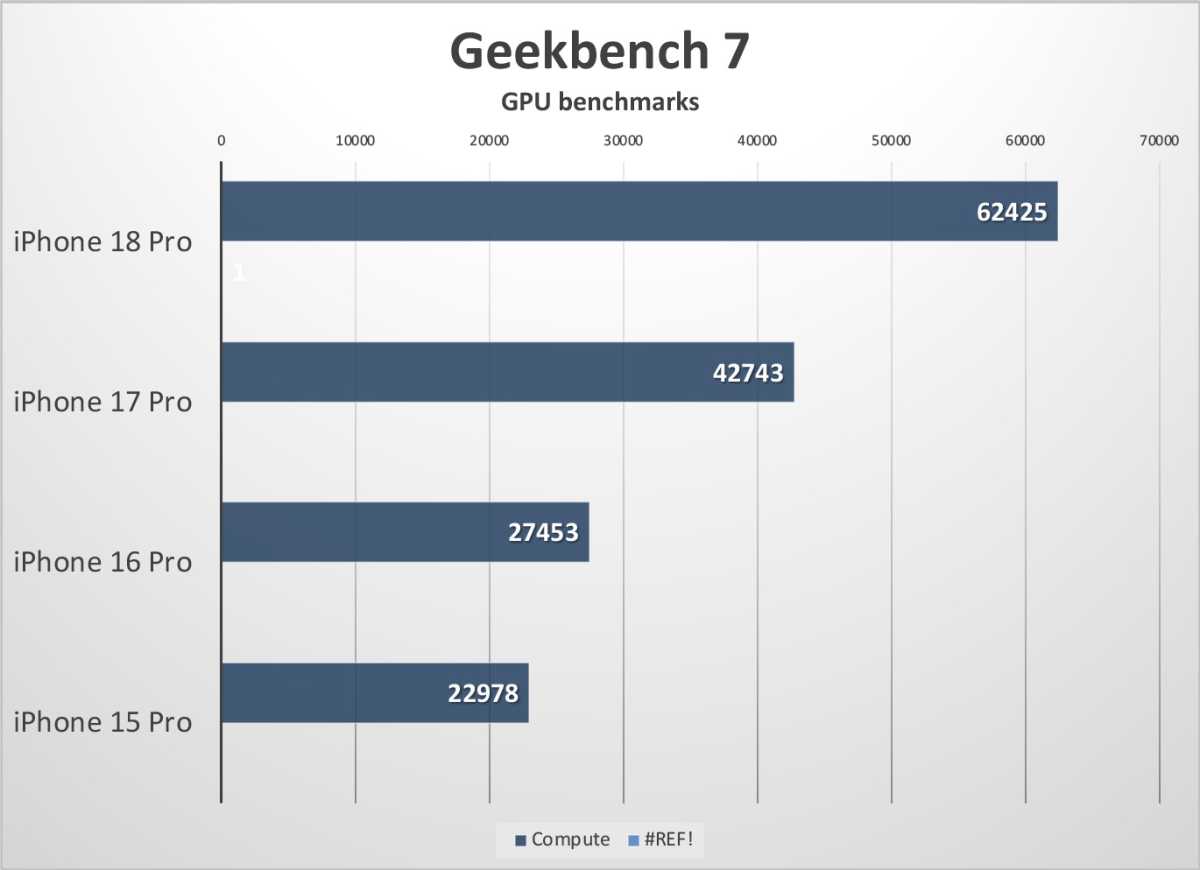
As impressive as the CPU is, the GPU seems to get an even bigger speed boost. Let’s take a lot at GPU performance for computational tasks (image segmentation, horizon detection, blurring backgrounds, face detection, and so on) using Geekbench 7’s GPU test.
Foundry
A 46 percent jump in GPU compute performance in a single year? It seems unthinkable, but Apple increased memory bandwidth by 50 percent and that is often a bottleneck for all kinds of graphics performance. For context, an M4 Mac scores around 54,000 in this test—13 percent slower. This is performance somewhere in-between the M1 Pro and the regular M5. In your pocket.
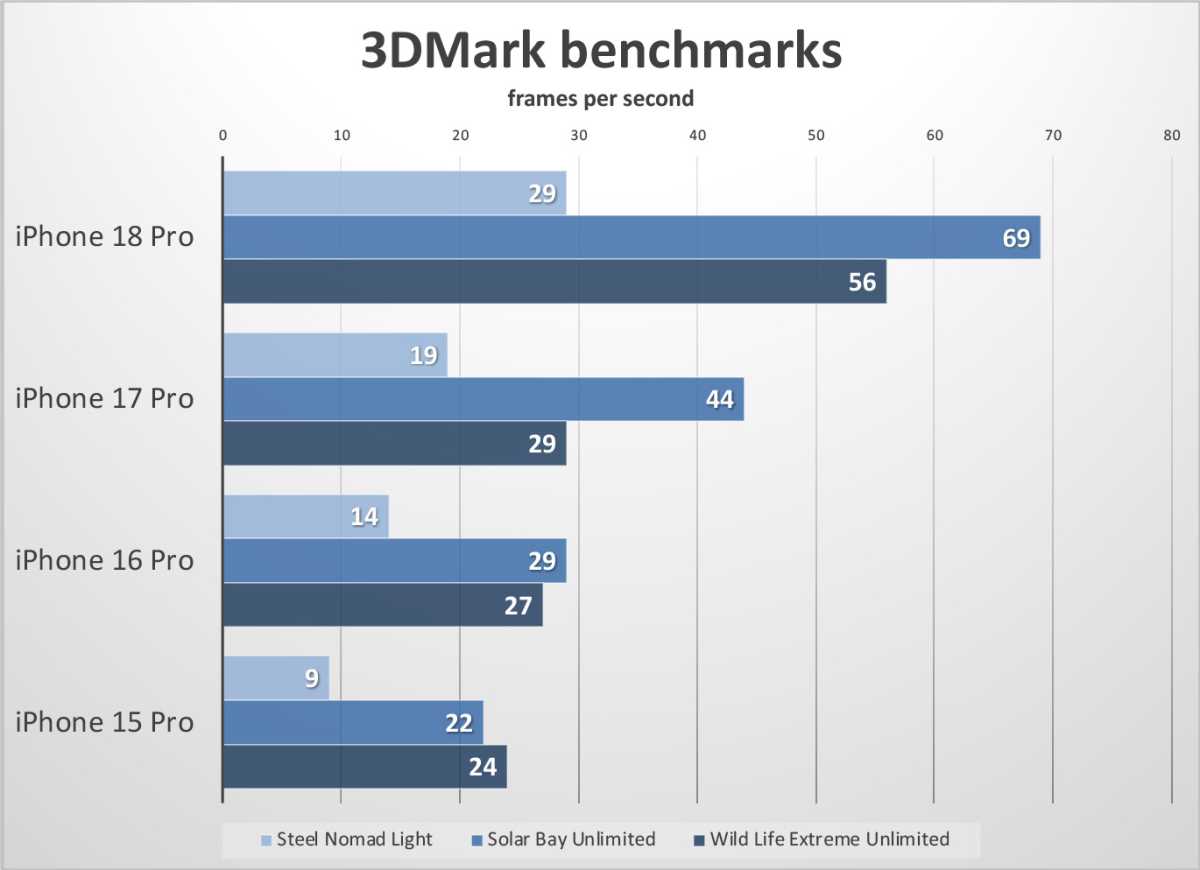
But that’s GPU compute. Surely when it comes to rendering complex 3D graphics like the kind used for high-end games, and stressing the CPU at the same time, the improvement isn’t as big? Think again.
Foundry
Through several generations of 3DMark real-time graphics benchmarks, we see massive improvements with the A20 Pro. The relatively simple Wild Life Extreme test is 93 percent faster, almost twice as fast! The Solar Bay benchmark stepped up complexity and added some ray tracing elements, and the A20 Pro is 57 percent faster that last year’s A19 Pro. Steel Nomad Light is the heaviest test, though it doesn’t feature any ray tracing. It’s 53 percent faster.
This is graphics rendering performance that is faster than the M4 an an iPad Pro and almost as fast as an M5. Spot-checking with actual games, which are harder to benchmark in a deterministic fashion, we see a lot of the same results. Most games either just lock at 60 frames per second, or they’re anywhere from 40 percent faster to almost twice as fast.
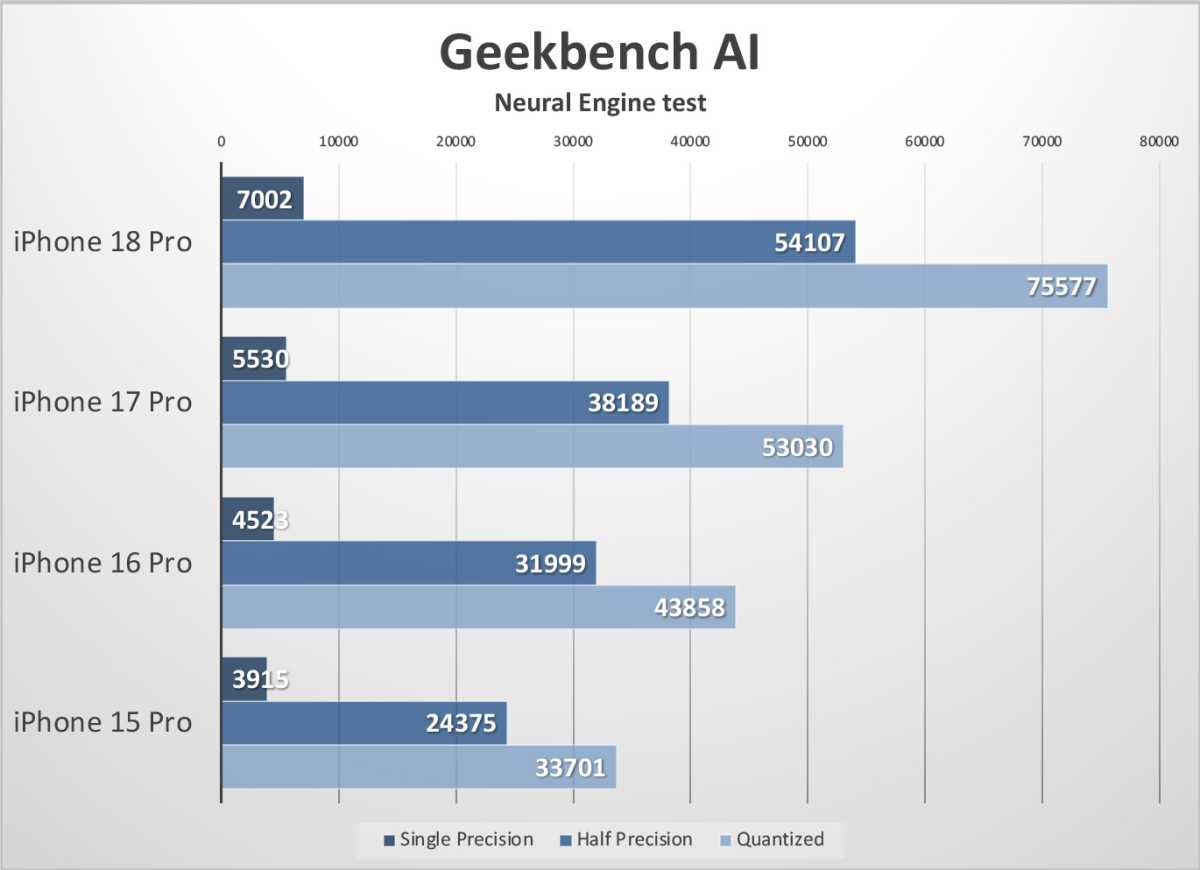
The Neural Engine is more difficult to test, but the Geekbench AI benchmark affords us the ability to get a look at running machine learning routines on the Neural Engine alone if we want.
Foundry
Most of the ML/AI code that runs on neural processing units (NPUs) are the lighter half-precision and quantized routines that demand quick results in a power-efficient way. The new Neural Engine has double the cores and runs these sorts of tasks more than 40 percent faster. Apple’s been steadily improving Neural Engine performance for years, but we usually see a 20-30 percent boost, not this.
Again, this is desktop-class stuff. An M5 doesn’t deliver scores like this, even. Apple doubled the Neural Engine cores in the M6, though, and that manages to pull ahead of the A20 Pro.
I’ve been testing and reviewing consumer tech for over 20 years, from early DIY gaming PCs through mobile technology and beyond. I’m not easily impressed by a year-over-year performance improvement. But the A20 Pro has me genuinely shocked. Single-core, multi-core, GPU, Neural Engine…it’s all drastically faster than the A19 Pro, which was already at the top of its class. In test after test, the A20 Pro delivers results that equal desktop-class chips of the sort you’d find in thin-and-light laptops bought in the last year or two.
iPhone 18 Pro: Camera improvements
For all the “pro” features Apple has added to the Pro iPhone cameras over the years — ProRAW photos, ProRES video, Dolby Vision, Genlock syncing, and so on — the actual photo-taking experience has felt decidedly point-and-shoot. If you wanted to take real control over your shots, you’d have to ditch the default Camera app and use a third-party app such as Halide or Blackmagic Camera.
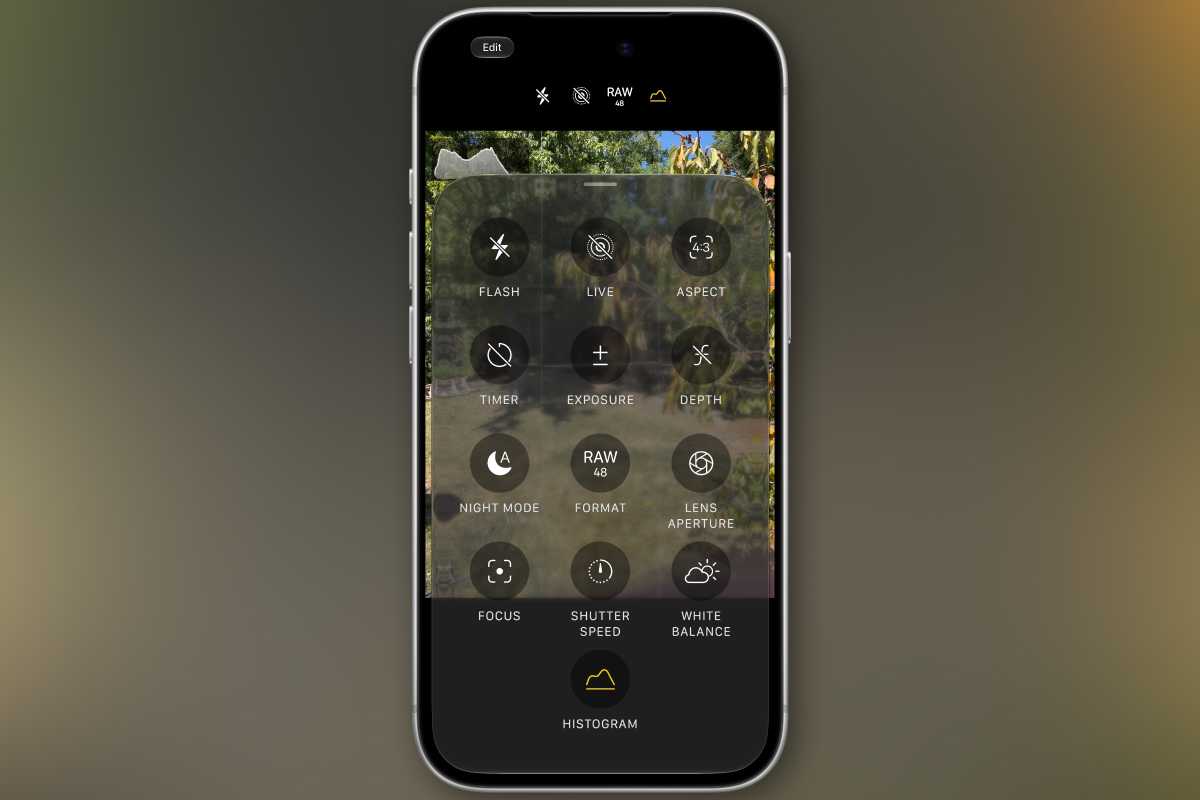
This year, Apple has finally added what it calls “Pro controls” to the Camera app, which eliminates the need to use one of those apps for most photographers that want more than point-and-shoot style control. You get menus to adjust white balance, focus distance, shutter speed, and lens aperture, and can display a real-time histogram.
Foundry
It’s hard to believe that it took Apple this long to provide these basic manual controls, at least for the “Pro” iPhones. And it should be a scandal that they’re only available on the iPhone 18 Pro and Pro Max, instead of coming as a software update to earlier Pro models. There’s nothing about any of these controls, save for the aperture setting, that need to be exclusive to this year’s models. And indeed, most of them are alredy available on third-party apps.
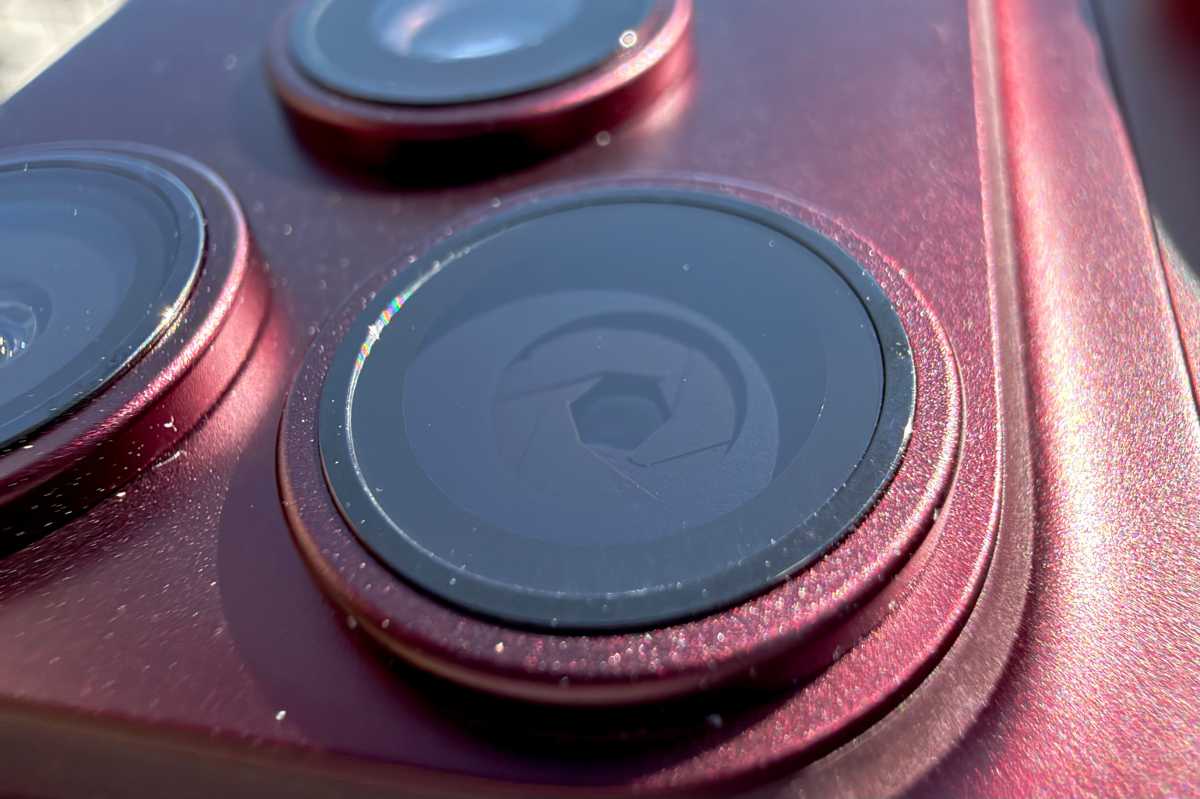
About that aperture setting. It’s true, the main camera (and only the main camera) now has an adjustable physical aperture. It only has four settings: f/1.48, f/1.8, f/2.8, and f/4. It defaults to f/1.8, which is a similar aperture wideness to earlier iPhones, and performs about the same. But it’s neat to see it move!
Foundry
The f/1.48 is wider and lets in more light, so it kicks in during low-light scenes, but an aperture that wide on a sensor this small results in slightly less sharp photos. So it wouldn’t be a good setting for a fixed-aperture lens on other iPhones, but it’s nice to have in a pinch.
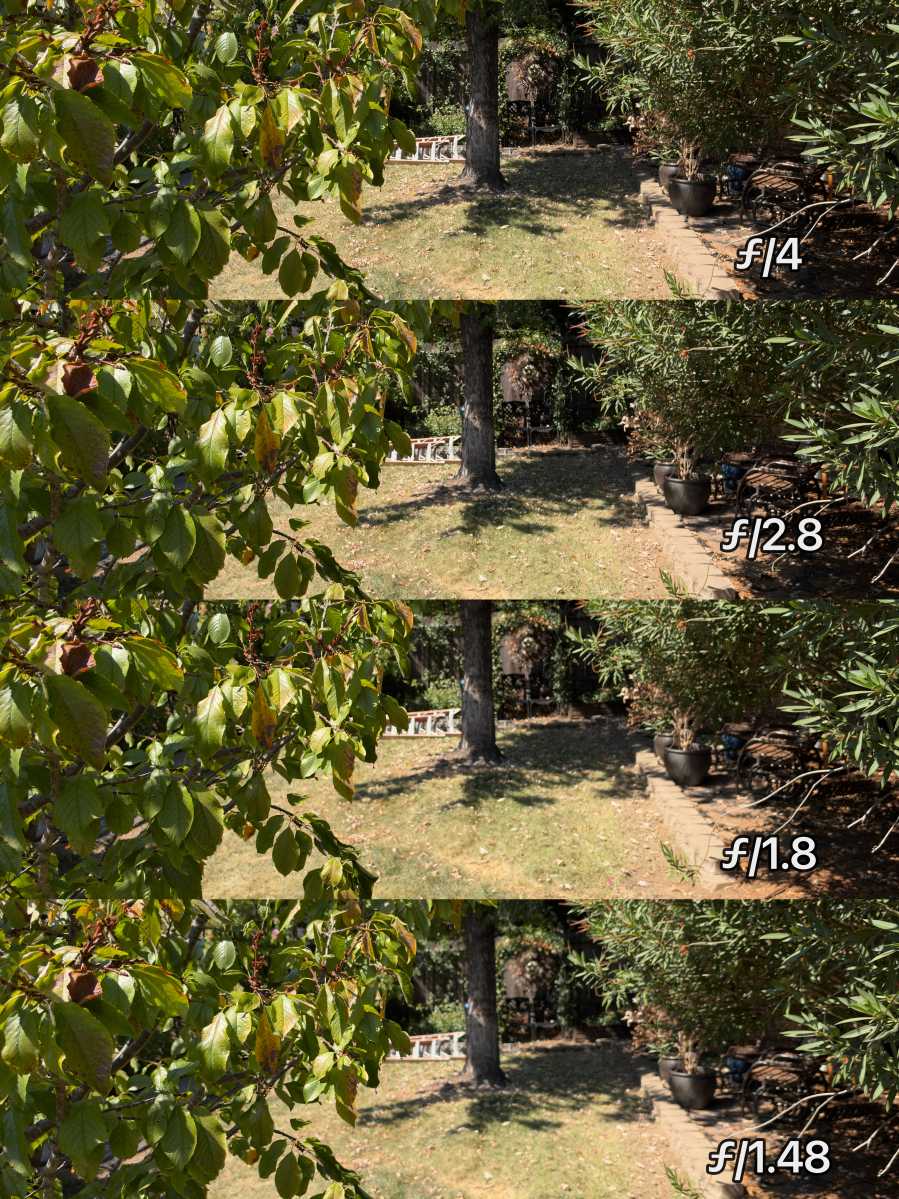
Moving up to higher f-stop numbers makes the aperture smaller, which lets in less light and is more appropriate for bright daytime photography. It also makes the focus depth longer, so more of the background is in focus.
Foundry
Here’s an example. Focusing on the tree in the foreground, you can see the ladder in the background get a bit sharper as the aperture gets smaller. The effect is not dramatic; small sensors are less responsive to this sort of thing, and a maximum F-stop of 4 is still pretty wide. Most full-frame cameras have a maximum F-stop of at least F/16 or F/22.
Users have complained for years now that Apple’s more recent image processing pipelines tend to make photos look worse than they did on older phones. The chief complaint seems to be oversaturation of colors and tone and a “plastic” effect that loses all grain and texture.
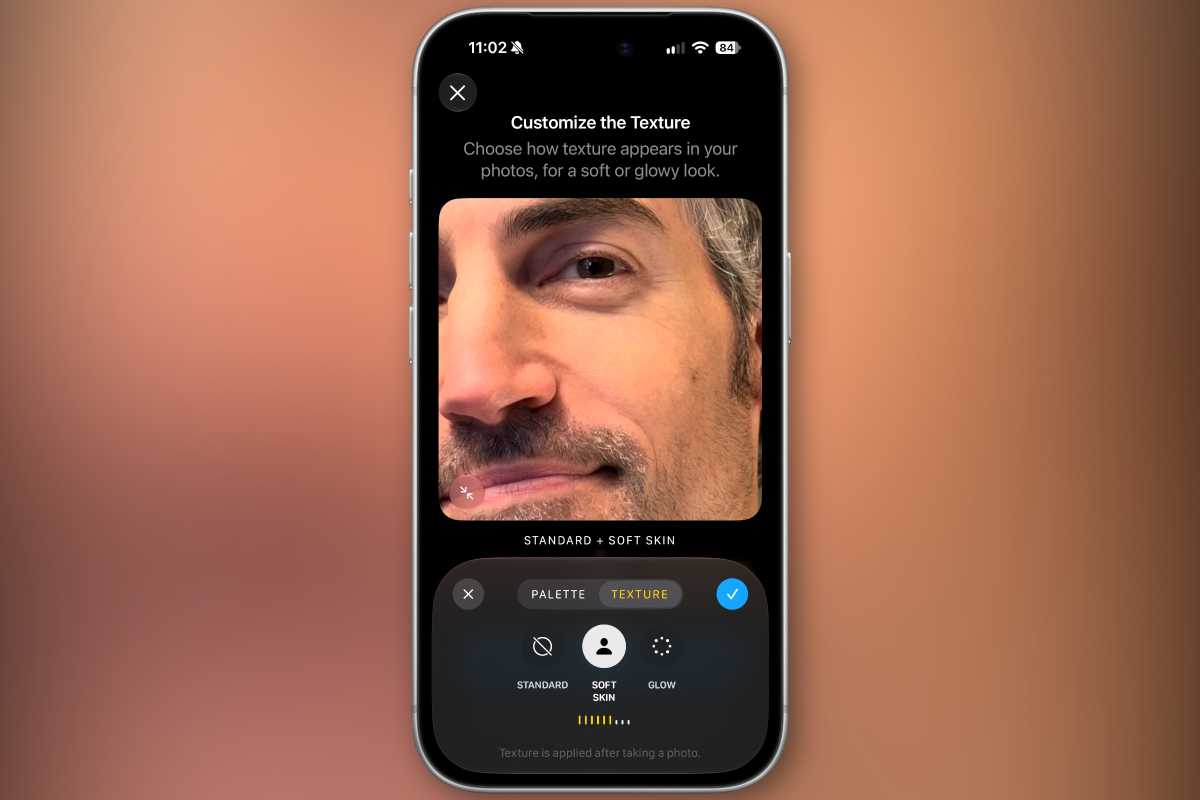
This year, Apple has tweaked its Photographic Styles setup yet again to give users more control over color temperature and tone. New this year is a “texture” setting that lets you increase or decrease fine texture detail or adjust the amount of skin smoothing or brightening.
Foundry
It’s another good attempt to bring some authenticity and humanity back into photos that, by their very nature, are very processed. I like it, but I think Apple may have been better off paying attention to the “Process Zero” fad sweeping the third-party camera apps lately, and provided a similar control of its own. Just a one-button, “minimal processing” setting that turns off all the AI help and gives you an authentic image, warts and all.
There a couple of other new tricks. A smart focus tracking feature lets you tap on an object and the focus will follow it as it moves. And Apple Reference Image, which signs individual pixels of the image and makes the original available all the time, to verify it has not been edited. You have to turn that on in Settings > Camera > Apple Reference Image, and then you have to take photos using the new Reference mode that appears. I suspect it won’t be used much outside of photojournalism.
Apple’s big advancement this year, the variable aperture camera, is a bit of a letdown. There’s just not enough aperture range for it to make a big difference with this small sensor. The new software controls, on the other hand, are very welcome and most of them should have been included on the Pro phones years ago. As much as I appreciate their inclusion in the standard Camera app today, I find it frustrating that Apple limits them to the iPhone 18 Pro for no good reason.
iPhone 18 Pro: Battery, charging, and thermal improvements
The A20 Pro’s performance is off-the-charts good, but it doesn’t suffer from poor efficiency at all. Quite the opposite.
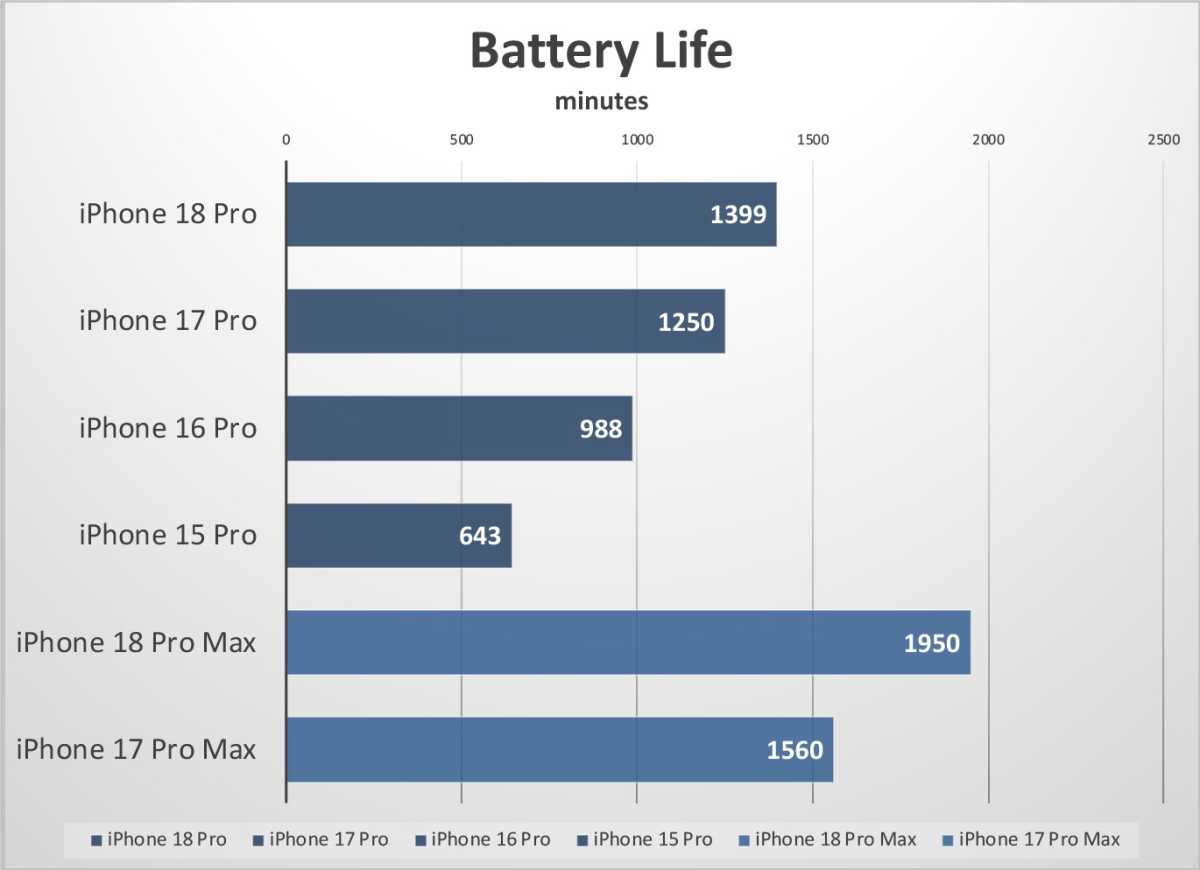
I used Geekbench 4’s battery benchmark, which runs sporadic tests in the background to keep the processor busy. It’s a more realistic and repeatable test than a typical video playback benchmark. (Dear Primate Labs: Please incorporate a new battery test in Geekbench 7!) I kept the display fixed at 200 nits of brightness, which is about midway on the brightness slider, and turned off all dynamic brightness and low-battery mode features.
Foundry
We’re looking at a 12 percent increase in battery life from last year’s model. The iPhone 18 Pro Max, which is identical in every way except size and battery, lasts an impressive 25 percent longer than the iPhone 17 Pro Max. It really is impressive to see how far iPhone battery life has come in just a few years. In three generations, Apple has more than doubled the real usable battery life of the iPhone Pro models.
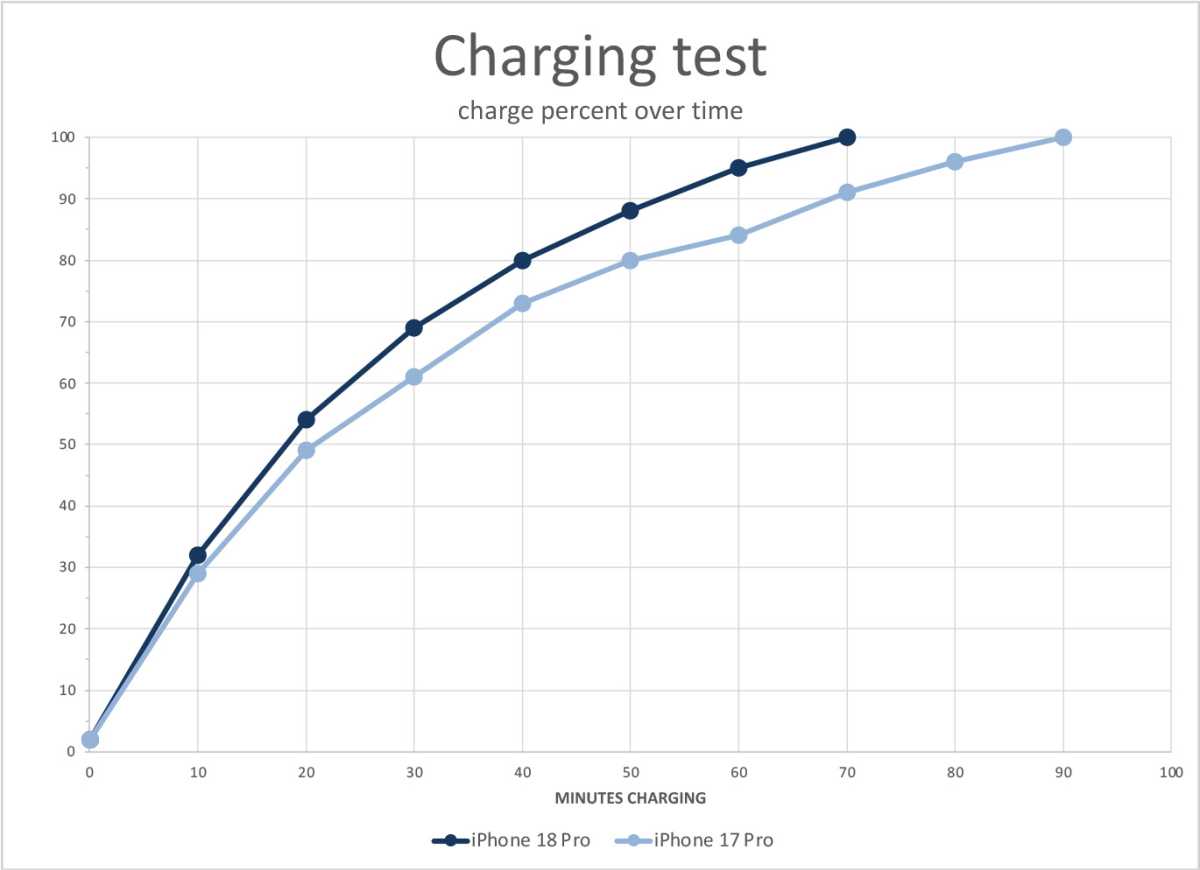
It has sort of flown under the radar, but Apple improved charging speed this year as well.
Foundry
The iPhone 18 Pro charges at a little bit higher rate from 0-80 percent, then sort of flatlines at around 10W or less for the rest of the charge curve. This gets it to 50 percent a few mintues faster than the iPhone 17 Pro, to 80 percent about 10 minutes faster, and to 100 percent almost 20 minutes faster.
It’s not a huge improvement, and it’s not as fast as the very fastest-charging Android phones, but it’s a noticeable improvement all the same.
Apple has made a big deal out of its new thermal solution, with a much bigger vapor chamber and a new chip packaging technique that moves the RAM to the side so it and the processor can be cooled more effectively. It’s a difficult thing to reliably test, but I can say from a year of experience with the iPhone 17 Pro that the iPhone 18 Pro definitely gets less hot. Playing certain games, recording extended video, and other long-term intensive tasks would often make the iPhone 17 Pro rather hot to the touch. I can’t claim that the 18 Pro stays cool in these same situations, but the heat buildup is very obviously less.
Should you buy an iPhone 18 Pro?
The iPhone 18 Pro could truly be called the iPhone 17 Pro S. It looks and acts the same as last year’s flagship. The only really new features are a variable aperture feature that doesn’t really make that much of a difference and some really welcome Camera app upgrades that have been available in third-party apps for years, and have no real business being locked to the new phone.
The A20 Pro is a revelation. It’s a high high water mark for mobile performance and efficiency, with real speeds that push into laptop territory and even longer battery life than the very good battery life of last year’s iPhone. It’s a year-over-year performance leap we almost never see anymore.
But it doesn’t enable anything new. The phone looks the same, and most of the features are the same. There’s no special AI thing or awesome new capability you get with the iPhone 18 Pro that you don’t get with the iPhone 17 Pro (outside of the variable aperture and aforementioned photography features that other apps have).
So this year’s best iPhone is last year’s best iPhone, only more so. Much faster. Longer battery life. Faster charging. And a camera that’s just a bit better. Oh, and the price went up by $100, or $300 if you get the highest storage tiers. iPhone 17 Pro S indeed.