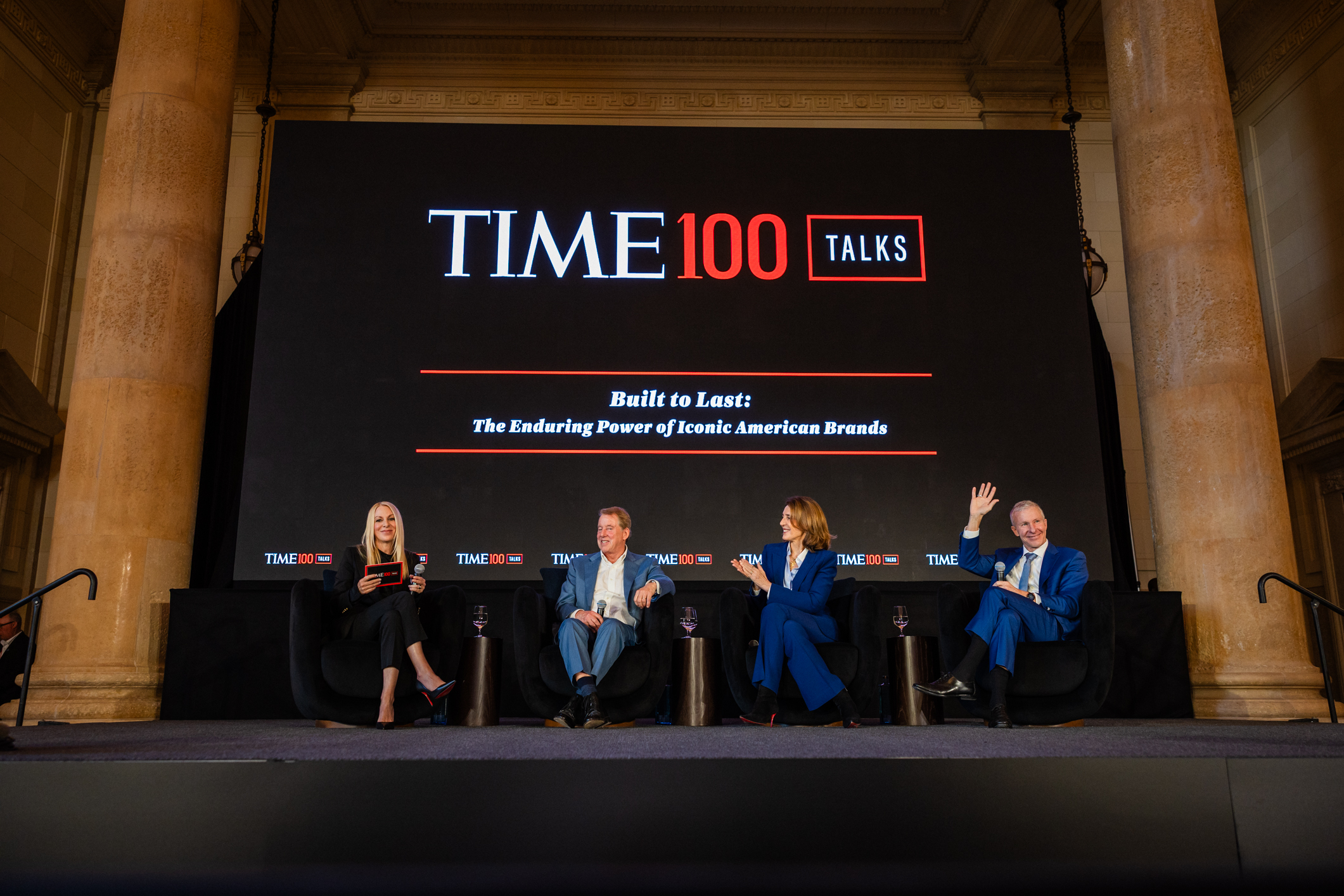
A panel of executives spoke on Tuesday at a TIME100 Talk titled “Built to Last: The Enduring Power of Iconic American Brands” about the ways in which their companies have been able to adapt and dominate their industries throughout the years.
Included on the panel were Scott Kirby, chief executive officer of United Airlines; Ruth Porat, president and chief investment officer of Alphabet, the parent company of Google; and Bill Ford, executive chair of automotive company Ford, which sponsored the event.
Each panelist spoke about the unique approaches their companies have taken to remain relevant and an asset to consumers across generations.
Ford said prioritizing his employees and the communities his company impacts is chief among his values.
“We take care of each other. We take care of our communities. We take care of our country,” he said. “Those values are timeless. And it’s different than culture because cultures change and cultures evolve. But I think the values that underlie that culture are what really have sustained us for our whole lifetime.”
Porat stressed “a commitment to long-term investing” and “relentless focus on innovation.” She said that “we should never take innovation for granted.” In this spirit, the founders of her company, she explained, created something called “20% time,” which allows employees to dedicate a fifth of their workload to an idea that is deemed great. “And out of that was born Gmail and our first AI entity, Google Brain,” Porat said. Alongside encouraging innovation, she continued, is setting ambitious goals.
“If we achieve 60% of the objectives we set out in a year, that is success,” she said. “Because if we achieve 100% it just means we have not been audacious enough. We haven’t set the goal high enough.”
Kirby attributed the long-term success of United Airlines to it being what he described as a “brand loyal airline.” This has entailed focusing on four areas of the business: “the reliability, the service, the hard product, and the technology.”
“We need to wow them consistently,” he said. “I wanted them to get on an airplane and be surprised with something new that we have done.”
The United CEO acknowledged that maintaining a high standard in each of these areas has been no easy feat, particularly during the COVID pandemic, which he described as the “most existential financial crisis that ever existed in aviation.” Despite disruptions to his company, his priority is to protect his employees.
After reflecting on how they’ve succeeded in the past, the panelists were also asked about their visions for the future.
“My number one goal, my north star for the company, is actually going to be to set the company up so that there’s never again a furlough at the airline,” Kirby said.
Part of Porat’s vision for the future lies in expanding Alphabet’s business infrastructure into space, where on Thursday the company will launch an AI data center.
“It’s an attempt to continue to ask a question that our technical infrastructure team has been asking for a long time, which is how can we build as efficiently as possible using resources as wisely as possible to deliver the best experiences as possible,” Porat said about the launch. “This is a tiny little step. We still call it research.”
Ford hoped for a lot more of the same, and again stressed the value of his product for customers.
“I think what gets me most excited is the fact that we will still be the most American car company 25 years from now,” he said, “and that we’ll be making our customers’ lives better, and hopefully give them back their most precious asset, which is time.”
TIME100 Talks: Built to Last: The Enduring Power of Iconic American Brands was presented by Ford.