We’ve been reporting on the supposedly imminent launch of a foldable iPhone for years. There have been strong and reliable rumors of a foldable iPhone being just two years away, dating as far back as 2018, at least. Back then, reliable reports from the likes of CNBC said Apple was going to have a folding iPhone on the market in 2020.
That became 2021, 2022, 2024, 2025… and now it’s expected to land in 2026.
So, while the rumors and reports from parts suppliers and analysts are heating up and we have more specifics than ever before, we would advise even more caution and skepticism than usual with Apple speculation. With that said, here’s what current rumors suggest about the release of a folding iPhone.
Update April 24, 2026: We’ve updated this guide with the latest rumors, including more dummy units and leaked dimensions, hinge challenges, and additional camera information.
Folding iPhone rumors at a glance
- Expected launch date: September 2026, but limited supply possible
- Likely name: iPhone Ultra
- Form factor: Book-style, iPad mini-like when open
- Display: 7.7–7.8-inch inner display, approx 5.3–5.5-inch outer
- Camera: Four cameras, no telephoto
What will the foldable iPhone be called?
- iPhone Ultra is the expected name
Many fans and pundits have got into the habit of referring to the rumored device as the iPhone Fold, but this may not necessarily be the official name. The rumors and leaks from spring 2026 onwards suggest that Apple is looking to call it iPhone Ultra.
In March, Mark Gurman at Bloomberg claimed that the folding iPhone will be one of several “Ultra” products coming this year – though not all will use “Ultra” branding, it’s certainly a possibility for the folding iPhone.
Then, in April, the Weibo account Digital Chat Station (which is hit-and-miss) said Apple is looking to use the iPhone Ultra name, too.
When will the foldable iPhone launch?
- September 2026 launch expected
It is expected that Apple will introduce this new style iPhone in September 2026, along with the iPhone 18 Pro and Pro Max (but not the regular iPhone 18 which is said to be delayed until 2027).
After a report from Nikkei Asia said that Apple is somewhat behind on the production timetable, Bloomberg’s Mark Gurman claimed it’s still on track, though supplies may be limited at first. Apple is aiming to put the device on sale at the same time or “soon after” the non-folding iPhone 18 Pro models, he claims.
According to MacRumors, Barclays analyst Tim Long said in a research note that the folding iPhone will likely ship in December, a couple months after the expected September launch of the iPhone 18 Pro and Pro Max.
What are the biggest trade-offs for the folding iPhone Ultra
Despite its “Ultra” branding, the foldable design introduces some compromises:
- No unibody construction: Dummy models will require a more segmented build due to the hinge mechanism.
- Wireless charging limitations: The device may lack a traditional glass back, which could impact MagSafe or wireless charging implementation.
- iOS-based software: Rather than running iPadOS, the device is expected to use a customized version of iOS, offering some productivity features without fully replacing the iPad experience.
- No Face ID: Due to the very thin nature of the foldable iPhone, and the need for different front-facing cameras when folded up or unfolded, it will reportedly lack Face ID. Instead, Touch ID will be incorporated into the side button much as it is on the iPad Air’s power button.
- No telephoto camera: Due to space constraints in the foldable design this iPhone may drop the telephoto camera, used for optical magnification, which will feel like a huge compromise given the anticipated high price of this iPhone.
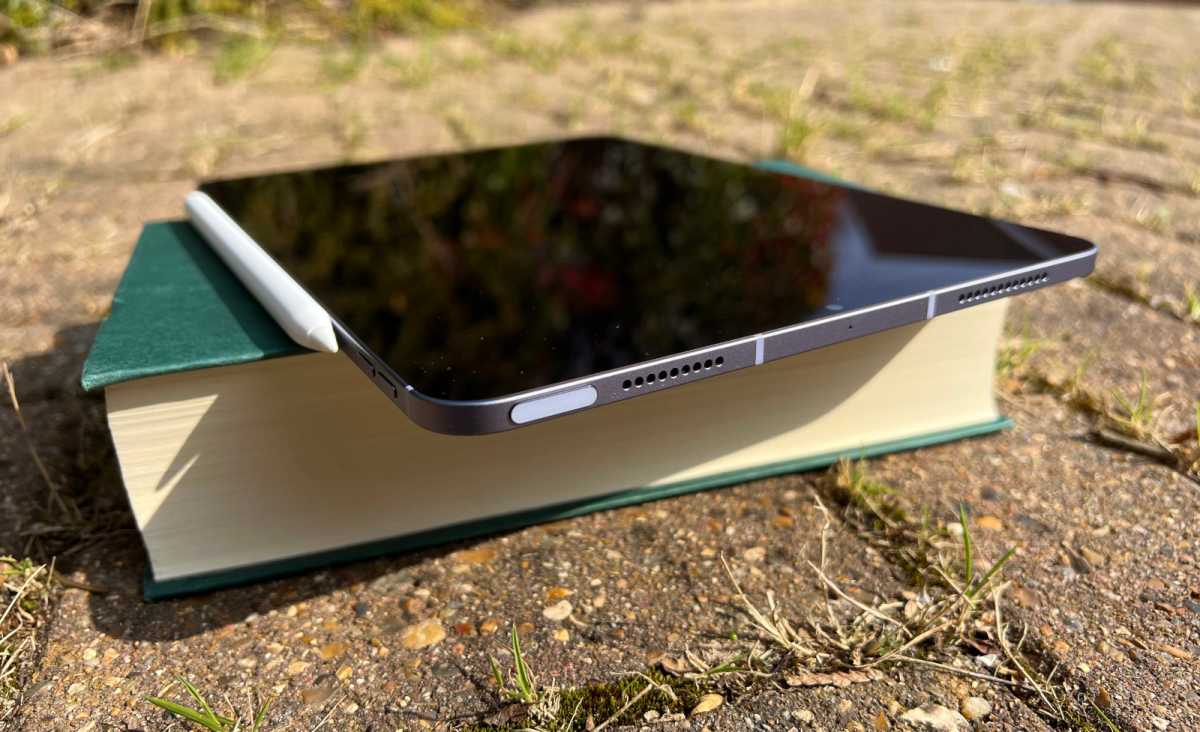
The folding iPhone will reportedly have a Touch ID-enabled power button rather than Face ID.
IDG
What will the folding iPhone look like? How will it fold?
- Book-like design with a vertical fold rumored
- Intended to be an iPhone/iPad hybrid
Apple’s rumored iPhone Ultra is reportedly nearing mass production, with its design largely finalized. Here’s what current leaks suggest about how the foldable iPhone will look and how the hinge and display may work.
Book-style, iPad hybrid, design
Multiple leaks point to a book-style foldable with a large, tablet-like internal display, rather than a compact flip-phone design. The device is expected to function as a hybrid between an iPhone and an iPad.
This “passport-style” design will appear noticeably squarer than a traditional iPhone when closed. When unfolded, it’s rumored to resemble an iPad mini-like screen with a 4:3 aspect ratio, offering a more expansive viewing experience.
Analyst Ming-Chi Kuo reported in 2025 that Apple’s foldable will adopt a dual-display setup, with a strong focus on achieving a near crease-free screen when opened.
Other 2025 leaks, including reports from Digital Chat Station on Weibo, also point to a vertical, book-style fold where the left and right sides close together – similar to devices like the Google Pixel 9 Pro Fold and Samsung Galaxy Z Fold.
Dummy models shared by Sonny Dickson on X in April 2026, demonstrate this book-like form factor.
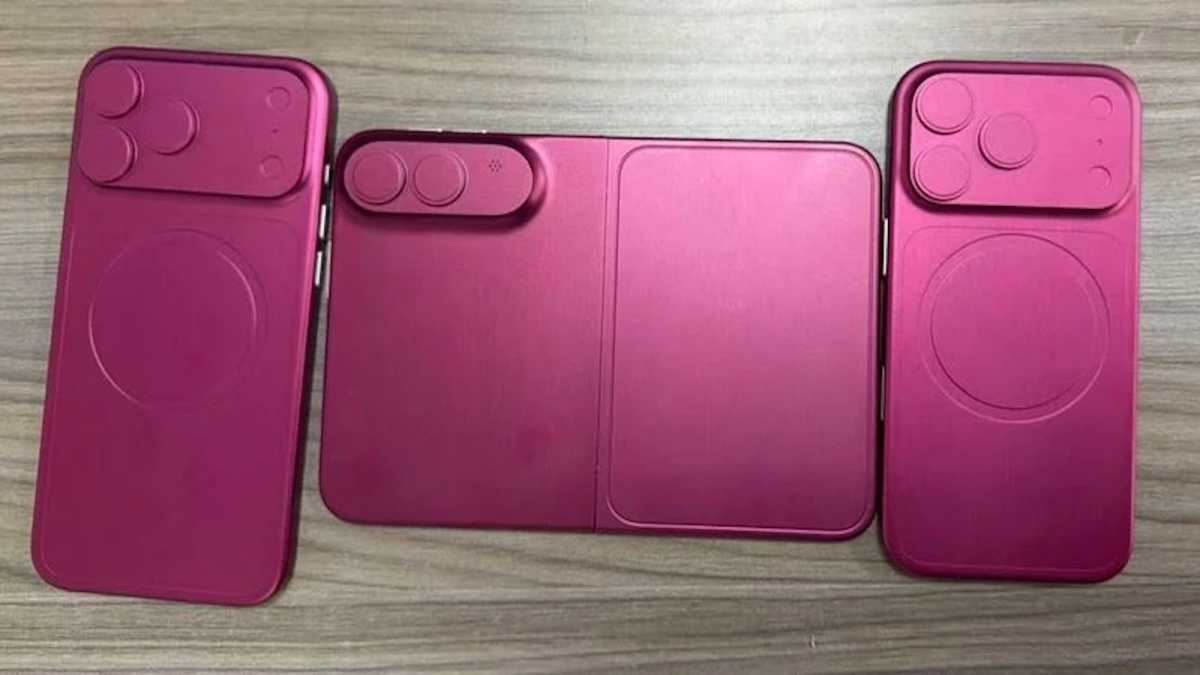
Sonny Dickson
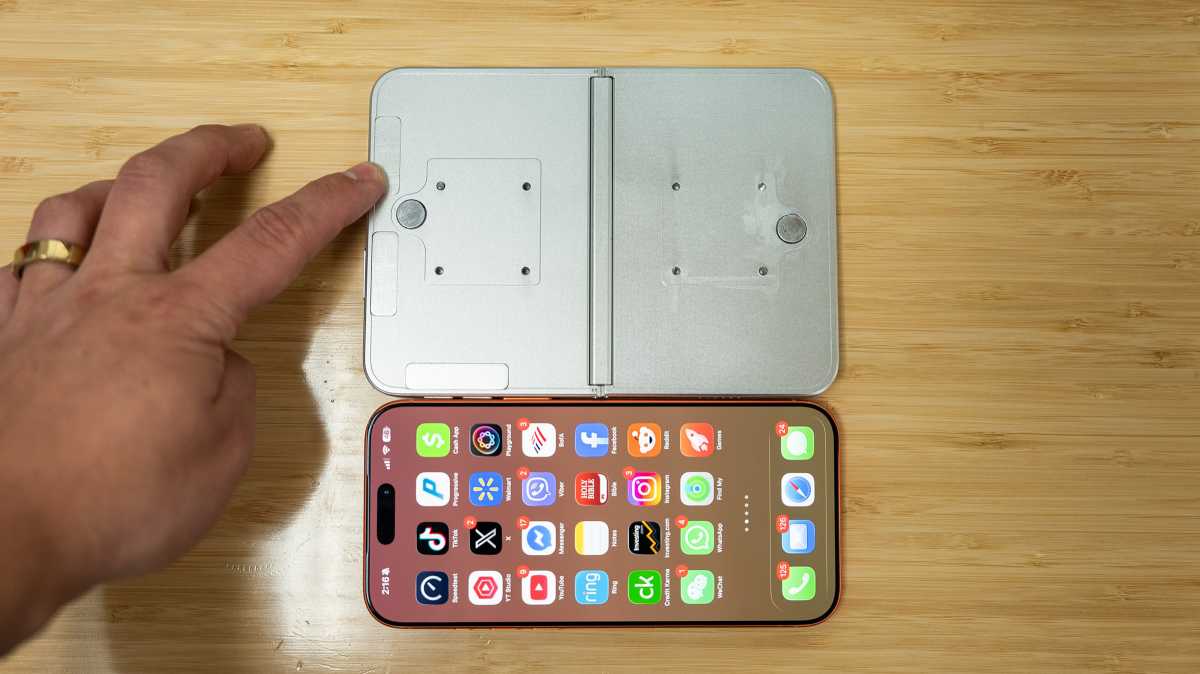
Additional dummy unit images from tech YouTuber Vadim Yuryev, further reinforce this wide, book-like “passport” design.
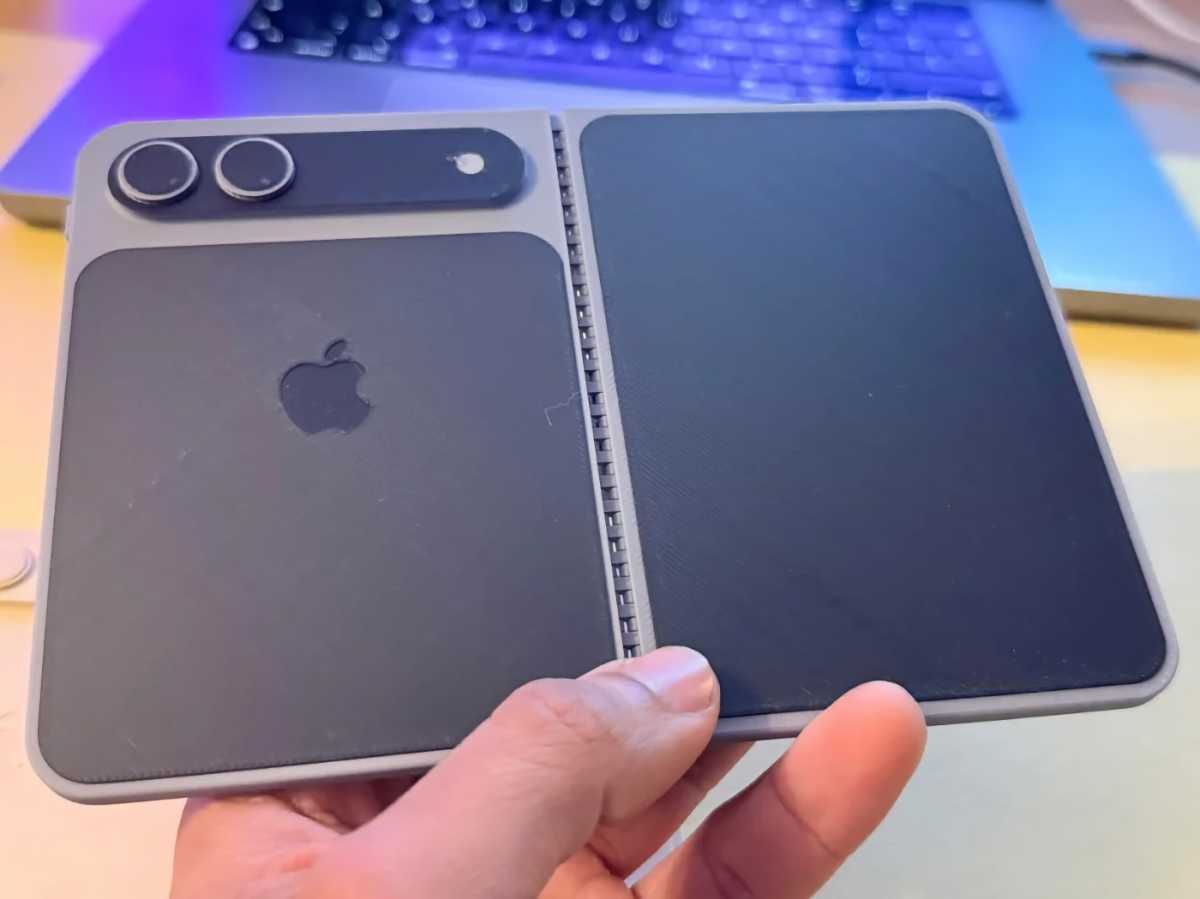
In December 2025, this 3D image of the iPhone Ultra, based on leaked CAD files, was created by a hobbyist and shared on MakerWorld (now removed), also aligning with these design expectations.
However, alternative concepts have existed. In 2024, The Information reported that Apple had explored clamshell-style prototypes, where the device folds top-to-bottom, similar to traditional flip phones.
This design direction may already be influencing competitors. Our colleagues on TechAdvisor report that Samsung is developing a “Galaxy Z Fold 8 Wide” with a similar 4:3 aspect ratio, potentially positioning it as a direct rival to Apple’s anticipated September 2026 launch.
How Apple is overcoming hinge design and crease reduction challenges
Adding a hinge to an iPhone introduces significant engineering challenges that Apple has spent years trying to resolve. While competitors have released multiple generations of foldables, Apple’s slower entry to the market is widely attributed to its focus on refining the hinge and delivering a more seamless user experience.
The biggest technical challenge is the visible and tactile crease where the screen folds. Apple has reportedly made this a priority, aiming to minimise it to the point of being nearly imperceptible.
As a result, the hinge is expected to be a defining feature of the iPhone Ultra, combining advanced materials and engineering to deliver a smoother, more durable folding experience.
To maintain both thinness and durability, Apple is reportedly testing high-end materials for the hinge:
- Titanium alloy (rumored for structural strength)
- LiquidMetal, according to Ming-Chi Kuo (March 2025), for improved durability, better screen flatness, and reduced creasing.
In July 2025, Kuo reported that Apple had developed a method to reduce crease visibility using metal support plates to better distribute and control bending stress. Apple may use this “laser-drilling metal plate technology” rather than conventional etching to create a more precise microstructure.
Apple also holds several patents for foldable mechanisms which, along with several rumored technologies, may be used:
- Variable Thickness Glass: A key part of Apple’s approach is said to involve variable thickness display glass, which is thinner at the fold point to reduce stress during repeated use. This is expected to work alongside an optically clear adhesive layer, designed to further minimise strain and help prevent the visible crease that commonly develops in foldable devices over time.
- Stress-Reducing Adhesive: An optically clear adhesive designed to reduce strain on the display during folding.
- Ultra-Thin Profile: Expected thickness of around 4.5mm unfolded and 9.5mm folded.
- Internal Support: Metal plates beneath the display to maintain a completely flat surface when opened.
In March 2026, reports suggested that Samsung Display – Apple’s primary screen supplier – has developed a near-creaseless OLED panel, showcased at CES 2026 specifically to meet Apple’s standards.
How big will the foldable iPhone Ultra be?
- Approx. 9.5mm thick when folded
- Approx. 4.5mm when unfolded
According to Jon Prosser in December 2025, Apple’s foldable iPhone Ultra could measure around 9.5mm when closed and just 4.5mm when open. For context, the iPhone 16 Pro Max is 8.5mm thick, while the iPhone Air measures 5.6mm.
If accurate, this would make the iPhone Ultra one of the slimmest foldables, highlighting Apple’s focus on minimising bulk despite the hinge.
However, when asked about the thickness of the iPhone Ultra in April 2026, YouTuber Vadim Yuryev said it would be “exactly 11mm”, which is larger than Prosser’s prediction. He also claimed it would be 0.36mm taller and 0.39mm wider than the iPhone 17 Pro.
Other design features
A leak from Weibo account Instant Digital in February 2026 indicates the volume buttons will be on the top edge, aligned right.
How big will the iPhone Ultra screens be?
The iPhone Ultra is widely expected to feature:
- Approx. 7.7–7.8-inch internal display
- Approx. 5.3–5.5-inch external display
Ming-Chi Kuo (2025) and TrendForce (July 2025) both pointed to a 7.8-inch inner and 5.5-inch outer display, while The Information later suggested slightly smaller sizes of 7.7 inches and 5.3 inches. This suggests Apple may still be refining final dimensions.
However, a December 2025 report from The Information slightly revised these figures to 7.7 inches internally and 5.3 inches externally, indicating that Apple may still be fine-tuning the final dimensions.
When unfolded, the device is expected to feature a 4:3 aspect ratio, aligning it more closely with the iPad and reinforcing its positioning as a productivity-focused, hybrid device. This would be a notable departure from the tall, narrow displays seen in earlier foldables like the Samsung Galaxy Z Fold series.
This wider layout is said to:
- Improve multitasking
- Enhance document reading and web browsing
- Deliver an experience closer to an iPad mini
What specs will iPhone Ultra offer?
- A20 chip, 12GB RAM, C2 modem expected
We don’t know what processor the folding iPhone will contain, but based on the release timeline, it will probably feature an A20 or A20 Pro – some variant of the processor found in the iPhone 18 Pro.
We expect most iPhones to use Apple’s own cellular modem and Wi-Fi/Bluetooth chips by that time as well. This will probably be the new C2 modem and the N1 for Wi-Fi 7 and Bluetooth.
This iPhone is also said to have the largest battery ever, at 5,000-5,500mAh, according to Weibo leaker Fixed Focus Digital in February 2026.
What cameras will the foldable iPhone have?
The foldable iPhone is rumored to feature two 48MP rear cameras, likely a standard wide and an ultrawide, along with two front-facing cameras—one for use when the device is closed and another when it’s unfolded.
However, it may lack a dedicated telephoto lens. While this is likely due to space constraints in the foldable design, it could be seen as a notable drawback—especially for a premium “Ultra” model at a high price point.
On the back, the cameras are expected to sit on a long, thin “plateau,” similar to the iPhone Air, but in black rather than color-matched to the device.
On the front, leaks suggest a mix of one under-display camera and a second punch-hole camera. A November 2025 report from JP Morgan also claimed Apple could drop LiDAR and optical image stabilisation, though this remains uncertain.
Not all the rumors point to compromises: Tech YouTuber Vadim Yuryev claimed in April 2026 that the cameras could be physically larger than those on the iPhone 17 Pro.
How much will the folding iPhone Ultra cost?”
- Premium price expected: $2,000 or more
The latest rumors from Weibo leakers suggest starting price of RMB 15,999 in China for the 256GB model, up to RMB 19,999 for the 1 TB model. When applying the same yuan-to-dollar ratio as other Apple products, this translates to a $1,999 starting price, up to $2,399 for the 1TB model.